
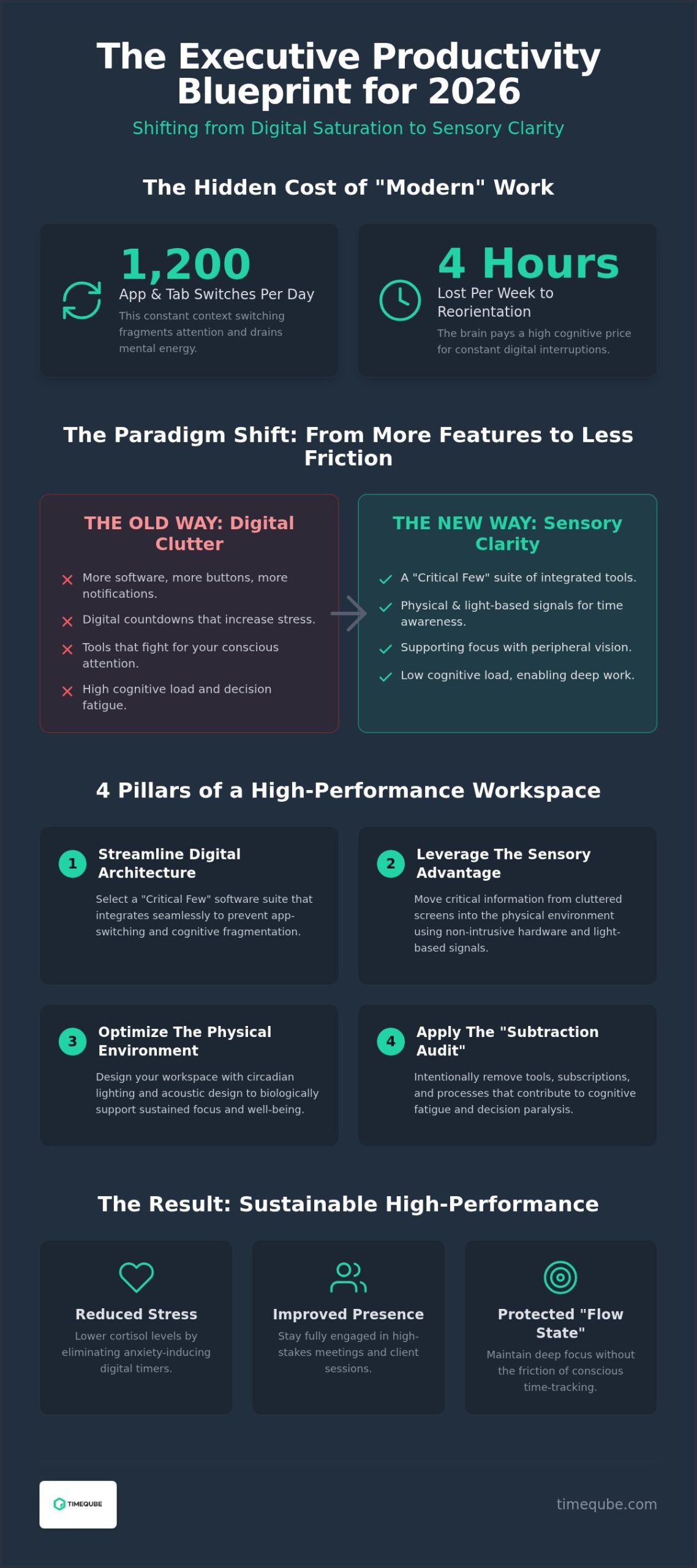
Knowledge workers switch between digital applications and browser tabs approximately 1,200 times every single day. This constant fragmentation of attention forces the brain to spend nearly four hours each week simply reorienting itself. It’s a high price to pay for modern connectivity. You likely feel the weight of this cognitive drain through persistent meeting fatigue and the anxiety of notification overload. The traditional approach to executive office productivity tools has prioritized more software, yet more software often leads to more distraction.
It’s time to shift the focus from digital saturation to sensory clarity. You deserve a workspace that respects your biological limits and encourages deep, uninterrupted work. This roundup explores a curated selection of tools for 2026 designed to eliminate friction and restore professional harmony. We will examine how physical anchors and minimalist design can create a distraction-free environment. You’ll discover how to set better boundaries during meetings and protect your mental well-being through intentional, science-backed choices.
Key Takeaways
- Learn why the next generation of executive office productivity tools prioritizes the removal of friction over the addition of features.
- Streamline your digital architecture by selecting a “Critical Few” software suite that integrates into your workflow without causing interruptions.
- Leverage peripheral vision and light-based signals to maintain time awareness without the cognitive tax of digital countdowns.
- Optimize your physical workspace with circadian lighting and acoustic design to sustain focus and protect your mental well-being.
- Apply the “Subtraction Audit” to identify and remove tools that contribute to cognitive fatigue and decision paralysis.
The Evolution of Executive Productivity Tools in 2026
The modern executive environment is undergoing a silent transformation. For decades, Productivity software competed on feature density. More buttons. More integrations. More notifications. In 2026, the paradigm has shifted toward friction reduction. High-performance leadership requires a cognitive-first approach that respects the brain’s biological limits. While 89% of workers now use AI for work in some capacity, individual gains don’t always translate to organizational clarity. The most effective executive office productivity tools now act as unobtrusive allies rather than loud interruptions. They move critical information from the cluttered digital screen into the physical environment. This transition allows for a stress-free approach to time management and professional harmony.
The Problem with Digital Notification Bloat
Many so-called “productivity” applications have become the primary sources of distraction. Every notification represents a micro-interruption that fragments focus. For leaders, the cost of task-switching is particularly high; it takes significant mental energy to reorient after a disruption. Cognitive load is the total volume of mental effort required to process information and make decisions within the brain’s limited working memory. When this load exceeds capacity, decision quality drops and fatigue sets in. In an era of digital saturation, the goal is to filter low-value decisions before they reach the executive’s awareness. It’s about protecting the mental space required for strategic thinking.
Transitioning to a Sensory-Optimized Office
Executives are increasingly investing in hardware that interacts with peripheral vision. This shift recognizes that the human brain processes environmental cues more efficiently than digital alerts. Visual and haptic signals allow a leader to maintain a “Flow State” without checking a clock or a dashboard. By moving time awareness to a physical signal, you remove the friction of active monitoring. These types of executive office productivity tools prioritize subconscious processing over conscious effort. This approach offers several advantages:
- Reduction in stress-induced cortisol levels by removing digital countdowns.
- Improved presence during high-stakes board meetings and client sessions.
- Enhanced awareness of time passing without the need to switch focus from the task at hand.
Understanding The Science of the Professional Meeting Timer reveals why these visual cues are superior to traditional digital clocks for maintaining presence. This sensory-first strategy creates a workspace that feels sophisticated, intentional, and calm. It transforms the office into a sanctuary for deep work rather than a hub of digital noise. They don’t fight for attention; they support it.
Essential Digital Architecture: Streamlining the Executive Stack
A digital stack should act as a silent partner, not a source of friction. High-level leadership requires a foundation of executive office productivity tools that integrate seamlessly into a cohesive workflow. This “Critical Few” approach prevents the cognitive fragmentation caused by constant app-switching. By selecting software that filters noise, you preserve the mental energy needed for strategic decisions. Effective digital architecture prioritizes asynchronous communication. It ensures that deep work remains the default state rather than a rare occurrence.
Intelligent Knowledge Management
Your digital memory must be an asset that requires minimal upkeep. Tools like Notion or Obsidian allow for structured knowledge retrieval without the burden of constant manual maintenance. As of late 2026, the Notion Business plan, priced between $18 and $20 per user monthly, offers the AI capabilities needed to synthesize complex meeting notes and internal data. Security is a non-negotiable factor in this selection process. Choosing platforms with end-to-end encryption ensures that sensitive executive data remains private and secure. A well-designed knowledge base reduces the anxiety of forgotten details and provides a clear path to informed action.
Autonomous Scheduling and Boundary Setting
Protecting your schedule requires moving beyond simple calendars. AI-driven schedulers now automate the process of time-blocking, shielding your “Think Time” from administrative creep. The market has seen significant shifts, such as the shutdown of Clockwise in early 2026, highlighting the need for sustainable, well-supported platforms. These tools reduce the back-and-forth of meeting coordination by learning your personal preferences and priorities. By setting firm digital boundaries, you reclaim control over your most valuable resource: your attention. This digital discipline is the necessary precursor to physical focus. For those looking to anchor these digital boundaries in the physical world, integrating a Timeqube for Business Meetings can provide a tactile signal that reinforces your commitment to focused time.
The Sensory Advantage: Physical Hardware for Deep Executive Focus
The human brain is biologically optimized to detect environmental changes without breaking concentration. While most executive office productivity tools remain trapped behind a glass screen, the most effective solutions for 2026 are moving into the physical workspace. This shift leverages peripheral vision, a powerful but underutilized asset in professional time management. Unlike a digital clock that requires active, conscious monitoring, a physical visual signal is processed subconsciously. This allows a leader to maintain presence during complex negotiations or deep work sessions without the cognitive tax of “checking the time.”
Clocks are data points; visual signals are experiences. For the executive brain, a ticking digital countdown often acts as a subtle stress trigger, spiking cortisol and inducing a sense of urgency that hinders creative problem-solving. Transitioning to sensory-first hardware is particularly beneficial for leaders navigating neurodiversity or ADHD. These tools provide a gentle, non-intrusive structure that respects the brain’s natural rhythm. You can explore these concepts further in this guide on Time Management for Neurodiversity.
Timeqube: Subconscious Time Management for Meetings
Effective meeting facilitation requires a delicate balance between structure and flow. The Timeqube for Business Meetings achieves this through a simple, color-coded light system. The transition from Green to Amber and finally to Red provides a clear, silent indication of time remaining. This removes the need for verbal interruptions or awkward glances at a watch. In high-stakes boardrooms, this clarity fosters a sense of professional harmony and ensures that every agenda item receives the necessary attention. It replaces the anxiety of the unknown with the calm of visual certainty.
Branding Productivity: Customized Executive Tools
A physical tool on an executive desk is more than a utility; it’s a statement of intentionality. Investing in Timequbes with Your Logo reinforces a culture of time-respect and focus within a leadership team. Customization creates a sense of cohesion and signals that the organization values the mental space of its executives. These tools act as a physical anchor in an increasingly digital world, grounding the user in the present moment. A physical timer acts as a mindfulness anchor on an executive desk, gently pulling the wandering mind back to the priority at hand. This blend of psychology and design ensures that productivity remains sustainable, protecting the well-being of the leader while maximizing output.
Designing the High-Performance Executive Office Environment
The physical office is a sensory container for leadership. Productivity is a biological outcome influenced by the surrounding environment. High-performance executive office productivity tools in 2026 extend beyond the desk to include the atmosphere itself. Research from Human Spaces indicates that employees in workplaces with biophilic elements report 15% higher well-being. This environmental optimization reduces the friction between the brain and the task.
Acoustic management has evolved beyond noise-canceling headphones. Modern executive suites utilize tailored soundscapes to mask distractions and lower stress levels. Movement-integrated furniture, such as the Haworth Fern or the Colamy Atlas, facilitates a dynamic posture throughout the day. This physical activity prevents the metabolic slowdown associated with prolonged sedentary work. Minimalism remains a core principle for the high-level leader. A clutter-free desk reduces visual stimuli. It prevents decision fatigue before the workday even begins.
Circadian-Aware Lighting and Focus
Lighting temperature directly regulates cortisol levels and cognitive alertness. Cool, blue-enriched light enhances concentration during the morning peak by suppressing melatonin. Warmer tones signal the brain to begin the recovery process in the late afternoon. Non-flicker, sensory-safe hardware prevents the sub-perceptual strain that leads to cognitive fatigue. Integrating visual signals with these natural lighting cycles creates a seamless transition between intense focus and necessary rest. This biological alignment ensures that professional output remains sustainable over long horizons.
Minimalist Hardware Selection
The feature creep of digital devices often results in unintended distractions. Choosing tools with a singular, dedicated function preserves the mental space required for deep work. Physical timers are essential executive office productivity tools because they do not serve as gateways to social media or notifications. They offer a tangible, aesthetic value where form meets function. For those seeking to master their intervals, this Physical Pomodoro Timer for Work guide provides a detailed 2026 comparison. To begin curating your own sensory-first environment, consider the Timeqube for Business Meetings as your primary physical anchor.
Selection Guide: Choosing Tools for Sustainable Leadership
Sustainable leadership is not a result of how many applications you can manage simultaneously. It is the outcome of how well you protect your focus. Many executive office productivity tools claim to save time while actually creating new layers of administrative friction. To build a resilient workflow in 2026, you must evaluate your stack through the lens of cognitive preservation. This requires a shift from a mindset of accumulation to one of intentional subtraction. You don’t need more features; you need more space to think.
The Executive Tool Audit
A periodic audit ensures that your digital environment remains an asset rather than a liability. Follow these steps to refine your current stack:
- Step 1: Identify “Notification Anxiety.” Track which applications cause a physiological stress response when they alert you. If a tool constantly demands attention without providing immediate strategic value, it is a candidate for removal.
- Step 2: Replace Digital Countdowns. As established in previous sections, digital timers often act as stress triggers. Replace these with passive visual cues that reside in your peripheral vision.
- Step 3: Consolidate and Dedicate. Reduce your reliance on multi-purpose software suites that encourage tab-switching. Invest in dedicated hardware that performs one function with clinical precision.
Investing in Mental Well-being
Productivity and well-being are biologically inseparable. High-performance leadership requires periods of recovery to maintain cognitive sharpness. The Timeqube for Mind/Body Therapies has become an essential tool for executives who prioritize meditation and structured reflection. By providing a gentle, light-based boundary for silence, it allows the brain to transition from high-frequency decision-making to a state of restorative presence. This sensory-friendly approach ensures that your mental energy is replenished rather than simply managed.
The ideal 2026 executive office stack is a balanced ecosystem. It consists of a few highly secure, encrypted digital platforms supported by physical, “Analog Anchors.” These hardware tools provide the necessary boundaries to prevent digital creep and executive burnout. By choosing tools that respect the biological limitations of the human brain, you create a workspace defined by professional harmony and understated leadership. True efficiency is found in the removal of noise, not the addition of more signals.
Reclaiming the Executive Workspace
The landscape of 2026 demands a departure from the digital saturation that defined the previous decade. True leadership excellence now relies on the intentional selection of executive office productivity tools that prioritize mental well-being over notification density. By transitioning to a sensory-first environment, you replace the friction of constant task-switching with the steady flow of deep work. You’ve discovered how physical anchors and circadian-aware lighting transform a chaotic office into a sanctuary for strategic thought.
This scientific approach to peripheral awareness ensures you remain present and focused during every high-stakes interaction. It’s time to move beyond the stress of digital countdowns and embrace an elegant, hardware-only solution. Upgrade your executive suite with Timeqube: The distraction-free visual timer. Trusted by professionals worldwide, this elegant hardware design fosters professional harmony while respecting your brain’s biological limits. Step into a future where your workspace supports your vision rather than competing for your attention.
Frequently Asked Questions
What are the most essential executive office productivity tools for 2026?
The most essential executive office productivity tools for 2026 combine streamlined digital architecture with sensory-focused hardware. You need a secure knowledge base like Notion for synthesized data and AI-driven scheduling to protect your “Think Time.” Physical anchors like the Timeqube for Business Meetings are equally vital. These tools work together to reduce friction and eliminate the need for constant application switching, allowing you to maintain a steady state of professional focus throughout the day.
Why should executives choose physical timers over digital apps?
Digital apps often contribute to screen fatigue and notification anxiety. Physical hardware provides a dedicated, single-function solution that doesn’t compete for your attention with emails or social media. Choosing a light-based signal allows your brain to process time subconsciously through peripheral vision. This removes the stress-trigger of a ticking digital clock. It ensures that your focus remains on the strategic discussion at hand rather than the mechanics of the tool itself.
How do visual cues improve meeting productivity in corporate settings?
Visual cues regulate the flow of a meeting by providing silent, color-coded transitions. When a device shifts from green to amber, participants naturally begin to wrap up their points without a verbal interruption. This subconscious awareness keeps sessions on schedule while maintaining professional harmony. It is a more sophisticated approach than traditional timers because it respects the natural rhythm of human conversation and avoids the abruptness of an audible alarm or digital alert.
What is cognitive load, and how do office tools affect it?
Cognitive load refers to the total amount of mental effort your working memory uses to process information. Many digital executive office productivity tools increase this load by bombarding you with notifications and requiring constant manual monitoring. In contrast, sensory-safe hardware reduces cognitive strain by moving critical signals to your environment. This allows your brain to stay focused on high-level decision-making while your subconscious handles background tasks like time awareness and environmental regulation.
Can custom logo productivity tools improve company culture?
Branded tools like Timequbes with Your Logo act as a physical statement of organizational values. They signal to your team that you prioritize focused work and respect everyone’s mental space. These customized objects serve as a unifying anchor during collaborative sessions, fostering a culture of intentionality and discipline. By integrating your brand into a functional, distraction-free tool, you reinforce a professional identity centered on clarity, presence, and the efficient use of shared time.
How can I reduce digital distraction in my executive office?
Reducing digital distraction starts with a “Subtraction Audit” to identify tools that cost more time than they save. You can reclaim your focus by moving essential functions off your screen and onto your desk. Single-purpose hardware ensures that you don’t accidentally wander into distracting browser tabs. Setting firm digital boundaries and utilizing asynchronous communication platforms also helps protect your deep work hours from the persistent creep of administrative noise and unnecessary notifications.
Are visual timers effective for executives with ADHD or neurodiversity?
Visual timers are highly effective for neurodiverse leaders who may experience time blindness. The gentle transition of light provides a non-intrusive structure that traditional alarms cannot match. It acts as a mindfulness anchor, pulling the wandering mind back to the task without inducing a stress response. This approach respects the biological limitations of the brain, offering a sophisticated solution that helps maintain focus while protecting the user’s overall mental well-being and energy.
What is the best way to implement a new productivity stack without causing stress?
The best approach is to introduce one change at a time to avoid decision paralysis. Start by replacing your most distracting digital alert with a physical tool that provides the same information. This creates an immediate “Analog Anchor” in your workspace. Focus on tools that require zero maintenance and offer immediate sensory relief. Gradually consolidating your software while investing in dedicated hardware ensures a smooth transition to a more sustainable and stress-free executive workflow.