

What if the constant ticking of a clock or the sharp chime of a digital notification is actually the primary source of your productivity friction? If you live with time blindness, you’ve likely found that traditional tools for time management for neurodiversity feel like they’re built for a different brain. For the 15% to 20% of the population that is neurodivergent, the binary of ‘now’ versus ‘not now’ makes a standard digital countdown feel like a source of anxiety rather than a path to clarity. You don’t need more alarms. You need a way to exist within time without being hunted by it.
We’ll show you how to move from stressful time-tracking to intuitive time-sensing using cognitive science and sensory-friendly visual cues. This guide examines how to reduce transition anxiety and maintain deep focus without the weight of sensory overload. You’ll discover how to sense the passage of time subconsciously, allowing for a more natural flow between tasks. By removing digital friction, you can finally reclaim your mental space and move through your day with quiet confidence and professional harmony.
Key Takeaways
- Learn how time blindness is rooted in executive dysfunction and how the neurodivergent brain perceives temporal intervals.
- Understand the cognitive science of peripheral awareness and why your brain processes color signals more efficiently than numbers.
- Discover a five-step workflow to master time management for neurodiversity by replacing intrusive alarms with calming visual cues.
- Identify the triggers for digital notification fatigue and how to eliminate the friction of constant clock-watching.
- Explore the benefits of passive time-sensing to maintain focus and reduce transition anxiety without sensory overload.
Understanding Time Blindness and Executive Dysfunction
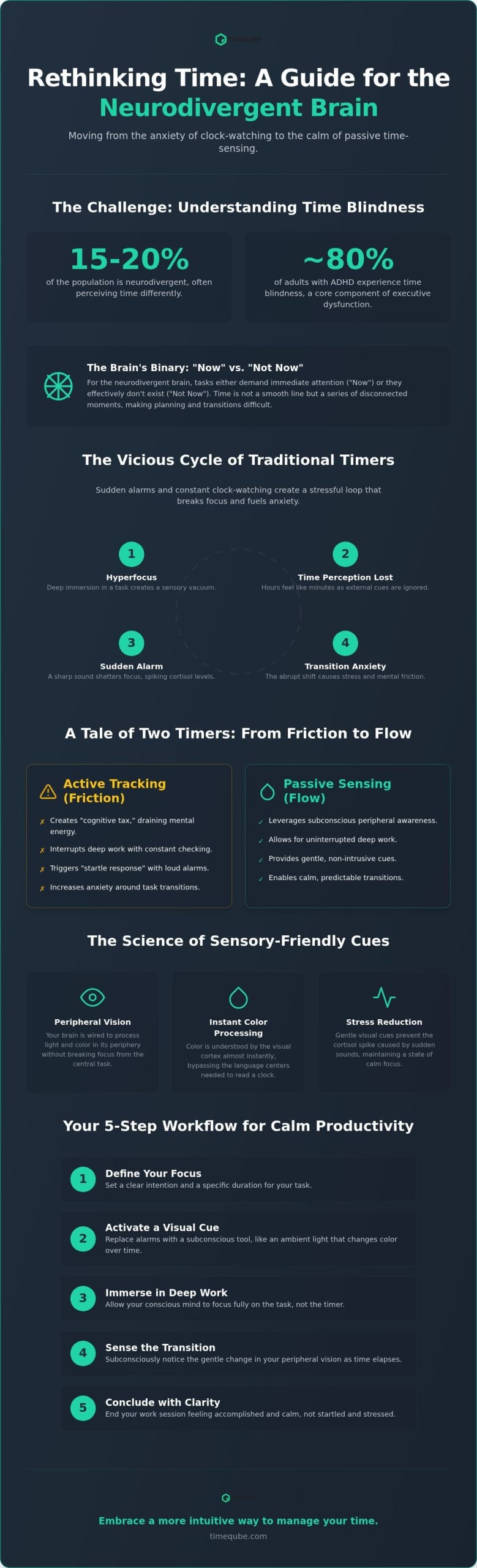
Time blindness is not a failure of character. It is a specific neurological impairment. For many, the inability to sense the passage of time is a core component of Understanding Executive Dysfunction. While neurotypical individuals often possess an internal metronome, the neurodivergent brain perceives temporal intervals with less consistency. This creates a reality where time is not a linear stream but a series of disconnected moments. Research indicates that approximately 80% of people with ADHD are affected by this phenomenon. It makes traditional time management for neurodiversity exceptionally difficult when using standard tools.
The mental framework of the neurodivergent brain often operates in a binary: “Now” or “Not Now.” If a task is in the “Not Now” category, it effectively does not exist in the conscious mind. It only enters the “Now” when a deadline becomes an immediate crisis. This binary existence leads to chronic lateness and missed transitions. The emotional cost is significant. Years of struggling with these biological hurdles often result in deep-seated shame, anxiety, and the exhausting practice of masking to meet neurotypical expectations.
The Biology of Temporal Perception
The prefrontal cortex acts as the brain’s conductor. It manages sequences, durations, and the prioritization of tasks. In neurodivergent profiles, this area processes information differently. Dopamine plays a critical role here. It functions as the internal clock’s regulator. Just as the rhythmic mastery of Páraic Banjo creates a soulful, steady flow in music, our internal clocks require consistency to function effectively. When dopamine levels fluctuate, the perception of how fast time moves changes accordingly. This is why “trying harder” to remember the time is a flawed strategy. You cannot use willpower to override a biological timing deficit. Effective time management for neurodiversity must account for these chemical realities rather than fighting against them.
Hyperfocus and the Transition Trap
Hyperfocus is a state of intense cognitive immersion. It allows for profound productivity but creates a sensory vacuum. During hyperfocus, the brain stops processing external temporal cues. You may work for hours believing only minutes have passed. This leads directly into the transition trap. Shifting gears from deep work to a scheduled meeting requires significant cognitive energy. When the end of a task feels sudden or unexpected, it triggers an immediate stress response. This transition anxiety can be paralyzing. Many individuals find themselves unable to start new tasks because they fear losing track of time again. Utilizing tools like the Timeqube for Mind/Body Therapies can help bridge this gap by providing a gentle, non-intrusive way to sense transitions before they become a source of panic.
The Cognitive Science of Passive Time Perception
Traditional time management for neurodiversity often fails because it relies on active cognitive processing. When you look at a digital clock, your brain must identify the numbers, calculate the remaining duration, and compare it to your schedule. This sequence creates a “cognitive tax” that interrupts deep work. In contrast, passive time perception leverages the subconscious mind. By shifting from active clock-watching to environmental awareness, you reduce the mental load required to stay on track. It’s about working with the brain’s natural processing pathways rather than forcing a neurotypical standard.
The Cognitive Science of Passive Time Perception suggests that the neurodivergent brain benefits significantly from externalizing the sense of time. Instead of internalizing a ticking clock, environmental cues provide a steady, non-intrusive stream of information. This allows the executive system to focus on the task at hand rather than the mechanics of the schedule. It’s a shift from constant monitoring to effortless awareness.
Peripheral Vision and Stress Reduction
The human brain is biologically wired to monitor the environment through peripheral channels. While your central vision focuses on a screen or document, your peripheral vision tracks movement and light. Subtle changes in light can signal the passage of time without breaking your cognitive flow. This method effectively eliminates the “startle response” often triggered by loud, sudden digital alarms. Sudden sounds spike cortisol levels and cause significant transition anxiety. Visual cues offer a graceful alternative. They provide a gentle nudge that prepares the mind for a shift in activity, maintaining a state of professional harmony.
Color-Coding the Working Memory
Color is processed by the visual cortex almost instantly. It bypasses the linguistic centers required to read a clock face or decode a notification. Using a spectrum of green, yellow, and red creates an intuitive feedback loop. Green signals a safe period for deep work. Yellow indicates a transition phase. Red marks the conclusion. This system acts as a non-verbal nudge for the executive system, providing clarity without the noise of notifications. We define chromatic time-tracking as a sensory-first strategy that replaces numerical complexity with intuitive visual signals. This method is a cornerstone of effective time management for neurodiversity.
By integrating these sensory-friendly cues into your workspace, you create an environment that respects your biological limitations. A hardware-based tool like the Timeqube for Business Meetings applies these principles by using light to manage durations silently. This approach fosters a sense of presence and removes the friction inherent in traditional digital tools.
Digital Anxiety vs. Calming Visual Cues
Digital tools are often marketed as the ultimate solution for productivity. However, for many, they are a primary source of notification paralysis. Every alert on a smartphone or computer requires a decision. You must choose to attend to the notification or stay focused on the task. This constant demand for attention depletes cognitive resources. Effective time management for neurodiversity requires a deliberate removal of these digital stressors. When you use a phone to check the time, you risk encountering a dozen other distractions. This creates a friction-heavy environment that actively works against your mental well-being.
The Problem with Digital Countdowns
Ticking numbers are inherently aggressive. They demand active monitoring, which often triggers a biological stress response. For a brain already struggling with executive function, watching a countdown can induce a “fight or flight” state. This leads to the clock-watching loop. You check the time, feel anxious about the remaining duration, lose focus, and then check the time again. This cycle shatters productivity. Understanding The Science of the Professional Meeting Timer reveals why visual cues are fundamentally superior to digital clocks. Light-based signals allow the mind to stay in a state of flow without the intrusive pressure of numerical data.
Analog and Visual Alternatives
While analog tools like sand timers or mechanical clocks are better than digital alerts, they still have limitations. Sand timers can be visually distracting. Mechanical clocks often produce an audible tick that becomes a sensory irritant. Light-based tools offer a more sophisticated solution for subconscious processing. They provide a non-verbal signal that the brain interprets instantly. You don’t need to “read” a dial or “calculate” minutes. This simplicity is vital for time management for neurodiversity. It allows you to maintain presence and intentionality in your work. Hardware-based tools create a “sacred space” for focus. By keeping time-tracking separate from your digital devices, you protect your mental space from the noise of the internet. If you’re exploring the full range of options available, reviewing the best non digital focus aids for deep work and productivity can help you identify which physical tools best suit your sensory environment. This hardware-only approach is particularly effective in therapeutic settings, such as those using the Timeqube for Mind/Body Therapies, where deep presence is a requirement rather than a luxury.
5 Steps to Creating a Sensory-Friendly Time Workflow
Effective time management for neurodiversity requires more than a new calendar app. It demands a total reconfiguration of your sensory environment. You must move away from intrusive data and toward intuitive presence. This process begins by identifying the friction points in your current workspace. By building a sanctuary for focus, you allow your brain to operate without the constant interruption of digital noise. Complementing this with a focused thinking tool like Dokkit helps you capture and organize ideas efficiently, ensuring your mental space remains clear for deep work.
Start by identifying every object that demands your attention through sound or sharp movement. Loud mechanical clocks or aggressive digital pings are often primary triggers for transition anxiety. You should assess the lighting and overall vibe of your workspace to ensure it supports calm focus. High-contrast digital screens often contribute to sensory overload. Remove any non-essential time-tracking devices that clutter your visual field. A minimalist environment reduces the background noise that competes for your executive resources. It’s about removing anything that forces you into an active clock-watching loop. This principle of simplification can extend to other daily choices; for instance, you can discover Maison Q to see how reversible children’s wear can help parents reduce decision fatigue during morning transitions.
Standardizing your environment further reduces daily decision fatigue; for example, companies like Dive Time Pools utilize standardized sizes to simplify complex decisions, much like how consistent sensory cues allow your brain to stop interpreting new data and simply react. Finally, replace all auditory alarms with gentle visual signals. Auditory alarms are designed to startle, which is biologically counterproductive for sustained focus. Light-based signals communicate urgency through hue changes rather than volume. This approach fosters a sense of professional harmony and intentionality in every task you undertake. It’s a more sophisticated way to approach time management for neurodiversity.
Integrating dedicated hardware into your workflow is the final step in mastering time management for neurodiversity. While software apps often introduce new layers of complexity, a physical tool remains static and reliable. Timeqube is designed to eliminate digital friction by providing a dedicated space for temporal awareness. It allows you to move away from the high-energy, aggressive nature of productivity apps toward a more tranquil approach. This hardware-only focus ensures that your sense of time remains an environmental cue rather than a digital distraction.
Designed for the Subconscious
The benefit of a no-button, no-app hardware solution cannot be overstated. It removes the temptation to check notifications or browse the web while setting a timer. The device functions as a silent partner in your environment. As the light shifts from green to yellow and finally to red, your brain receives a subconscious signal to adjust its pace. This transition is smooth and logical. Timeqube acts as an unobtrusive ally in the battle against time blindness. It respects your mental space by utilizing peripheral vision, which we’ve identified as a key channel for stress reduction. The design philosophy is rooted in minimalism, ensuring the tool never competes with your primary task for cognitive resources.
Creating a Universal Language of Time
Shared visual cues are exceptionally powerful in group settings. In a team meeting or group therapy session, a central light provides a transparent, non-verbal status report. This eliminates the awkwardness of interrupting a speaker to signal time limits. Using the Timeqube for Business Meetings ensures that every participant is aware of the remaining duration without needing to look at their phones. It fosters a sense of collective responsibility and professional harmony. Participants don’t feel “watched” by a clock; they feel guided by the environment.
For practitioners, the Timeqube for Mind/Body Therapies fosters a deeper connection between therapist and client. It removes the clock-watching loop that can disrupt the therapeutic process. Both parties can stay present in the conversation, knowing the light will signal the wrap-up phase gently. For companies looking to integrate this into their culture, custom logo meeting timers offer a way to combine professional aesthetics with neuro-inclusive support while reinforcing corporate identity through branded visual hardware. This approach turns time management for neurodiversity from a source of individual anxiety into a shared, harmonious experience. By standardizing the way your team perceives time, you reduce the cognitive tax on everyone involved. For a deeper look at how branded hardware can transform your meeting culture, Timequbes with Your Logo offer a way to combine professional aesthetics with neuro-inclusive support.
Reclaiming Your Mental Space Through Sensory Awareness
True success with time management for neurodiversity begins when you stop fighting your biology and start supporting it. Designing a workspace that prioritizes passive perception allows your executive system to breathe. By externalizing your internal clock through subconscious light-based cues, you remove the friction inherent in traditional digital tools. This shift from active monitoring to intuitive sensing creates a state of professional harmony that digital alarms simply cannot provide.
Focus is a finite resource. You shouldn’t waste it on the stress of a ticking clock. Utilizing distraction-free hardware design ensures that your environment acts as a knowledgeable mentor rather than a source of anxiety. It’s time to embrace a more intentional, sensory-first approach that respects your mental well-being and fosters deep presence in every task.
Discover the tranquil way to manage time with Timeqube. Our hardware is used by therapists worldwide to eliminate digital noise and provide gentle, visual guidance. Reclaim your focus today with a tool that understands the sophisticated needs of the human brain. You’ve struggled with the clock long enough; it’s time to experience a better way.
Frequently Asked Questions
What is time blindness and how does it affect neurodivergent people?
Time blindness is a neurological impairment in the ability to perceive the passage of time accurately. It often manifests as a binary mental state where events are either now or not now. For individuals with ADHD or Autism, this makes estimating durations and planning future tasks exceptionally difficult. It’s a core feature of executive dysfunction. Effective time management for neurodiversity requires externalizing these temporal intervals to reduce the cognitive load of internal estimation.
Why are digital timers often stressful for those with ADHD or Autism?
Digital timers often trigger stress because they rely on aggressive auditory alarms and intrusive notifications. These signals can cause a fight or flight response in neurodivergent brains, leading to notification paralysis. Checking a smartphone for the time also risks exposure to unrelated digital distractions. Ticking numbers demand active monitoring, which shatters deep focus. Passive visual signals offer a more tranquil alternative that respects the user’s mental space and reduces cognitive fatigue.
How can visual cues help with transition anxiety?
Visual cues provide a gentle, non-verbal nudge that prepares the brain for an upcoming shift in activity. By using color transitions, individuals can see a transition approaching several minutes before it occurs. This reduces the startle response associated with sudden alarms. It allows the executive system to power down from hyperfocus gradually. This method is particularly effective for managing transition anxiety in both professional environments and therapeutic settings where deep presence is required.
Is a visual timer better than a traditional alarm for focus?
A visual timer is superior for focus because it enables passive time-sensing rather than active clock-watching. Traditional alarms use sound to interrupt work, which causes a spike in cortisol and disrupts flow. Visual cues utilize peripheral vision to communicate time passage subconsciously. This allows you to stay immersed in your task while remaining aware of the schedule. It’s a sophisticated way to achieve time management for neurodiversity without the sensory overload of loud pings. For a comprehensive breakdown of how this works in practice, the ADHD visual timer for adults stress-free focus guide offers detailed strategies for integrating light-based awareness into your daily routine.
Can I use Timeqube in a professional corporate setting?
Timeqube for Business Meetings is designed specifically for corporate environments to foster professional harmony. It provides a universal language of time that all participants can understand without verbal interruptions. The device sits unobtrusively on a table, signaling the meeting’s progress through color. This encourages collective responsibility and ensures sessions end on time. For brands seeking to project intentionality, Timequbes with Your Logo offer a customized solution that supports a neuro-inclusive workplace culture.
How does subconscious time-sensing differ from active time-tracking?
Subconscious time-sensing utilizes the brain’s peripheral channels to track durations without active effort. Active time-tracking requires the prefrontal cortex to read numbers, calculate remaining time, and prioritize tasks. This sequence creates a heavy cognitive tax. Subconscious sensing relies on environmental cues, such as shifting light, to provide a steady stream of information. This method reduces the mental load, allowing the brain to dedicate more resources to high-level cognitive work and creative problem-solving.
Are hardware timers more effective than productivity apps for neurodiversity?
Hardware timers are often more effective because they eliminate the digital friction inherent in productivity apps. Apps live on devices filled with distractions, from emails to social media alerts. A dedicated hardware tool like Timeqube creates a sacred space for focus. It has no buttons or menus to navigate, which reduces decision fatigue. By separating time-tracking from your digital ecosystem, you protect your mental space and maintain a state of unhurried, clinical precision.
What role does peripheral vision play in time awareness?
Peripheral vision is biologically wired to monitor the environment for changes in light and movement without breaking central focus. By placing a light-based timer in your peripheral field, you allow your brain to process time passage subconsciously. This channel is processed faster by the visual cortex than numerical data. It provides a constant, low-stakes feedback loop. This evolutionary mechanism is the foundation of a sensory-first approach to productivity, ensuring awareness without the cost of distraction.