

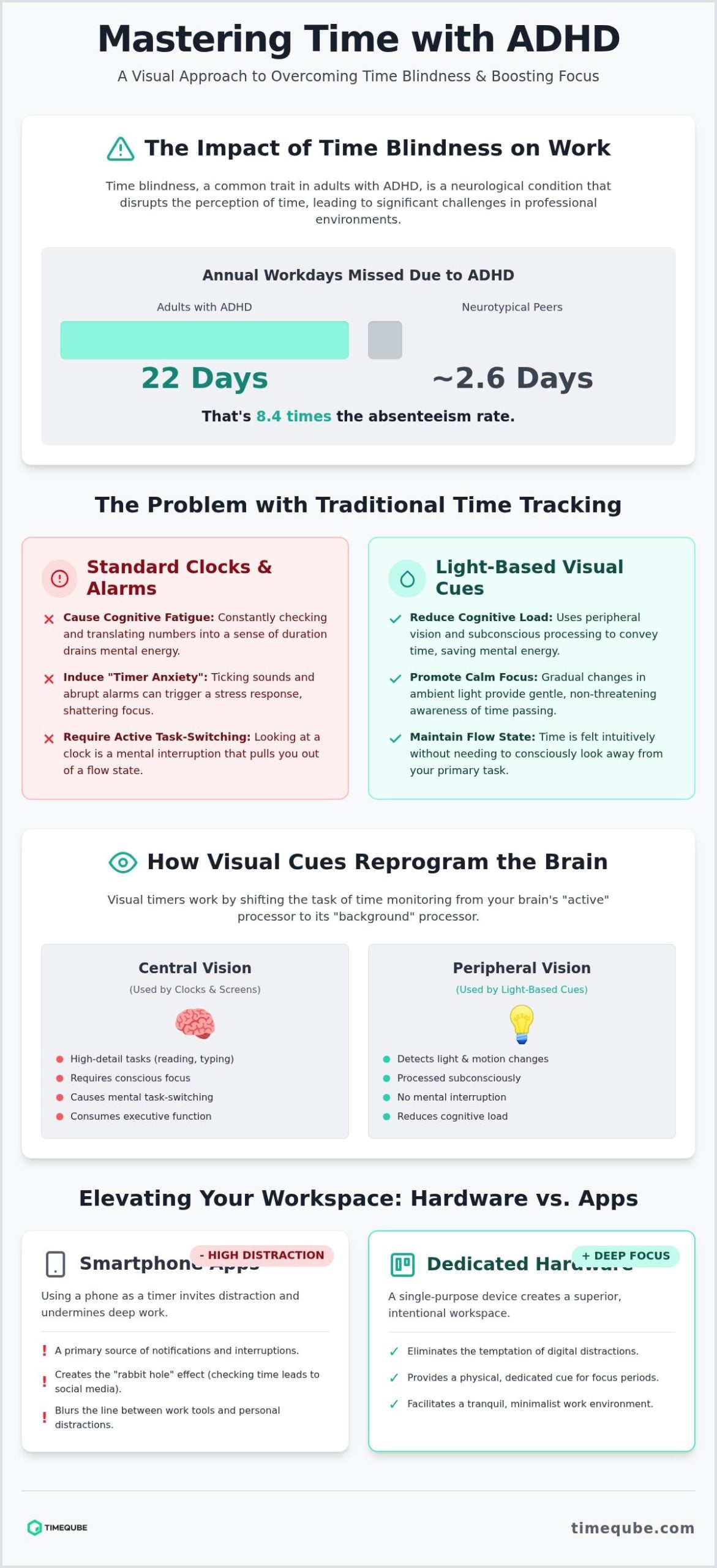
On average, adults with ADHD miss 22 workdays per year. This is 8.4 times the absenteeism rate of their neurotypical peers. Most of this friction results from time blindness. This condition makes the passage of time feel invisible until a deadline triggers a state of panic. You’ve likely tried to manage this with smartphone apps, only to find that digital notifications offer more distraction than clarity. Finding an effective adhd visual timer for adults is a vital step in protecting your mental space from these intrusive interruptions.
A ticking clock or a vibrating phone often triggers sensory overload rather than focus. This guide explores how to master time management using peripheral visual cues that reduce anxiety. You’ll learn to leverage subconscious processing to create a calm workspace and lower the friction of task initiation. By moving away from digital noise and toward intentional, light-based awareness, you can support your brain’s natural rhythm. This approach replaces the pressure of a countdown with a sophisticated, stress-free solution for professional focus.
Key Takeaways
- Understand why numerical clocks cause cognitive fatigue and how to bypass the exhaustion of active time tracking.
- Discover how an adhd visual timer for adults leverages peripheral vision to maintain focus through subconscious cues.
- Compare light-based signals with mechanical timers to eliminate sensory overload and the anxiety of ticking sounds.
- Learn the optimal placement for visual cues to reduce transition friction and improve your natural task initiation.
- Identify why dedicated hardware creates a superior workspace by removing the constant temptation of digital distractions.
Understanding Time Blindness: Why Adults with ADHD Struggle with Standard Clocks
Time blindness isn’t a lack of discipline; it’s a neurological deficit. It involves a fundamental disruption in the subjective perception of the passing of time. For neurodivergent individuals, the brain doesn’t always register the “flow” of minutes as a physical sensation. This leads to a disconnect between a planned schedule and the actual experience of time passing. Standard clocks fail in this context because they rely on abstract symbols rather than intuitive sensory feedback. Reading a digital clock is an active cognitive process that requires translating a number into a concept of duration. This translation exhausts the ADHD brain, which already faces high cognitive demands.
To better understand how visualizing time can change your workflow, watch this helpful video:
This neurological gap often creates a phenomenon known as “waiting mode.” If an appointment is scheduled for 2:00 PM, an adult with ADHD may feel paralyzed as early as 11:00 AM, unable to start any meaningful work. The uncertainty of how much time remains creates a state of high-arousal anxiety. Traditional timers often worsen this by introducing “timer anxiety” through aggressive ticking or sudden, loud alarms. These stimuli trigger a fight-or-flight response, which disrupts the very focus you’re trying to achieve. An adhd visual timer for adults addresses these issues by making time a visible, non-threatening property of your environment.
The Executive Function Gap
The prefrontal cortex manages temporal sequences, but in ADHD, this management is often inconsistent. “Just checking the clock” isn’t a simple glance; it’s a cognitive interruption that forces the brain to switch tasks and re-evaluate its progress. This often leads to a total loss of focus. Working memory also plays a critical role. If you can’t hold the current time and your goal time in your mind simultaneously, estimating task duration becomes impossible. A visual cue bypasses this memory requirement by providing a constant, externalized representation of time remaining. For those seeking to address the underlying neurological patterns of focus, you can learn more about Neurobics and their professional neurofeedback services.
Moving Beyond Digital Stress
Many professionals turn to smartphones for time management, but these devices are often sources of profound distraction. A single notification ping can destroy a flow state in seconds. Using a phone as a timer invites the “rabbit hole” effect where checking the time leads to checking emails or social media. For a deeper look at sustainable strategies, explore time management for neurodiversity. Relying on a dedicated adhd visual timer for adults ensures that your focus remains on the task, not the device, facilitating a more tranquil and intentional workspace.
The Science of Peripheral Vision: How Visual Cues Reduce Cognitive Load
Peripheral vision is a powerful, often underutilized tool for neurodivergent focus. While central vision handles high-detail tasks like reading or typing, the peripheral field is specialized for detecting changes in light and motion. This biological distinction is critical for managing time. Most productivity tools force you to use central vision to read numbers, which creates a constant, exhausting cycle of task-switching. An adhd visual timer for adults leverages pre-attentive processing. This allows the brain to register information without requiring active attention or a conscious shift in focus.
The brain processes color signals subconsciously. Research consistently highlights that ADHD is associated with difficulties in time estimation and discrimination. When you rely on a digital clock, your brain must work to translate digits into a sense of duration. This consumes valuable executive function. In contrast, a change in ambient light is processed by the primitive parts of the brain. It’s an intuitive signal that registers even when you aren’t looking directly at the device. This reduces the cognitive load required to stay aware of your schedule.
Subconscious Time Awareness
Light-based cues allow for a unique “time sensing” experience. You don’t need to stop your work to check how many minutes remain. The information is simply present in your environment. This is especially beneficial in mind/body therapies where silence is essential and any sudden noise can disrupt a state of presence. A gentle shift in color eliminates the startle response often triggered by loud, vibrating, or flashing alarms. By removing this sensory shock, you can transition between tasks with a sense of professional harmony rather than panic.
Color Psychology in Time Management
The psychological impact of the Green-Yellow-Red transition is foundational to stress-free pacing. Each color serves a specific cognitive purpose:
- Green: Facilitates the “initiation” phase. It signals a safe, open window for deep work, helping to lower the barrier to starting a task.
- Yellow: Acts as a soft transition. It provides a gentle nudge that the session is nearing its end, allowing you to begin wrapping up thoughts without triggering a state of urgency.
- Red: Establishess a clear, non-aggressive boundary. It signifies the end of a block, making the stop point visible and final.
This intuitive sequence mirrors natural biological signals. It provides a structured rhythm that supports the brain’s need for external scaffolding. Integrating an adhd visual timer for adults into your workspace transforms time from a source of anxiety into a visible, manageable element of your environment. For those seeking a more intentional way to work, using a dedicated tool like Timeqube ensures that time management remains a background process, leaving your conscious mind free for high-level creativity.
Comparing Visual Timer Types: Light-Based vs. Mechanical Countdowns
Choosing an adhd visual timer for adults requires an understanding of how different stimuli affect your nervous system. Mechanical timers typically use a shrinking red disk to show time. While this is a step up from digital numbers, it remains an “active” visual cue. You must look directly at the device to gauge your progress. This creates a repetitive cycle of checking that can break your concentration. Light-based timers function as “passive” cues. They provide a steady glow that changes color in your peripheral vision, allowing you to sense time without a conscious shift in focus.
The noise factor is a significant differentiator. Many mechanical timers produce a faint ticking sound. For individuals with sensory sensitivities, this repetitive noise can trigger irritability or hyper-focus on the sound itself rather than the task. Light-based hardware is entirely silent. It removes the auditory friction that often accompanies traditional time management tools. Additionally, the pressure of a physical countdown can induce anxiety. Watching a disk disappear feels like a loss of time. Watching a color transition feels like a natural progression of energy.
Analog Disks vs. Digital Screens
Analog tools are generally superior to digital screens for neurodivergent focus. Digital timers on phones or monitors contribute to screen fatigue and blue light exposure. They also exist within a landscape of potential distractions like emails or social media. However, even analog disks require direct eye contact to be effective. Exploring non-digital focus aids reveals that the most effective tools are those that don’t compete for your central vision. This allows your brain to remain grounded in the work at hand.
The Case for Light-Based Hardware
A glowing cube offers 360-degree visibility. You don’t need to position it at a specific angle on your desk to see the current status. This “set it and forget it” design is ideal for high-pressure professional environments. Physical hardware also provides a tactile grounding that digital apps lack. The presence of a dedicated, minimalist object on your desk signals a commitment to a specific work block. It becomes a sophisticated part of your office aesthetic, moving away from the primary-colored, plastic look of tools designed for children. This professional maturity is essential for an adhd visual timer for adults used in corporate or therapeutic settings.
Step-by-Step: Master Adult ADHD Workflow with Visual Timers
Effective time management begins with an honest assessment of your focus threshold. This is the duration you can maintain deep work before your attention naturally drifts. For many, this window is shorter than the traditional 50-minute hour. Identifying your personal limit prevents the cycle of shame associated with unfinished tasks. Once you know your threshold, set your adhd visual timer for adults to match this biological reality. This creates a realistic framework for productivity that respects your brain’s unique wiring.
Placement is as important as the duration itself. Position the timer in your peripheral vision rather than your direct line of sight. This allows your brain to process the changing light signals subconsciously. It removes the need for active monitoring, which often leads to cognitive fatigue. By keeping the device at the edge of your awareness, you maintain a steady sense of presence without the distraction of a ticking clock or a flashing screen.
The “Transition Buffer” is a vital strategy for reducing friction. Set a 5-minute yellow phase to act as a gentle nudge that the session is nearing its end. This prepares your mind for the shift in activity, preventing the jarring shock of a sudden stop. You can also use the timer to audit your routine. Many adults with ADHD suffer from the planning fallacy, consistently underestimating how long routine tasks take. Tracking these sessions provides the data needed to build more accurate schedules in the future.
The Professional Meeting Protocol
In a corporate environment, time management is often a collective challenge. Introducing a professional meeting timer helps keep teams aligned without the need for verbal interruptions. Frame the device as a tool for mental well-being and efficiency rather than a monitoring system. This creates a shared visual language that respects everyone’s time. It allows for a graceful wrap-up during the final minutes, ensuring that meetings conclude with clarity and professional harmony.
Managing Hyperfocus Burnout
Hyperfocus is a powerful asset, but it often leads to physical and mental exhaustion. Use the “Red Light” signal as a hard boundary to stop working and take a restorative break. This prevents the burnout that typically follows long periods of intense concentration. If you face task paralysis, try the “Just 10 Minutes” trick. Set your adhd visual timer for adults for a brief window to lower the barrier to entry. This small commitment often provides the momentum needed to overcome initial resistance. To implement these strategies in your own workspace, consider the sophisticated design of Timeqube for Business Meetings to maintain focus and energy throughout the day.
Elevating Your Workspace: Why Minimalist Hardware Beats Digital Apps
A dedicated work tool offers a psychological advantage that digital applications cannot replicate. When a device has only one function, it eliminates the cognitive load of choice. This is essential for maintaining a distraction-free environment. An adhd visual timer for adults serves as a physical anchor for your attention. It creates a clear boundary between your digital workspace and your mental focus. This separation is vital for professionals who struggle with the blurred lines of modern remote or office work.
Checking a smartphone to track time is a significant risk for neurodivergent individuals. A quick glance at a screen often leads to the “rabbit hole” of notifications and unrelated tasks. Minimalist hardware removes this temptation entirely. By externalizing time into a physical object, you protect your flow state from the intrusive nature of mobile devices. The aesthetic value of such design also reduces visual clutter. A clean workspace promotes a calm mind, which is vital for managing sensory overload and maintaining long-term presence.
A physical Timeqube also serves an external purpose. It acts as a non-verbal signal to colleagues or family members. When the device is glowing, it communicates that you are in focus mode. This reduces interruptions and helps establish professional boundaries without the need for constant explanation. It creates a shared understanding of your availability, allowing you to work with quiet confidence.
Building a Distraction-Free Environment
Single-tasking tools are a necessity in a multi-tasking world. Using dedicated hardware creates a Pavlovian response over time. When you see the light, your brain begins to associate that specific visual cue with deep work. This simplifies the process of task initiation. You aren’t just setting a timer; you’re creating a sacred space for concentration. The gentle glow provides a constant, reassuring presence that grounds your awareness in the present moment, effectively removing the friction of transitions.
Customization and Professionalism
Many tools designed for ADHD feel toy-like or juvenile. This can be alienating for professionals in corporate or therapeutic settings. Sophisticated office hardware respects the user’s maturity and professional environment. There are even options for custom logo timers that align with corporate branding. This integration allows time management to feel like a seamless part of a professional identity rather than a medical necessity.
Mastering time management is a skill that requires the right leverage. Tools don’t replace effort, but they remove the biological friction that makes effort feel impossible. By choosing an adhd visual timer for adults that prioritizes mental well-being, you reclaim control over your workspace. This intentional approach transforms your relationship with time from one of anxiety to one of professional harmony.
Reclaiming Your Focus through Intentional Design
Transforming your relationship with time requires moving beyond the stress of digital countdowns and aggressive alarms. By leveraging peripheral vision and subconscious color processing, you can bypass the executive function gaps that lead to time blindness. Replacing numerical clocks with intuitive light signals reduces sensory overload. It lowers the friction of task transitions. This shift allows you to maintain a state of professional harmony throughout your workday.
Investing in a dedicated adhd visual timer for adults is a commitment to a distraction-free environment. Unlike smartphone apps that invite interruption, minimalist hardware signals a clear intention to focus. It acts as a silent ally in your workspace. It grounds your awareness without exhausting your mental energy. You’ll find that having a physical tool creates a more grounded and present mindset.
Discover the Timeqube: The stress-free visual timer for professionals. It’s used by therapists and corporate leaders worldwide. It offers subconscious color-coded time tracking with no ticking, no apps, and zero distractions. You don’t have to manage time through panic. You can master it through presence.
Frequently Asked Questions
What is the best visual timer for ADHD adults in an office setting?
Light-based hardware is the most effective choice for professional environments. Unlike mechanical timers often designed for children, a sophisticated light-based adhd visual timer for adults offers a minimalist aesthetic for a corporate desk. It provides 360-degree visibility without the distraction of ticking sounds. This allows you to maintain awareness of your schedule while preserving the tranquil atmosphere of a modern office. It’s a professional tool designed for mental well-being and intentionality.
How does a visual timer help with ADHD time blindness?
Visual timers externalize the passage of time into a physical property. Time blindness often makes minutes feel invisible until a deadline causes panic. By using peripheral color cues, these devices allow the brain to sense duration subconsciously. This bypasses the executive function required to translate digital numbers into concepts. It provides a constant, non-intrusive anchor that helps ground your awareness in the present moment. This reduces the cognitive fatigue associated with active time tracking.
Can visual timers reduce anxiety for neurodivergent individuals?
Yes, they reduce anxiety by replacing aggressive alarms with gentle transitions. Traditional timers often use loud, sudden sounds that trigger a startle response. A light-based timer uses a green-yellow-red sequence to signal the approach of a deadline. This allows for a calm, intentional wrap-up of tasks. By removing the pressure of a ticking clock, you experience a reduction in time-related stress. It feels like a sophisticated partner that values your mental space.
Why should I use a physical timer instead of a phone app?
Physical timers eliminate the rabbit hole of digital distractions. Every time you check a phone app, you risk seeing notifications that destroy your flow state. Dedicated hardware has no other functions. It’s a single-tasking tool for a multi-tasking world. It creates a Pavlovian response for focus. The physical presence of a timer on your desk also signals your focus mode to others. This helps establish boundaries without the need for constant explanation.
How long should an ADHD adult set a timer for deep work?
The ideal duration depends on your personal focus threshold. Many find success with 25 to 50-minute blocks. The key is to set a realistic goal that prevents mental exhaustion. Using an adhd visual timer for adults allows you to audit your routine and see how long tasks actually take. Start with shorter intervals to overcome task paralysis. Gradually increase the time as your stamina for deep work improves to sustain long-term productivity.
Are visual timers helpful for therapists working with ADHD clients?
Therapists frequently use light-based timers to manage sessions without verbal interruptions. In mind and body therapies, maintaining a quiet environment is essential. A silent, color-coded cue allows the therapist to track time subconsciously while remaining fully engaged with the client. This professional harmony ensures that sessions wrap up gracefully. It respects the therapeutic space by removing the jarring nature of standard clocks. It’s a sophisticated solution for both the practitioner and the client.
Do visual timers make noise, or are they silent?
Most sophisticated visual timers designed for adults are entirely silent. Mechanical models may produce a faint ticking sound. For those with sensory sensitivities, this noise can be highly distracting. Light-based hardware removes this auditory friction completely. It relies on pre-attentive visual processing rather than sound. This silent operation is vital for deep work and professional meetings. It ensures that a ticking clock or sudden alarm won’t disrupt the collective focus of the room.