

What if the most effective tool for your cognitive performance isn’t found in an app store? The irony of using a screen to escape screen fatigue has become impossible to ignore. Every notification from a digital timer acts as a micro-interruption that fractures your flow state. Choosing a dedicated non digital focus aid allows you to reclaim your mental environment by removing the digital friction that triggers notification anxiety. This shift prioritizes your biological limitations over technical complexity.
You likely feel the weight of constant connectivity and the mental exhaustion that follows a day of staring at glowing pixels. True deep work requires a sanctuary for your senses, not another tab on your browser. This guide explores why physical tools outperform software for sustained concentration. You will learn how to select the right device for your specific workspace. We will examine the science of peripheral awareness and the sensory stimuli that cue your brain for effortless productivity. By the end, you’ll understand how to build a workspace that supports your mind instead of draining it.
Key Takeaways
- Digital fatigue is a biological reality that software cannot solve. Physical tools provide the necessary boundary to protect your cognitive resources.
- Peripheral vision allows for passive awareness of time. This enables you to maintain a deep flow state while remaining subconsciously aware of your progress.
- Integrating a non digital focus aid into your workspace removes the friction of software-based alerts. These tools eliminate notification anxiety by removing the need for screen interaction.
- Effective focus environments are built on sensory intentionality. Address visual, tactile, and auditory triggers to design a workspace that promotes professional harmony.
Escaping the Digital Distraction Trap: Why Non-Digital Focus Aids are Essential
A non digital focus aid is a physical instrument designed to facilitate deep concentration without requiring screen interaction. It represents a departure from the noise of the digital world. The analog focus movement is a deliberate shift toward tactile, intentional workspaces that prioritize the biological needs of the human brain. This movement recognizes that high-performance work requires a physical environment that cues the subconscious mind. By removing the digital interface, you remove the primary gateway to distraction.
Digital fatigue occurs when the very tools intended to help us become the primary sources of our distraction. Adding more software to solve a lack of focus often backfires. It creates a paradox where the solution consumes the same mental energy as the problem. Each new app requires a setup phase, a learning curve, and constant updates. These requirements deplete your finite cognitive resources before you even begin your work.
By utilizing physical cues, we can effectively address the Zeigarnik Effect. This psychological principle suggests that the brain remains in a state of tension when tasks are left incomplete. A physical tool acts as a tangible marker for the beginning and end of a session. It helps close these mental loops by signaling a dedicated period of deep work. This clarity is essential for entering the mental state of flow, where productivity becomes effortless and time seems to disappear.
The Problem with Digital Timers and Apps
Digital timers live on the same hardware that houses your email and social media feeds. This proximity creates a cognitive conflict. When you check a countdown on your phone, you’re one swipe away from a notification trap. The “just one more tab” impulse is reinforced by the digital environment. Additionally, constant blue light exposure during these sessions can diminish long-term cognitive endurance. It strains the eyes and signals the brain to remain in a state of high-alert stress rather than calm focus.
The Rise of the Tactile Workspace in 2026
Professionals in 2026 are increasingly returning to physical notebooks, mechanical keyboards, and visual timers. These objects provide sensory feedback that a screen cannot replicate. Using a physical non digital focus aid helps set the stage for professional performance. It creates a ritualistic boundary. When the tool is active, the brain recognizes it’s time to work. When it’s put away, the work day is finished. This physical separation reduces mental fatigue and helps prevent the “always-on” exhaustion common in remote environments.
The Science of Sensory Focus: How Color and Light Direct Your Brain
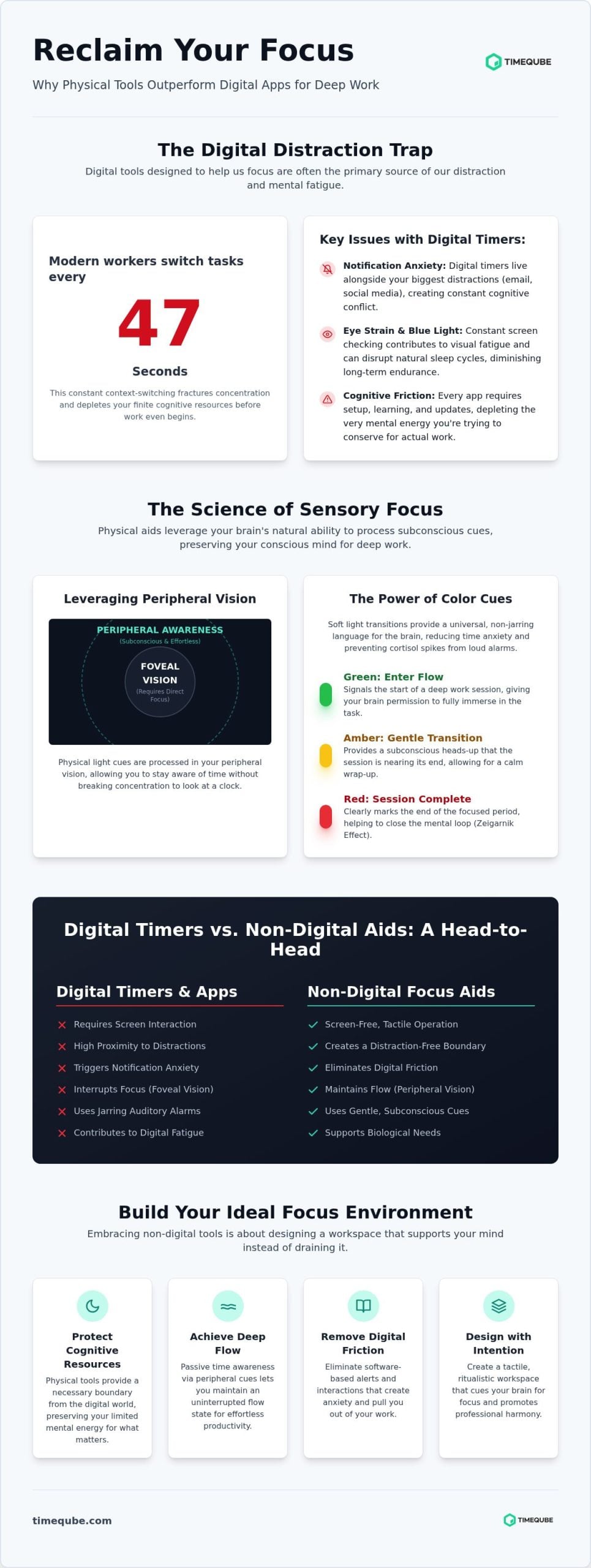
Our brains are biologically programmed to monitor the environment through peripheral vision. This evolutionary trait lets us detect subtle changes without shifting our primary focus. Recent research on shrinking attention spans shows that modern workers now switch tasks every 47 seconds. A physical non digital focus aid leverages this reality. It provides cues that the subconscious mind processes instantly, allowing the conscious mind to remain dedicated to the task at hand.
Passive awareness allows you to track time without checking a clock. Color-coded light serves as a universal language for the brain. Green signals the freedom to enter flow. Amber provides a gentle transition as time nears its conclusion. Red indicates completion. These transitions reduce time anxiety. Traditional alarms are jarring. They trigger a cortisol spike that breaks concentration. Soft light changes allow the brain to transition between tasks with professional harmony and quiet confidence.
Why Peripheral Cues Beat Digital Countdowns
Digital clocks require foveal vision. This is the central, high-resolution part of your sight. When you look at a digital timer, you must disengage from your work to read the numbers. This micro-interruption fractures your concentration. Peripheral light cues are different. They are processed by the older, more intuitive parts of the brain. You can sense the shift from green to amber without looking away from your task. You can explore the science of the professional meeting timer to understand why visual cues are superior to digital clocks for deep work.
Subconscious Time Management for Therapy and Business
Selecting the right non digital focus aid requires understanding how different stimuli affect your cognitive load. Tools for concentration generally fall into three distinct categories: internal, kinetic, and environmental. Internal aids, such as nootropic supplements, attempt to alter your biology from within, though professional Spiritual Intelligence Training offers a more skill-based approach to internal mental mastery. Kinetic aids, like fidget tools, utilize physical movement to channel restless energy. Environmental aids, including visual timers and specialized lighting, reshape your physical surroundings to support concentration. While all three have merits, environmental tools offer the most sustainable path to long-term productivity because they don’t require metabolic energy or active physical engagement.
Supplements vs. Hardware: A Strategic Choice
Many professionals rely on caffeine or chemical nootropics for a short-term cognitive spike. However, these substances often lead to a subsequent crash and provide no structural support for your workflow. A physical non digital focus aid represents a long-term system rather than a temporary boost. There is a clear cost-benefit advantage here. Supplements require ongoing purchases and repeat consumption. A hardware investment like the Timeqube provides a permanent, reliable anchor for your workspace. This physical presence cues the brain for work without the physiological stress or health considerations of stimulants.
Fidget Tools and Kinetic Aids
Kinetic aids can be effective for managing ADHD or neurodiverse energy, but they often fail during periods of intense deep work. The primary issue is engagement. A fidget spinner or mechanical toy requires active manipulation, which can quickly become a distraction itself. Deep work thrives on low-engagement tools that remain in the background. Understanding how technology affects our attention is crucial for choosing the right tool. Dr. Gloria Mark’s research highlights how easily our focus is fractured by active interruptions. Using a physical cube for the Pomodoro method is superior to a phone app because it removes the temptation of a digital screen. For those in mind and body therapies, a silent visual timer maintains the sanctity of the space. It allows for presence without the tactile distraction of kinetic tools. Choosing a dedicated visual timer ensures your environment remains a sanctuary for focus, providing a steady signal that guides your progress without demanding your attention.
Building Your Analog Deep Work Station: A Step-by-Step Guide
Creating a sanctuary for deep work requires a deliberate curation of your environment. You must first identify your primary distraction triggers. For many, these are a combination of smartphone alerts, ambient noise, and the internal monologue that leads to procrastination. A successful analog station addresses these through a sensory-first approach. By selecting a dedicated non digital focus aid for each sensory category, you build a resilient barrier against interruption. This allows you to transition from a reactive state to one of professional intentionality.
Step 1: Audit Your Digital Exposure
Digital devices are designed to capture attention. To reclaim yours, you must remove non-essential screens from your immediate line of sight. Replacing your phone’s timer with a dedicated physical device is the first step toward mental sovereignty. Smartphones operate on the principle that out of sight is out of mind. When your device is in another room, the urge to check notifications diminishes significantly. This simple removal of digital friction protects your cognitive resources for the work that matters most.
Step 2: Implement Visual Time Management
Positioning is critical for effective time management. Place your visual timer in your peripheral vision rather than directly in front of your monitor. This setup leverages your subconscious awareness without forcing you to disengage from your primary task. Establish clear intervals, such as a 50 minute work block followed by a 10 minute rest period. Using color-coded cues also serves a social function. It signals to colleagues or family members that you are in a deep work state. When the light is green, your focus is protected. This creates a stress-free environment for professional business meetings and individual productivity alike.
Step 3: Refine and Iterate
A focus stack is not static. You should adjust your tools based on your daily energy levels and the complexity of your tasks. Combine your visual timer with noise-canceling headphones to create a complete sensory seal. This auditory and visual combination reinforces the boundary between your workspace and the outside world. Evaluate your productivity gains after 14 days of analog-first work. You will likely notice a reduction in mental fatigue and a greater sense of presence. If you are ready to optimize your professional environment, consider how a non digital focus aid can transform your daily flow.
Timeqube: The Minimalist Science of Subconscious Focus
Timeqube stands as the premier non digital focus aid for the professional landscape of 2026. It represents a fundamental shift from active time-tracking to passive awareness. The device features a sophisticated zero-interaction design that prioritizes your mental space. You simply set the duration and allow the light to guide your progress. This “set it and forget it” philosophy eliminates the cognitive friction inherent in starting, stopping, or monitoring digital timers. The hardware is crafted from high-end materials designed to complement a minimalist desk. It isn’t just a tool; it’s an intentional piece of design that projects an aura of professional harmony and quiet confidence.
For organizations seeking to scale this clarity, Timequbes with your logo offer a way to unify team productivity. These customized versions ensure that every meeting space follows the same intuitive rhythm. This consistency reduces the collective cognitive load across the office. It replaces the stress of the “ticking clock” with a shared, silent signal that everyone understands instinctively.
To complement these physical tools, organizations can also invest in interactive experiences; Jelly Donut Events provides virtual sessions that strengthen team bonds through unique, tactile, focus-driven challenges.
Designed for Professionals and Therapists
The application of Timeqube for mind and body therapies fosters a deeper connection between practitioner and client. It removes the subtle but disruptive act of checking a watch, which can fracture the sense of presence in a session. In corporate environments, it facilitates the stress-free meeting. You don’t need a designated timekeeper or a “clerk” to keep the agenda on track. The light provides a shared reality for all participants, ensuring that transitions happen naturally. You can explore Timeqube for business to see how it streamlines professional discourse without the need for intrusive alarms or digital interfaces.
The Universal Language of Color
Color is a universal language that the human brain processes faster than text or numbers. This non digital focus aid bypasses language and literacy barriers through intuitive light shifts. The gentle transition from green to amber and finally to red respects your biological limits. It avoids the cortisol spike associated with traditional, jarring alarms. This transition supports mental health by allowing the brain to prepare for a task switch rather than being forced into one. For those who find traditional clocks anxiety-inducing, Timeqube offers a tranquil alternative. It replaces the pressure of passing seconds with a calming, peripheral glow that supports your flow state instead of interrupting it.
Reclaiming Your Mental Sovereignty
True concentration isn’t a result of willpower. It’s the natural outcome of a workspace designed for the human brain. By shifting away from digital interruptions and towards a physical non digital focus aid, you protect your cognitive endurance. You have learned how peripheral cues reduce task-switching friction and how tactile environments signal the subconscious to enter a flow state. This intentional design removes the anxiety of the ticking clock, replacing it with a sense of professional harmony.
Choosing a dedicated tool is the final step in building a resilient deep work station. Timeqube offers a scientific approach to time awareness through 100% distraction-free hardware. It’s already used by leading therapists and corporate teams to maintain presence and productivity without the noise of digital notifications. It’s time to stop fighting your environment and start working with your biology.
Upgrade your workspace with the Timeqube Visual Timer today. You deserve a workspace that respects your mental clarity and supports your most important work. Your journey toward a more focused, tranquil professional life begins with a single, intentional change.
Frequently Asked Questions
What exactly is a non-digital focus aid?
A non digital focus aid is a physical instrument designed to facilitate concentration without requiring screen interaction. These tools use sensory stimuli, such as color-coded light or tactile feedback, to guide the brain into a flow state. Unlike software, they exist as permanent fixtures in your physical environment. This removes the risk of notification anxiety and digital friction. They prioritize biological needs over technical complexity, offering a stress-free approach to time management.
Are physical focus aids better than productivity apps?
Physical aids are often superior because they don’t reside on the same devices that house distractions. Productivity apps frequently trigger notification anxiety or lead to the “just one more tab” trap. A physical tool provides a dedicated boundary between work and rest. It functions independently of your phone or computer, reducing screen fatigue. This allows for sustained concentration without the cognitive load required to manage complex software interfaces.
Can a visual timer help with ADHD and neurodiversity?
Visual timers are highly effective for managing ADHD and neurodiversity by making the abstract concept of time tangible. They address “time blindness” by providing a constant, non-intrusive visual cue of progress. Color-coded transitions allow users to sense time passing without the stress of a ticking clock. This sensory-friendly approach reduces cognitive load and helps maintain focus. It provides a gentle structure that supports individual needs without the jarring nature of traditional alarms. For a deeper look at how light-based tools address these challenges, explore our complete guide to the ADHD visual timer for adults.
How do I use a visual timer for professional meetings?
You can use a visual timer in professional meetings by placing it in a central location visible to all participants. It acts as a silent moderator, keeping the agenda on track without the need for verbal interruptions. The light transitions signal when it’s time to conclude a topic or move to the next item. This creates a shared sense of pace and reduces meeting stress for everyone involved. It ensures professional harmony by keeping discussions focused and efficient.
Do focus supplements like FocusAid work as well as physical tools?
Focus supplements and physical tools address concentration from different angles. Supplements offer a chemical boost to your biology, which can lead to energy spikes and crashes. In contrast, a non digital focus aid provides a permanent environmental system. It cues the brain through external stimuli rather than internal alterations. While supplements may offer temporary benefits, physical hardware creates a sustainable, distraction-free workspace that supports long-term cognitive endurance without physiological side effects.
Why is peripheral vision important for concentration?
Peripheral vision is crucial because it allows the brain to process environmental changes without shifting primary focus. When a timer uses light cues in your periphery, your subconscious monitors the time while your conscious mind remains dedicated to the task. This passive awareness prevents the micro-interruptions caused by checking a digital clock. It leverages intuitive parts of the brain to maintain flow, reducing the overall mental fatigue of time management.
Is Timeqube suitable for home office use?
Timeqube is an ideal addition to any home office environment. It helps establish a clear physical boundary between professional work and domestic life. By activating the device at the start of a deep work session, you signal to your brain that it’s time to focus. Its minimalist design complements a home aesthetic while providing the same sophisticated time management used in corporate settings. It ensures your workspace remains a sanctuary for productivity and mental well-being.
How long does the battery last on a Timeqube focus aid?
The battery is designed for professional endurance, ensuring it lasts through multiple deep work sessions or a full day of meetings. It utilizes a rechargeable system, removing the need for constant battery replacements. This reliability ensures that your focus isn’t interrupted by a failing power source. The device is built for longevity and consistent performance, serving as a dependable partner in your daily productivity routine. It supports your flow state without requiring frequent technical maintenance.