

Is it possible to achieve true mental clarity while using a device designed to steal your attention? Most professionals attempt to manage their focus with the very screens that cause their exhaustion. We set digital alarms only to be greeted by a barrage of notifications that disrupt our flow. Integrating a physical visual timer for deep work offers a sophisticated exit from this digital noise. It’s a way to reclaim your mental space without the friction of a numeric countdown. You likely feel the weight of digital notification fatigue and the subtle anxiety triggered by a ticking clock. It’s a common paradox to use a distracting phone to solve a distraction problem.
This guide explores how light-based signals protect your cognitive resources and sustain your attention. You’ll discover how to replace the stress of time pressure with a calm, subconscious awareness of your progress. We’ll examine the biological science of peripheral perception and how a dedicated physical ritual can transform your productivity into a sustained state of flow. These insights provide a path toward longer periods of uninterrupted work and reduced stress during transitions. By the end, you’ll understand how to protect your focus from the modern world’s endless demands.
Key Takeaways
- Understand how to eliminate attention residue by protecting your cognitive resources during high-intensity tasks.
- Discover why a physical visual timer for deep work outperforms smartphone apps by removing the temptation of digital notifications.
- Learn how light-based transitions engage your peripheral vision to provide subconscious time awareness without the stress of ticking clocks.
- Master a simple two-step process to prepare your physical and mental workspace for uninterrupted flow.
- Explore the benefits of hardware-first tools that create a dedicated ritual for starting your most important work sessions.
The Psychology of Deep Work and the Role of Visual Cues
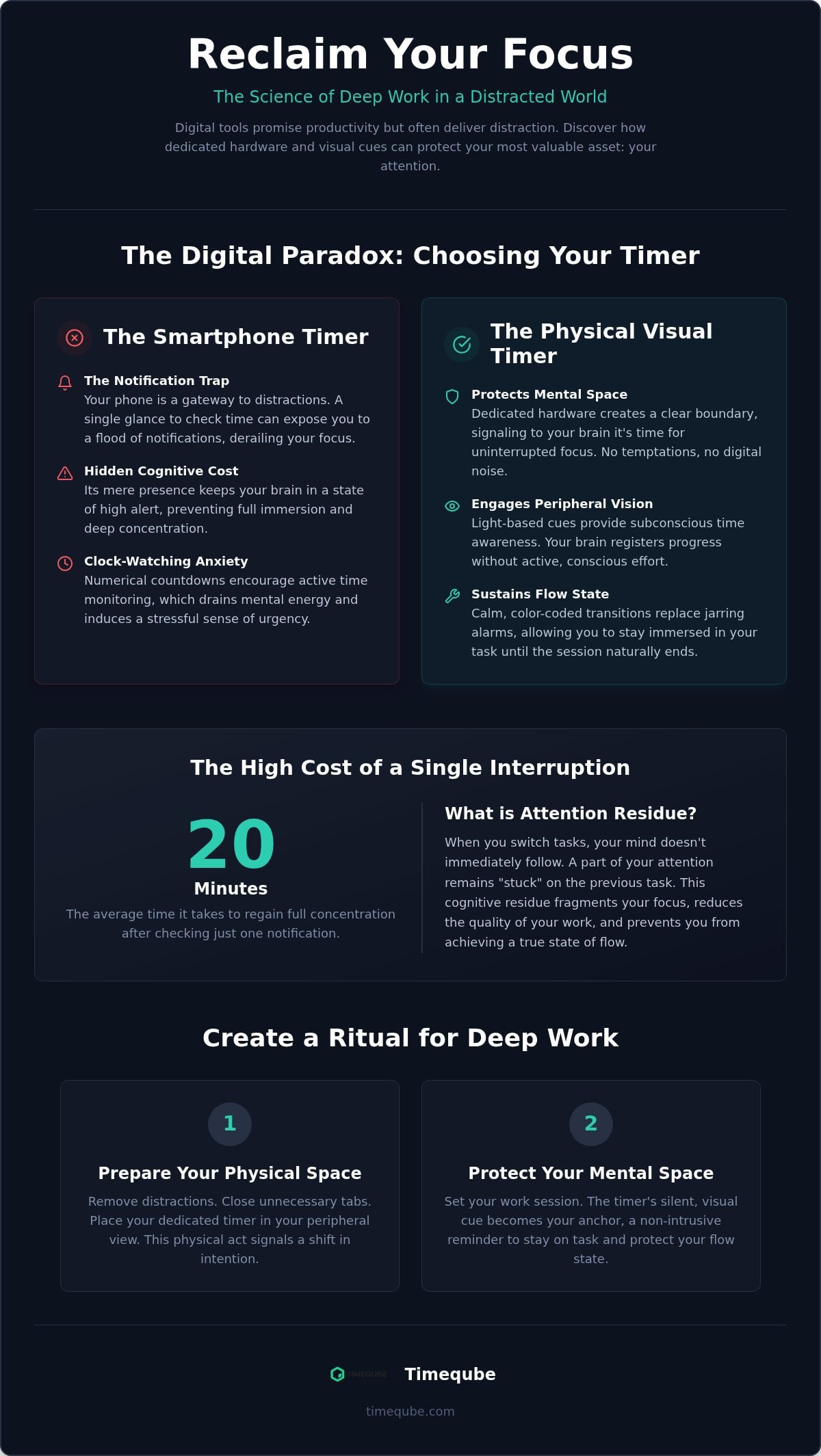
Deep work is the ability to focus without distraction on a cognitively demanding task. It’s a state that pushes your information processing capabilities to their limit. This level of concentration is essential for producing high-value results in an increasingly distracted world. When you allow interruptions, you suffer from attention residue. This phenomenon occurs when your mind remains tethered to a previous task, even after you’ve switched to a new one. This residue fragments your focus and diminishes your overall output quality. It can take up to twenty minutes to regain full concentration after a single notification check.
Your prefrontal cortex requires a constant signal to maintain high-level concentration. A physical visual anchor provides this signal without requiring active mental effort. The human brain processes visual cues significantly faster than numerical data. While reading a digital clock requires conscious interpretation, a color-coded light is registered almost instantly by the subconscious mind. By using a visual timer for deep work, you create a dedicated external structure that protects your internal focus.
Understanding the Flow State
Achieving flow requires a delicate balance between the difficulty of a challenge and your individual skill level. If the task is too easy, you’ll feel bored; if it’s too difficult, you’ll experience anxiety. The Psychology of Deep Work suggests that full immersion is necessary for peak cognitive performance. A visual timer for deep work acts as a gentle safety net for a wandering mind. It provides a non-intrusive reminder of your current intention, helping you stay within the bounds of your session. Flow state is a neurobiological peak performance phase.
Why Visual Timers Outperform Traditional Clocks
Traditional clocks often introduce friction rather than focus. The persistent sound of a ticking clock can induce a sense of urgency that triggers the body’s stress response. Numerical countdowns force the brain into a state of “clock-watching,” where you’re constantly calculating the remaining time. This active monitoring drains your mental energy and breaks your immersion. Light-based timers use peripheral vision to communicate progress. You don’t need to look directly at the device to know how much time remains. Color transitions from green to amber and red provide a calm, intuitive sense of duration. This subconscious awareness allows you to stay deep within your work until the session naturally concludes without the anxiety of a looming alarm.
The Digital Paradox: Why Your Phone is a Poor Deep Work Timer
The Distraction Paradox is a fundamental flaw in modern productivity. We attempt to regulate our focus using the very devices designed to fragment it. Using a smartphone as a timer is like inviting a distraction expert into your office while you try to solve a complex problem. Every time you glance at the screen to check the remaining minutes, you risk encountering a notification. This simple act of checking the time carries a hidden cognitive cost. Your brain doesn’t just see numbers; it sees a gateway to social media, emails, and unfinished business. Even if you don’t unlock the phone, the mere presence of the screen keeps a portion of your mind in a state of high alert.
Physical hardware establishes a clear boundary between your digital life and your deep work sessions. It signals to your brain that it’s time to enter a specific, protected mode. This tactile ritual provides a sense of grounding that digital interfaces completely lack. By opting for a dedicated visual timer for deep work, you remove the constant friction of the digital ecosystem. This choice allows you to transition into a state of flow without the lingering threat of a “quick check” turning into a thirty-minute detour.
The Notification Trap
Digital timers are forced to compete with a constant stream of high-priority alerts. Slack messages and emails are engineered to be irresistible. Even with “Do Not Disturb” settings active, the presence of a live screen creates a persistent pull on your attention. Research into visual cues for deep work suggests that environmental signals are far more effective than digital ones for maintaining concentration. A smartphone screen is a reactive environment; deep work requires a proactive and stable one.
The Benefits of Hardware-Only Solutions
Hardware-only solutions offer a “set and forget” simplicity that digital apps cannot replicate. There are no menus to navigate and no software updates to disrupt your flow. This zero-distraction design respects your mental well-being by providing only the essential information you need. A physical visual timer for deep work becomes a sacred object for your focus ritual. When you place it on your desk, you’re making a physical commitment to your own productivity. This tactile feedback grounds you in the present moment, reinforcing your intention to stay focused.
It’s why tools like Timeqube for Business Meetings are becoming essential in professional environments. They provide a shared reference point that keeps everyone aligned without the need for intrusive screens. This intentional removal of digital friction is the key to sustaining high-quality output over long periods. You can find a more peaceful way to manage your time by exploring Timeqube’s physical solutions.
How to Structure Your Deep Work Environment with a Visual Timer
Creating a sanctuary for focus requires intentional design. Before activating your visual timer for deep work, you must define a singular objective. Ambiguity is the enemy of concentration. Specify exactly what success looks like for this session. This clarity reduces the cognitive load required to start. You don’t want to spend the first ten minutes of your session deciding what to do.
Next, remove all non-essential items from your physical and digital workspace. A cluttered desk creates visual noise that competes for your attention. Close unnecessary browser tabs and silence all notifications. Once your environment is clear, position your timer in your peripheral vision. It should be visible but not in your direct line of sight. This placement allows your brain to monitor time without breaking your immersion in the task. Setting a duration that matches your current energy levels, typically between 60 and 90 minutes, ensures you don’t overextend your cognitive resources.
The cognitive benefits of deep work are most pronounced when you respect your biological limits. Finally, commit to the color signal. The light is your only guide. Work until the transition to red occurs, then allow yourself a period of complete mental rest. This commitment builds a powerful psychological association between the light and your productive output.
Choosing Your Interval Strategy
The Pomodoro Technique, involving 25-minute intervals, is effective for administrative duties or lighter tasks. However, complex problem solving often requires longer cycles to reach the depth of focus needed. Ultradian rhythms suggest that the human brain operates in 90-minute cycles of high-frequency electrical activity. Aligning your sessions with these natural peaks leads to better sustained focus and higher quality output. For those exploring Time Management for Neurodiversity, these structured light-based intervals provide a predictable framework that reduces the anxiety of open-ended tasks. It creates a clear start and end point that the brain can trust.
The Importance of Peripheral Placement
Looking directly at a clock forces your brain to switch contexts. This shift interrupts the flow state and requires mental energy to resume your work. Peripheral placement leverages the subconscious mind’s ability to detect environmental changes without active effort. Your brain monitors the shifting hues of a visual timer for deep work while your conscious focus remains entirely on your output. This ergonomic optimization ensures that time awareness remains a supportive background process rather than a primary distraction. Adjust your desk setup so the device sits at a slight angle from your primary monitor. This subtle positioning maintains the flow signal while respecting your cognitive boundaries.
The Science of Light: Why Peripheral Cues Sustain Focus
Human perception is biologically tuned to detect environmental changes through peripheral vision. This sensitivity allows the brain to process information without requiring direct foveal focus. When you use a visual timer for deep work, you leverage this evolutionary trait. The device communicates time through subtle shifts in color rather than demanding your central attention. This method ensures that your primary cognitive resources remain dedicated to your work. The prefrontal cortex remains focused while the amygdala stays calm, free from the physiological stress of a sudden auditory alarm.
Light-based transitions from green to amber and finally to red create a subconscious temporal map. These gradual changes reduce the phenomenon of “Time Anxiety,” which often occurs when a deadline feels like a looming threat. Instead of a ticking clock that forces conscious monitoring, a glowing surface provides a tranquil awareness of progress. This non-aggressive approach to time management respects your mental well-being and prevents the jarring interruptions that typical digital tools provide. Understanding how an ambient time awareness device leverages these principles of peripheral perception can deepen your appreciation for why light-based timing is so effective for sustained focus.
Color Psychology in Productivity
The choice of color in a productivity tool is never arbitrary. Specific wavelengths trigger distinct psychological responses that either support or hinder your focus. Universal color signals provide an intuitive language for the brain:
- Green: This hue signals safety and stability, encouraging the brain to enter a state of creative flow.
- Amber: The transition to amber provides a gentle nudge, signaling that it’s time to begin wrapping up current thoughts.
- Red: A firm but silent boundary that indicates the session has ended and a restorative break is necessary.
Reducing Cognitive Load
Reading numerical data requires active decoding by the brain. You must look at the digits, interpret their value, and calculate the remaining time. This process adds unnecessary cognitive load to an already demanding task. In contrast, perceiving light is a passive sensory experience. It happens subconsciously. This distinction is especially beneficial for users with ADHD who may struggle with hyper-focus burnout. A visual timer for deep work acts as a persistent anchor, preventing the total loss of time awareness without breaking the flow state.
This sensory-first approach is explored in detail within The Science of the Professional Meeting Timer, highlighting why visual cues are superior to digital clocks. By removing the friction of active time tracking, you preserve your mental energy for the work that truly matters. Enhance your focus and protect your mental space by selecting a Timeqube for your workspace today.
Elevating Your Focus with Timeqube: The Ultimate Deep Work Tool
Timeqube represents a fundamental shift in how we interact with time during periods of high cognitive demand. It’s a minimalist, hardware-first solution designed to protect your mental well-being. Unlike digital applications that share a screen with distractions, this device stands as a dedicated physical companion for your desk. It adheres to a strict no-distraction philosophy. There’s no ticking to induce anxiety and no jarring alarms to break your concentration. By using a visual timer for deep work, you replace digital clutter with a steady, silent sentinel. This reassuring glow respects your cognitive boundaries while providing a clear signal of your progress.
The premium design of the hardware ensures it fits seamlessly into professional executive suites or tranquil clinical settings. Its versatility extends beyond the home office, proving essential in mind/body therapy sessions where presence is the primary objective. This hardware-focused approach eliminates the temptation to “just check the time” on a smartphone, which often leads to the attention residue we discussed earlier. You aren’t constantly fighting the pull of the digital ecosystem because your time signal exists entirely outside of it.
A Ritual for Productivity
Psychological readiness is a prerequisite for entering a flow state. Turning on your Timeqube acts as a powerful environmental trigger. It signals to your brain that the period for shallow tasks has ended and the period for deep focus has begun. This physical action helps you build a “Flow Sanctuary” where your tools support rather than hinder your efforts. For organizations looking to foster this culture of focus across entire teams, Timeqube Customised offers branded solutions that align corporate identity with peak mental performance. These physical tools create a shared understanding of focus time in a busy office environment.
Sustainable Focus for the Long Term
Modern work culture often prioritizes the quantity of hours over the quality of output. Timeqube encourages a shift away from this exhausting “hustle” mentality toward a more sustainable, mindful productivity. It protects your long-term mental health by enforcing healthy temporal boundaries. When the light transitions to red, it provides a firm but silent signal that your brain requires rest. This prevents the cognitive exhaustion and burnout associated with over-extending your focus beyond your biological limits.
The simplicity of a dedicated hardware device means there are no software updates to manage or complex menus to navigate. It’s a durable, intentional investment in your personal focus infrastructure. By integrating a visual timer for deep work into your daily routine, you choose a path of professional harmony. You aren’t just managing your minutes; you’re protecting your most valuable resource: your attention. This steady approach leads to higher quality work and a more balanced mental state at the end of the day.
Protecting Your Cognitive Future
Mastering your attention is a prerequisite for professional excellence and mental well-being. By moving beyond digital distractions, you allow your brain to enter a state of sustained flow. A dedicated visual timer for deep work provides the necessary environmental signal to keep your prefrontal cortex engaged without the friction of active monitoring. You’ve seen how light-based transitions respect your biological limits while eliminating the anxiety of traditional clocks. This hardware-only solution ensures that your focus remains entirely on your most demanding tasks.
Professionals in therapy and business already rely on these minimalist tools to create distraction-free environments. The removal of digital noise isn’t just a productivity choice; it’s a commitment to your mental health. It’s time to replace screen-based interruptions with a sophisticated, physical ritual that honors your concentration. You can upgrade your deep work ritual with a physical Timeqube timer to reclaim your presence. Embrace a calmer, more intentional approach to your daily workflow. Your best work is waiting to be discovered in the silence.
Frequently Asked Questions
How long should a deep work session be for maximum productivity?
Deep work sessions are most effective when they last between 60 and 90 minutes. This duration aligns with the human body’s ultradian rhythms, which are natural cycles of high-frequency brain activity. Attempting to focus for longer periods often leads to cognitive fatigue and diminishing returns. Shorter sessions may not provide enough time to reach a state of full immersion. Consistency in these intervals helps your brain build the stamina required for complex problem solving.
Can a visual timer help with ADHD and neurodivergent focus?
A visual timer for deep work is an exceptional tool for managing time blindness associated with ADHD. Neurodivergent individuals often struggle with the abstract nature of numerical clocks. Light-based signals provide a concrete, external representation of passing time that the brain processes subconsciously. This reduces the hyper-focus burnout caused by losing track of the day. The silent, non-intrusive transitions prevent the sensory overload often triggered by loud digital alarms or persistent ticking sounds.
Why is a physical timer better than a free phone app?
Physical timers eliminate the distraction paradox inherent in smartphone applications. When you use a phone app, you’re one notification away from breaking your flow. A dedicated hardware device contains zero digital interruptions, ensuring your mental space remains protected. It acts as a sacred object for your productivity ritual. This physical presence signals a firm commitment to your task, a psychological boundary that a multipurpose device like a smartphone simply cannot replicate.
What is the best way to use a visual timer for the Pomodoro technique?
To apply the Pomodoro technique, set your visual timer for 25 minutes of focused effort followed by a five-minute break. The light-based signals allow you to monitor your progress without the stress of watching seconds count down. When the device transitions to red, you must honor the boundary and step away from your desk. This discipline prevents mental exhaustion. Using a physical visual timer for deep work makes these intervals feel like a natural rhythm rather than a forced schedule.
Where should I place my visual timer on my desk?
Optimal placement for a visual timer is within your peripheral vision, approximately 30 to 45 degrees from your primary line of sight. This positioning allows your brain to register color changes without requiring you to look away from your work. Direct placement can become a distraction, forcing your eyes to shift focus and breaking your immersion. By keeping the light in your periphery, you maintain a subconscious awareness of time while your conscious mind stays fully dedicated to the task.
What color signals are most effective for time management?
Universal color signals are the most effective for intuitive time management. Green represents a state of safety and creative flow, allowing you to work without concern. Amber serves as a gentle transition, providing a subconscious nudge to start concluding your current thoughts. Red acts as a firm but silent boundary, indicating the session has ended. This sequence respects the biological limitations of the brain, reducing the anxiety often caused by sudden, aggressive auditory alerts.
Can I use a visual timer for group work or meetings?
Visual timers are highly effective in collaborative environments and business meetings. They provide a shared reference point for all participants, creating a collective awareness of time without the need for verbal interruptions. This transparency helps keep discussions concise and ensures that every agenda item receives adequate attention. It’s an unobtrusive way to maintain professional harmony. Many teams use these tools to ensure that meetings remain productive, respectful, and focused on high-value outcomes.
Does a visual timer help reduce work-related stress?
Using a light-based timer significantly reduces work-related stress by eliminating clock-watching anxiety. Traditional clocks force you to actively monitor passing time, which triggers a subtle but persistent stress response. Light transitions are gradual and non-aggressive, allowing you to stay present in your work. This approach prioritizes your mental well-being by removing the friction of time pressure. You gain a sense of quiet confidence, knowing that the light will guide you through your session without jarring interruptions.