
The very tool you use to manage your focus might be the primary source of your anxiety. Most professionals rely on visual countdowns to stay on track. Yet the aggressive disappearing red disk of a traditional timer often triggers a low-level stress response. You want to stay present, but your brain is fixated on the shrinking circle. It’s a phenomenon rooted in how we process visual stimuli, where the solution creates its own distraction.
We understand the frustration of digital notification fatigue and the pressure of a ticking clock. This article explores the evolution of temporal management and identifies the most effective Time Timer alternative for 2026. You’ll discover why peripheral light-based timing is replacing the traditional disappearing disk for therapy, business, and deep work. We’ll compare the latest hardware and software solutions that prioritize mental well-being over digital noise. You’ll learn how to achieve subconscious time awareness and create a distraction-free environment that respects your cognitive limits. The future of productivity isn’t found in a disappearing disk, but in the subtle glow of calm technology.
Key Takeaways
- Professionals are increasingly rejecting digital notifications in favor of dedicated hardware to combat cognitive fatigue.
- Discover how peripheral light signals offer a stress-free Time Timer alternative by allowing you to sense time’s passage without breaking your concentration.
- Understand the neuroscientific difference between foveal focus and peripheral awareness to select a tool that aligns with human biology.
- Identify the optimal timing solution for your specific environment, whether you’re facilitating a business meeting or a sensitive therapy session.
- Learn how physical hardware establishes a clear tactile boundary for time, removing the friction common in software-based management.
Why Professionals Seek a Time Timer Alternative in 2026
A visual timer serves as a vital instrument for cognitive offloading. It allows the professional brain to delegate the tracking of time to an external device, preserving mental energy for complex tasks. By 2026, the shift away from digital interfaces has become a necessity for those seeking deep focus. Digital fatigue is no longer just a buzzword; it’s a measurable decline in cognitive performance caused by constant screen-based stimulus.
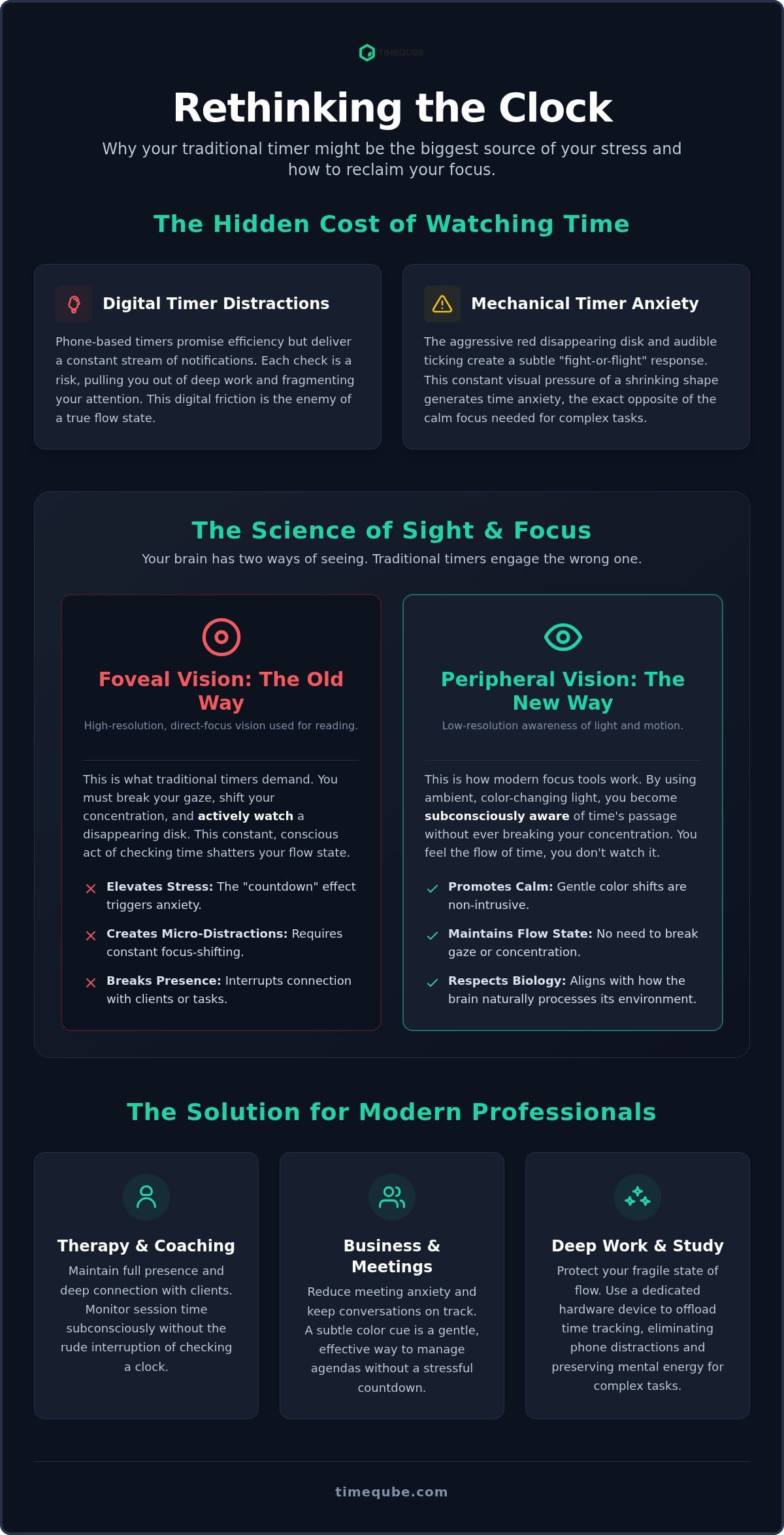
Many high-level practitioners now search for a Time Timer alternative because the traditional classroom aesthetic feels out of place in a sophisticated environment. While the red disappearing disk was revolutionary for education, it often introduces a sense of “time anxiety” in professional settings. The high-contrast visual of a shrinking shape creates a countdown effect that can trigger a subtle fight-or-flight response. This tension is the opposite of the professional harmony required for therapy or executive strategy. Choosing a dedicated device like the Timeqube helps re-establish that lost sense of calm.
The Problem with Digital Timer Apps
Digital applications often promise efficiency but deliver distraction. Every time a user checks a phone-based timer, they risk exposure to notifications that fragment attention. These interruptions destroy the flow state required for the Pomodoro Technique or other deep work methodologies. Phones remain the primary source of workplace distraction, making them poor tools for time management. Digital friction is the ultimate enemy of professional presence and sustained awareness.
Limitations of Mechanical Visual Timers
Mechanical timers present their own set of physiological hurdles. The audible ticking of a physical clock can be a significant sensory trigger for neurodivergent individuals, causing irritation rather than focus. Additionally, moving mechanical components are prone to wear and tear, often failing in high-use environments like busy clinics or corporate offices.
A significant drawback of the traditional disk is its reliance on foveal vision. This requires the professional to break their gaze and make direct eye contact with the device to gauge remaining time. This constant shifting of focus interrupts the connection between a therapist and their client or a speaker and their audience. A modern Time Timer alternative should instead leverage peripheral awareness, allowing for a more natural and less intrusive perception of time. Understanding how an analog focus timer replaces digital friction with tactile, light-based cues can help you make a more informed choice for your practice.
The Science of Visual Timing: Peripheral vs. Foveal Vision
The human brain processes visual information through two distinct channels: foveal and peripheral vision. Foveal vision is high-resolution and requires central focus. It’s what you use to read these words or check a digital clock. Peripheral vision, conversely, is sensitive to motion and light changes. It operates at a subconscious level, providing environmental context without demanding direct attention. This biological distinction is why a superior Time Timer alternative prioritizes light over shapes.
When you use a traditional timer with a disappearing disk, you’re forced to engage your foveal vision. This act creates a micro-distraction that breaks your flow state. You aren’t just aware of time; you’re actively watching it disappear. This central focus on a shrinking high-contrast shape can elevate stress levels. By switching to color-coded light, you move time management from the foreground of your mind to the background. It’s the most effective Time Timer alternative for those who value mental clarity. You begin to feel the passage of time through subtle shifts in the room’s atmosphere, which is significantly less taxing on your nervous system.
Subconscious Processing for Therapy and Coaching
In clinical settings, maintaining a deep connection with a client is paramount. Checking a clock is an interruptive gesture that can signal a lack of presence or a rush to finish. By utilizing Timeqube for Mind/Body Therapies, practitioners can monitor session progress through their peripheral field. The gentle transition of colors provides a silent narrative of the session’s rhythm. This allows the therapist to stay fully engaged in the human moment while the subconscious handles the logistics of the schedule. It’s a clinical solution that respects the sanctity of the therapeutic space.
Reducing Meeting Anxiety with Color Cues
Corporate environments often suffer from meeting creep and the anxiety of the last-minute rush. Traditional countdowns can feel like an impending alarm, heightening tension as the end approaches. Color cues change this dynamic by providing a graceful warning system. A shift from green to yellow suggests a natural wind-down period, while red indicates a firm conclusion. Peripheral awareness reduces cortisol spikes during transitions, as the brain isn’t startled by a sudden alarm or a ticking hand. This subconscious feedback loop helps teams manage their energy more effectively. If you’re looking to foster a more harmonious workspace, consider how tranquil time management can transform your office culture.
Comparing the Best Visual Timers for Focus and Productivity
Selecting a professional timing solution requires a careful evaluation of sensory input, aesthetic integration, and operational durability. Traditional digital clocks demand significant cognitive effort to interpret numerical data, which can fragment your concentration. Mechanical disks provide a clearer visual representation but often lack the minimalist elegance required for high-stakes environments. The most effective Time Timer alternative prioritizes a distraction-free status, ensuring the tool remains an unobtrusive ally rather than a source of stress.
Professional suitability is a critical factor for the C-suite and clinical offices. These spaces require tools that reflect an aura of professional harmony and intentionality. A classroom-style device, while functional, can inadvertently infantilize a sophisticated workspace. High-end professionals need a solution that blends scientific expertise with minimalist design, allowing time management to feel like a natural extension of the environment rather than a loud interruption.
Time Timer vs. Timeqube: A Direct Hardware Comparison
The fundamental difference between these tools lies in their physical construction and visual delivery. A mechanical disk relies on a physical red overlay that moves across the clock face. This design is functional but carries a classroom-red aesthetic that may not align with a modern executive or therapeutic setting. In contrast, solid-state LED hardware offers a more durable and sophisticated alternative. By replacing moving mechanical parts with a seamless light transition, devices like the Timeqube remove the risk of mechanical failure and ticking sounds.
While the disk requires direct foveal focus to gauge remaining time accurately, color-coded light signals leverage peripheral awareness. This allows you to maintain presence during a session or meeting without the need for direct eye contact with a clock. The result is a reduced cognitive load and a more tranquil approach to managing your schedule.
The Cost of Free: Why Apps Fail Professional Users
Digital timer applications are often free, yet they carry significant hidden costs in the form of distraction and lost billable hours. Every time you switch to a screen to check a timer, you invite digital friction. Phones are the primary source of workplace distraction, and using them as a timer often leads to accidental engagement with notifications. A physical time boundary on your desk creates a tactile reality that software cannot replicate. This hardware presence acts as a psychological anchor for deep work. For those seeking a deeper physical pomodoro timer for work, dedicated hardware remains the gold standard for maintaining professional presence and reducing anxiety.
How to Choose the Right Timer for Your Environment
Choosing the right tool requires an understanding of your specific environmental stressors. A professional environment is not a classroom. It demands a level of sophistication that generic tools often lack. When searching for a Time Timer alternative, you must consider the sensory profile of the user and the spatial constraints of the room. A therapist working in a dimly lit office has different needs than an executive in a bright, glass-walled boardroom. You must determine if the device is intended for individual focus or group coordination. An individual timer should be unobtrusive and personal; a group timer must be visible from multiple angles to ensure collective awareness.
Lighting conditions play a significant role in visibility. Mechanical dials can be difficult to read in low light or from across a large conference table. Solid-state LED hardware ensures that time signals remain clear regardless of the ambient lighting. Desk space is another practical factor. A compact, stationary cube provides a tactile boundary without cluttering the workspace. For those who move between clinics or offices, portable hardware that fits in a professional bag is essential. It’s about finding a solution that integrates into your workflow without adding to your cognitive load.
Selecting a Timer for Neurodiversity
For individuals with ADHD or sensory processing sensitivities, the ticking or clicking of mechanical devices can be a source of significant distress. Light-based cues offer a more harmonious experience. These signals provide information through the peripheral field, which is less likely to trigger hyperfocus interruptions. Silent operation is a universal psychological requirement for deep concentration. You can explore more about this in our guide on time management for neurodiversity. It’s important to choose a tool that respects the biological limitations of the human brain while offering a sophisticated solution to modern distractions.
Timers for the Corporate Meeting Room
In a group setting, a visual timer acts as an impartial facilitator. It democratizes time management by making the schedule visible to everyone simultaneously. This transparency reduces the social friction of interrupting a speaker. Using visual cues helps enforce a Professional Meeting standard where every participant respects the collective agenda. It removes the burden of time-keeping from the lead facilitator and places it in the shared environment. This methodology is explored further in The Science of the Professional Meeting Timer. When every participant shares the same visual cue, the meeting flow becomes natural and effortless.
If you’re ready to upgrade your professional environment, you can get your Timeqube here to experience the benefits of tranquil, light-based time management.
Elevating Your Practice with Timeqube: The Seamless Alternative
Timeqube represents the pinnacle of intentional design for the modern professional. It serves as the premier Time Timer alternative for 2026, specifically engineered to transition time management from a source of stress to a background awareness. For therapists and mind-body practitioners, the hardware offers a distinct clinical advantage. It facilitates the maintenance of a deep, uninterrupted connection with the client. By utilizing sensory stimuli rather than mechanical movement, the device ensures that focus remains entirely on the human interaction. This is the removal of friction in its most practical form.
The minimalist design philosophy centers on the elimination of digital noise. In an era characterized by notification fatigue, a dedicated hardware-only solution acts as a necessary cognitive boundary. It provides a tactile presence that software simply cannot replicate. This focus is essential for practitioners who require their professional environment to reflect the same tranquility they advocate for in their sessions. The result is an atmosphere of professional harmony where time is felt rather than watched. Professionals who have already embraced the analog focus timer approach consistently report a measurable reduction in session-related stress and a deeper quality of presence.
Custom Logo Timers for Corporate Identity
For consultancies and corporate entities, the integration of brand identity into productivity tools is a strategic decision. Branded timers serve as a functional reminder of a company’s commitment to a disciplined meeting culture. They act as high-end, sophisticated gifts that provide genuine utility to the recipient. You can explore options for Timequbes with Your Logo to align your time management tools with your corporate aesthetic. This customization transforms a utility into a symbol of professional intentionality and shared focus across an organization.
The Future of Distraction-Free Time Management
As we navigate the complexities of 2026, hardware-only solutions are emerging as the ultimate luxury for the focused professional. The ability to manage time without a screen or a high-contrast ticking disk is a hallmark of a sophisticated workspace. For therapists and business leaders, the recommendation is clear. You should choose a tool that respects your biological limitations and enhances your presence in the room. It’s time to move beyond the anxiety-inducing countdowns of the past. This Time Timer alternative provides the clarity and calm necessary for sustained high-level performance. Experience the tranquil flow of Timeqube and reclaim your mental space today.
Reclaim Your Cognitive Space
A sophisticated professional environment requires tools that facilitate focus rather than fracture it. This comparison demonstrates how moving time management to the peripheral field reduces cognitive load and cortisol spikes. By eliminating digital friction and the anxiety of high-contrast countdowns, you prioritize your mental well-being. Selecting a dedicated Time Timer alternative is a commitment to maintaining presence in every session and meeting.
Timeqube offers a 100% distraction-free hardware experience that is trusted by professional therapists worldwide. With its minimalist aesthetic and quiet operation, it acts as a visionary ally in your clinic or boardroom. You can now manage your schedule through subconscious awareness, allowing your foveal vision to remain on the work that matters most. It’s an intentional step toward a more harmonious professional life.
Upgrade your focus with the professional Timeqube alternative and discover the power of tranquil time management. Your peak performance begins with a clear mind.
Frequently Asked Questions
Is Timeqube better than Time Timer for ADHD?
Timeqube serves as a superior Time Timer alternative for ADHD by replacing mechanical movement with color-coded light. The disappearing disk of traditional timers can trigger hyperfocus interruptions or low-level anxiety. Light-based cues operate through the peripheral field, providing a gentle sense of time’s passage without demanding central focus. This approach respects the neurodivergent brain’s need for a calm, non-intrusive environment, allowing for smoother transitions between tasks and sessions.
Does Timeqube make any ticking sounds?
Timeqube is completely silent and does not produce any ticking or mechanical sounds. It utilizes solid-state LED hardware to communicate time, ensuring there are no sensory triggers for sensitive individuals. This silence is a critical requirement for deep work and therapeutic sessions where auditory distractions can break a client’s presence. By removing mechanical parts, the device also eliminates the wear and tear common in traditional moving timers.
Can I use Timeqube in a bright office environment?
You can use Timeqube effectively in bright office environments. The internal LEDs are engineered for high visibility, ensuring the color signals remain clear even under standard overhead lighting or near windows. While the glow is tranquil, it’s sufficiently vibrant to be captured by your peripheral vision. This reliability makes it a versatile Time Timer alternative for glass-walled boardrooms and modern executive suites where ambient light is often high.
Why should I choose a physical timer over a free phone app?
Choosing physical hardware over a phone app eliminates the risk of digital notification fatigue. Phones are the primary source of workplace distraction; every time you check an app, you risk seeing a message that fragments your attention. A physical timer creates a tactile boundary on your desk, acting as a psychological anchor for focus. It provides a dedicated, distraction-free space that software simply cannot replicate in a professional setting.
How long does the battery last on a Timeqube?
Timeqube is designed for professional endurance and typically supports several days of standard use on a single charge. The device is rechargeable via a standard USB cable, making it convenient for both stationary desk work and portable therapeutic practice. This long-lasting performance ensures that your sessions and meetings are never interrupted by power failure. It functions as a reliable partner that remains ready for use throughout a demanding work week.
Can I customize the colors or timing intervals?
You can easily customize timing intervals using the intuitive presets built into the hardware. Timeqube supports a wide range of standard professional durations for meetings and therapy sessions. Additionally, businesses can opt for customized units that feature corporate logos, aligning the device with their specific brand identity. This flexibility allows you to tailor the timing experience to the unique requirements of your practice or corporate culture without complex software.
Is there a warranty for Timeqube hardware?
Every Timeqube device comes with a 2-year global guarantee, reflecting its status as a premium professional tool. This warranty covers the solid-state hardware against defects, ensuring your investment is protected in a high-use environment. The devices are hand-made in the European Union with a focus on durability and minimalist elegance. This commitment to quality provides peace of mind for therapists and business leaders who require reliable, long-term timing solutions.
How does peripheral vision timing reduce stress?
Peripheral vision timing reduces stress by engaging the brain’s subconscious processing rather than its central focus. When you use foveal vision to check a clock, you consciously interrupt your current task. Peripheral cues allow you to feel time passing through subtle changes in ambient color. This prevents the cortisol spikes associated with sudden alarms or the visual pressure of a countdown, fostering a state of professional harmony and intentionality.