
What if the very tool you use to manage your time is actually sabotaging your focus? Most digital countdowns demand constant conscious attention; they pull you out of deep work every time you glance at the screen. You’ve likely experienced the mounting anxiety of a ticking clock or the disruptive jolt of an aggressive smartphone alarm. This digital friction creates a state of perpetual high alert that’s fundamentally incompatible with a true flow state. Integrating an analog focus timer into your workspace replaces this stress with a sophisticated, light-based approach to productivity.
It’s clear that the modern professional environment is saturated with notification fatigue. You deserve a method of time management that respects your mental space rather than competing for it. This article explores how tactile cues and peripheral signals allow you to track sessions subconsciously, which reduces stress during therapy or high-stakes meetings. By moving beyond the digital tick, you’ll learn to maintain longer periods of uninterrupted work while fostering a more harmonious relationship with your schedule. We’ll examine the science of sensory timekeeping and why a physical, screenless ally is the key to reclaiming your cognitive clarity in 2026.
Key Takeaways
- Digital countdowns trigger psychological stress and interrupt deep work. Switching to an analog focus timer preserves your flow state by providing non-intrusive cues.
- Peripheral vision enables the brain to process time signals subconsciously. This sensory method removes the friction of manually checking a clock.
- Silent, light-based signals are superior to mechanical ticking or sand timers in professional settings. Visual cues provide clarity without the distraction of noise.
- Effective implementation involves setting a clear intention before beginning a task. Positioning the device in your peripheral view ensures your focus remains on the work.
- A hardware-first approach to time management eliminates the risk of notification fatigue. Removing digital screens is essential for maintaining mental presence.
Why Digital Clocks Sabotage Your Deep Focus
Digital clocks are designed for mathematical precision, yet they often fail the human brain. While they show the exact second, they frequently destroy the focus you aim to protect. This is the paradox of the modern workspace. A digital countdown demands active monitoring, which forces your brain to exit a flow state just to check the time. This “tab-switching tax” is a heavy price to pay for productivity. By using an analog focus timer, you reduce the cognitive load required to stay on track.
Watching digits disappear also triggers countdown anxiety. It’s a psychological stressor that keeps your nervous system on edge. Reading a number requires active cognitive processing; your brain must decode symbols and calculate the remaining duration. In contrast, sensing a color or a physical change is a subconscious act. This is where a dedicated time tool excels. It bypasses the analytical mind and speaks directly to your intuition. A tactile time management device is a physical tool designed to provide sensory cues for time without digital interference. It replaces data with awareness.
The Distraction of the Notification Economy
In 2026, digital devices are rarely single-purpose. A smartphone timer is just a gateway to social media, emails, and news alerts. These interruptions are the primary enemies of deep work. Establishing “Analog Spaces” in your home or office is now a necessity for mental well-being. Physical hardware creates a clear mental boundary. When you activate a physical device, you’re making a sensory commitment to a specific task. It separates your work periods from the noise of the digital world.
Digital vs. Physical: The Battle for Attention
There’s a significant neurological difference between interacting with a screen and a physical object. Tactile feedback anchors your attention and improves task commitment. Many high-performers struggle with “time blindness,” where hours slip away without a clear sense of progress. A physical presence on your desk provides a constant, unobtrusive anchor. The Pomodoro Technique was founded on this principle of using a physical tool to ground the user in the present moment. For professionals in mind and body therapies, this physical presence helps maintain a tranquil environment for both the practitioner and the client. An analog focus timer serves as a silent, authoritative partner in your daily routine.
The Psychology of the Tactile Time Management Device
The human brain isn’t naturally optimized for the rigid precision of digital digits. It is, however, highly evolved for environmental awareness. Using an analog focus timer leverages this biological reality by replacing distracting numbers with intuitive light cues. This approach moves the burden of timekeeping from the conscious mind to the subconscious. You stop checking the clock and start feeling the passage of time. This transition is essential for maintaining deep focus in a high-pressure environment.
Specific wavelengths of light trigger predictable biological responses. Green light typically signals a state of safety and steady progress. As a timer transitions through amber toward red, it provides a gentle, non-verbal prompt to conclude a task. This gradual shift follows research-backed time management strategies that prioritize the reduction of cognitive friction. By avoiding the startle response triggered by loud alarms, you prevent unnecessary spikes in cortisol. Your nervous system remains regulated, which allows for a smoother transition between work and rest.
Peripheral Processing and Flow States
Your peripheral vision is a powerful tool for monitoring the environment without breaking concentration. While your central vision stays locked on your work, your brain continues to process color changes in its surroundings. A glowing cube is far less intrusive than a ticking hand or a blinking screen. It provides a constant but quiet signal of progress. This allows the prefrontal cortex to remain dedicated to complex problem-solving. You don’t have to look away from your task to know exactly where you stand in your session.
Sensory Cues for Mind and Body
Light-based timers offer significant benefits for time management for neurodiversity. Individuals with sensory processing differences often find the mechanical ticking of traditional clocks or the intrusive nature of digital notifications overwhelming. A steady, color-coded glow provides a predictable and soothing reference point. It supports a “Calm Tech” philosophy by existing at the edge of your awareness until it’s needed. This creates a more inclusive and peaceful workspace for everyone.
For practitioners in clinical settings, integrating a Timeqube for mind and body therapies ensures that the focus remains entirely on the client’s well-being. It provides a sophisticated, silent way to manage sessions with professional harmony.
Comparing Analog Focus Timers: Mechanical vs. Visual Light
Choosing an analog focus timer requires an understanding of how different sensory inputs affect your concentration. Mechanical disk timers are a frequent choice in educational settings. They use a colorful disk to show elapsing time, but their internal mechanics often produce a persistent ticking sound. For a professional seeking deep work, this noise is a constant auditory distraction. Sand timers offer a minimalist aesthetic; however, they’re inherently inflexible. You can’t adjust their duration on the fly, which makes them impractical for varied tasks or evolving schedules.
Visual light timers are the modern standard for professionals who require both silence and precision. They offer the physical presence of an analog tool without the mechanical noise or fixed-interval limitations of older designs. High-quality hardware devices project an air of professionalism that cheap plastic kitchen timers simply can’t match. The cognitive impact of digital clocks is often rooted in their aggressive data delivery. Light-based analog tools solve this by providing a tranquil, sensory-first experience that respects your mental space. For a deeper look at how these devices compare in real-world office settings, the non distracting office timer professional FAQ guide offers comprehensive answers to the most common questions from high-performance professionals.
The Sound of Silence in Deep Work
Silence is essential for cognitive endurance. The rhythmic ticking of a mechanical analog focus timer can inadvertently become a metronome for your stress. It forces you to notice every passing second, which prevents true immersion. Using visual timers for deep work allows your brain to remain in a flow state by removing auditory friction. In therapy, silent transitions are vital. They preserve the sanctuary of the session, ensuring that neither the practitioner nor the client is startled by a mechanical bell or the grinding of internal gears. This silence fosters an environment of professional harmony.
Versatility and Customization
Tactile devices provide a level of versatility that traditional fixed-interval tools lack. You can change durations instantly to suit different session lengths or meeting blocks. You shouldn’t settle for tools that prioritize volume over focus. For corporate environments, custom logo meeting timers integrate brand identity with functional design. These devices feature long battery life and excellent portability for the hybrid worker. They’re built for professionals who demand both aesthetic elegance and scientific precision in their daily tools.
Implementing Tactile Timers in Professional Environments
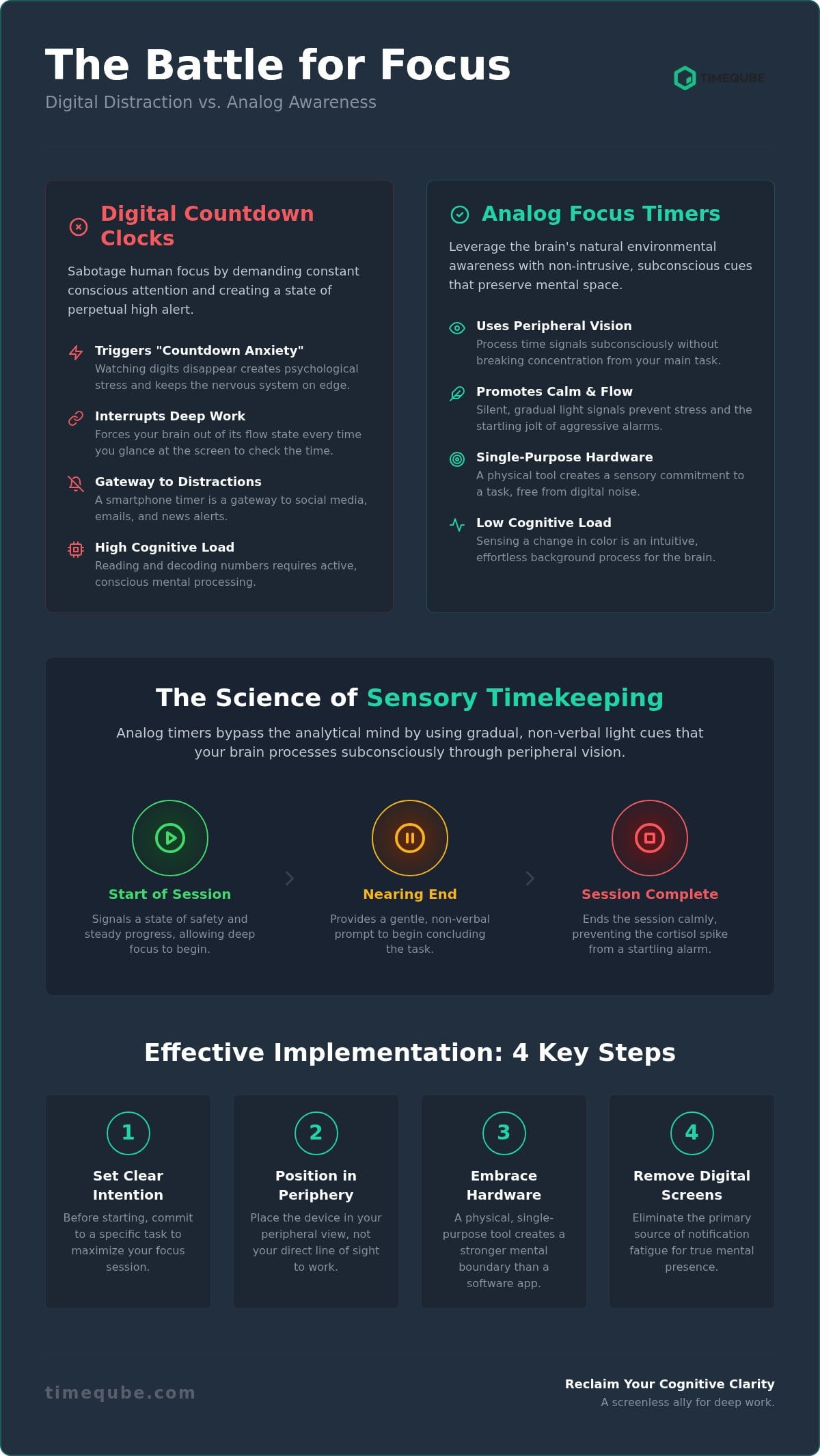
Integrating an analog focus timer into your daily routine is a deliberate act of cognitive hygiene. It requires a structured approach to ensure the tool supports your focus rather than becoming another source of noise. Following a simple four-step framework allows you to maximize the psychological benefits of sensory-based timekeeping. This process moves time management from an active stressor to a subconscious support system.
Step 1 involves setting a clear intention. Define your duration before the task begins. This conscious pre-commitment helps the brain transition into a state of readiness. Step 2 focuses on spatial awareness. Place the device in your peripheral vision, not your direct line of sight. This positioning allows you to monitor the passage of time subconsciously; it preserves your central flow state by removing the need for direct eye contact with a clock. You stay immersed in the task while remaining aware of the environment.
The third step is behavioral. Respond to color shifts, such as Amber, as a gentle prompt to wrap up. It shouldn’t be viewed as a hard stop that causes panic. Instead, it’s a transition phase that respects the natural rhythm of your work. Finally, Step 4 is about recovery. Use the Red signal as a permission to rest. This protects your mental energy and prevents the burnout associated with back-to-back high-intensity tasks. Honoring the break is just as important as honoring the work session itself.
Optimizing Therapy and Coaching Sessions
A tactile time management device for mind/body therapies keeps the focus entirely on the client. Checking a watch or a phone during a session can signal a lack of presence or a rush to finish. Visual cues provide a transparent way to manage time that builds trust between the practitioner and the client. Practitioners can end sessions gracefully by following the silent, color-coded transitions. This creates a professional harmony where the client feels heard until the very last moment of the encounter. It replaces the anxiety of “watching the clock” with a shared, peaceful awareness.
Revolutionizing Corporate Meetings
Using a professional meeting timer keeps agendas on track without the need for aggressive interruptions. Meeting fatigue often stems from a lack of visual pacing and the stress of open-ended discussions. When everyone in a room can see the time remaining through a shared color signal, it democratizes time management. There’s no longer a need for a designated timekeeper to interrupt the flow of conversation. The subtle shift from Green to Amber allows the team to conclude their points naturally. If you’re looking to upgrade your office culture, you can explore the range of visual timers designed for modern business environments.
Timeqube: The Evolution of the Analog Focus Timer
Timeqube represents the pinnacle of intentional timekeeping. It’s a tool born from the necessity of silence and the clarity of light. The philosophy is simple: minimalist design must meet cognitive science to be truly effective. Unlike digital alternatives, Timeqube is a hardware-first solution. It will never include distracting screens or complex menus. This commitment to simplicity ensures that your mental energy remains where it belongs: on your work. By removing the digital interface, you remove the primary source of time-related anxiety.
A high-quality analog focus timer should be an unobtrusive ally. Timeqube is built with professional durability in mind. It’s designed to last throughout your 2026 career goals and beyond. Whether you’re in a high-stakes boardroom or a tranquil therapy room, the device provides a sophisticated presence. It doesn’t just measure time; it creates an environment of professional harmony. This is the evolution of time management, where technology serves human biology rather than competing with it.
A Tool for Every Professional Setting
The Timeqube for Business model acts as a physical focus beacon on your desk. It serves as a visual anchor that signals your commitment to deep work. When colleagues see the steady green glow, they understand that you’re in a state of flow. This non-verbal communication reduces interruptions and fosters a culture of respect for deep focus. Visual cues are the final piece of the productivity puzzle. They provide the awareness you need without the friction of checking a clock or a phone.
Your Next Step Toward Distraction-Free Work
Reclaiming your focus starts with choosing the right tools for your specific environment. You can select from standard versions or explore customized Timequbes that reflect your brand identity. These devices integrate seamlessly into a physical Pomodoro timer workflow. They provide the tactile and visual feedback necessary to sustain long-term productivity without the cognitive drain of digital digits.
Transitioning to an analog focus timer is more than a change in equipment. It’s a move toward a more mindful, focused professional life. Join the movement of professionals who prioritize mental well-being alongside high performance. Your journey toward a distraction-free environment begins with a single, glowing cube. For those in clinical roles, the Timeqube for mind and body therapies offers the specialized support needed to manage sessions with quiet confidence and professional grace.
Mastering the Flow of Your Professional Day
Transitioning from aggressive digital countdowns to intuitive sensory cues is a fundamental shift in cognitive hygiene. By leveraging scientific peripheral vision technology, you remove the constant friction of manual time-checking. This approach fosters a state of professional harmony where deep focus is sustained rather than forced. It moves time management from an active stressor to a quiet, subconscious support system that respects your biological limits.
Choosing an analog focus timer is a deliberate step toward reclaiming your mental space. You don’t have to settle for the notification fatigue and anxiety inherent in screen-based tools. A physical, hardware-only design ensures that your attention remains entirely on your work or your client. This method is already trusted by therapists and corporate leaders worldwide who prioritize mental well-being alongside high performance. It’s the final piece of a sophisticated productivity puzzle.
The path to distraction-free work is clear and attainable. Upgrade your focus with the Timeqube Visual Timer today. You have the power to master your schedule without sacrificing your internal peace. Embrace a future where productivity and tranquility coexist effortlessly.
Frequently Asked Questions
Is an analog focus timer better than a phone app for ADHD?
Physical timers are significantly more effective for ADHD because they remove the gateway to digital distractions. A phone app exists on a device filled with notifications and social media triggers that easily derail focus. An analog focus timer provides a single-purpose sanctuary. It acts as a dedicated focus beacon that doesn’t require you to interact with a screen; this reduces the risk of accidental task-switching and cognitive overload.
How does a tactile time management device differ from a standard clock?
Standard clocks require your brain to perform active mathematical decoding of digits or hands. This increases your cognitive load and interrupts flow. A tactile device uses sensory cues like color-coded light to communicate time subconsciously. You transition from “checking the clock” to “sensing the time.” This shift preserves your mental energy for the task at hand rather than wasting it on constant time-monitoring calculations.
Can I use a visual timer for professional therapy sessions?
Visual timers are ideal for professional therapy because they maintain the sanctuary of the session. Checking a watch or phone can feel dismissive to a client. A silent, light-based timer provides transparent timekeeping that both the practitioner and client can see in their peripheral vision. This builds trust and ensures sessions end gracefully without the jarring interruption of a mechanical alarm or the distraction of a digital screen.
Why does peripheral vision matter for time management?
Peripheral vision allows your brain to monitor environmental changes without breaking your central focus. While your eyes are locked on your work, your brain still processes color shifts in the room. Using an analog focus timer leverages this biological trait to signal time subconsciously. This prevents the “tab-switching tax” on your attention. You stay immersed in deep work while remaining aware of your remaining time through gentle, non-verbal cues.
Do analog focus timers make noise during operation?
Modern light-based timers are completely silent. Mechanical versions often produce a rhythmic ticking that can become an auditory distraction or a source of anxiety. Silent operation is essential for deep work and therapeutic environments where noise can trigger a startle response. By removing sound, these devices foster a tranquil atmosphere. They allow you to focus on complex problem-solving or sensitive conversations without the pressure of a ticking metronome.
How do I choose the right duration for deep work sessions?
Duration choice depends on your specific task and cognitive endurance. Many professionals use 25-minute intervals for administrative tasks or 90-minute blocks for creative problem-solving. The key is setting your intention before the session begins. A physical hardware device allows you to select a preset duration quickly. This ritual creates a mental boundary that signals the start of a dedicated focus period, making it easier to enter a deep work state.
Are light-based timers effective for corporate meetings?
Light-based timers democratize time management in group settings by providing a shared visual reference. When everyone sees the transition from Green to Amber, the group naturally begins to wrap up discussions without a human timekeeper needing to interrupt. This reduces meeting fatigue and keeps agendas on track. It removes the friction of “policing” time, allowing the team to focus on collaborative results while respecting everyone’s schedule through clear, silent signals. If you’re evaluating options for your office, the non distracting office timer FAQ guide addresses the most common professional concerns about making the switch.
Will a physical timer clutter my desk or improve my setup?
A minimalist hardware timer improves your setup by creating a dedicated “focus station.” It replaces the digital clutter of open tabs and phone notifications with a single, elegant object. This physical presence serves as a psychological anchor for productivity. It helps establish a clear boundary between your work environment and your rest space. The sophisticated design of a professional timer adds an air of intentionality and professional harmony to any modern workspace.