

What if staying present in a long meeting depended less on trying harder and more on removing distractions? If you’re wondering how to stay present in long meetings, you’re not alone. Repeated updates, unclear agendas, and the pull of a phone can make it difficult to follow a discussion from start to finish. Attention naturally shifts, especially when a meeting offers few pauses or clear points of focus.
Long meetings can leave even thoughtful participants feeling mentally distant. Rather than trying to force constant concentration, build a few habits that help you return to the conversation, contribute when it matters, and leave knowing what was decided.
This guide covers how to set a simple intention, take notes that support active listening, and use pauses to reset your attention. You’ll also learn how to reduce digital multitasking and make time more visible. A physical visual timer, such as Timeqube for Business Meetings, provides an ambient time cue without requiring another screen check. These approaches are designed for real workplace meetings, not perfect focus.
Key Takeaways
- Learn how to stay present in long meetings by treating attention as something you can gently return to, not something you must hold perfectly.
- Before joining, identify the meeting’s purpose, the contribution you can make, and one question you want answered.
- Use discreet listening habits and brief mental resets to reconnect when your thoughts drift.
- Make extended discussions easier to follow with clear agenda segments, topic transitions, and planned pauses.
- After the meeting, note one useful decision or follow-up to build a steady routine without judging your concentration.
How to Stay Focused During Long Meetings
Attention can drift during a long meeting, especially when discussion is dense, updates repeat, or the purpose of a segment is unclear. That shift isn’t proof that you’re careless or disengaged. Sustained listening takes effort, and notifications, fatigue, or a passive role can make it harder to follow the thread.
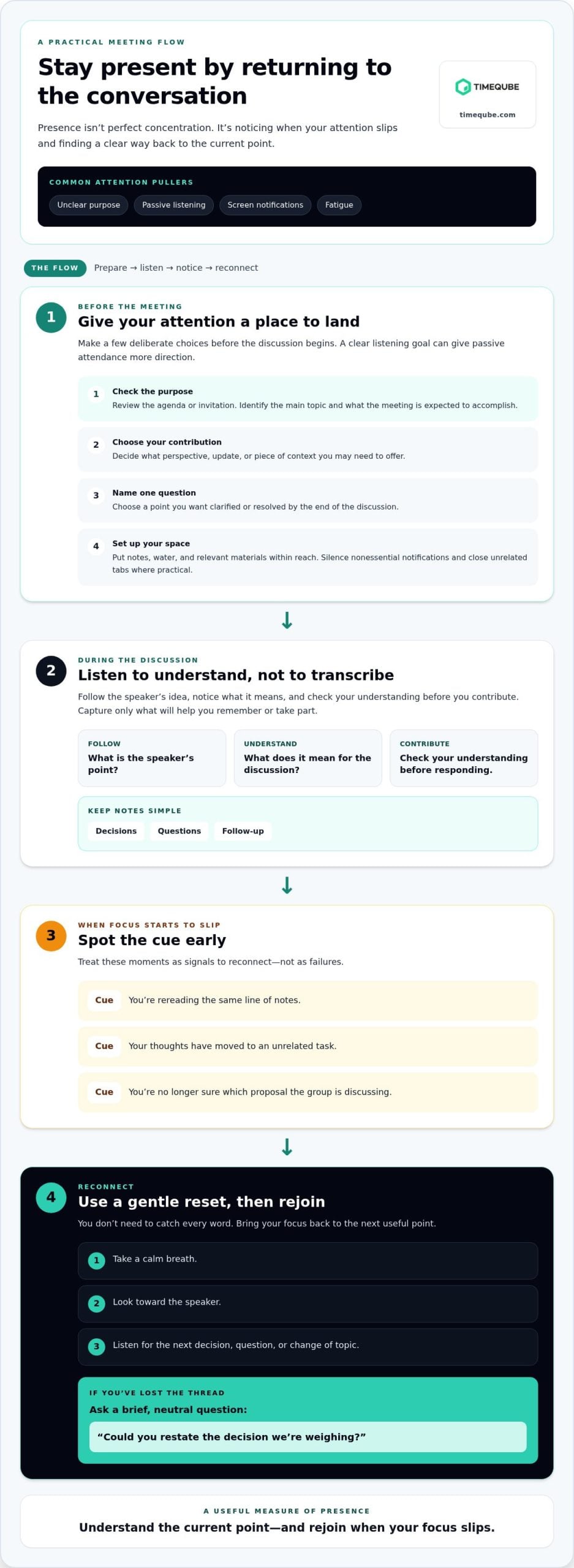
Presence doesn’t mean concentrating perfectly every minute. It means noticing when your attention has wandered and bringing it back. A practical definition is simple: meeting presence is listening closely enough to understand the current point and rejoin the discussion when your focus slips. That’s a more useful standard than expecting uninterrupted concentration.
Why long meetings make it harder to stay mentally engaged
Long meetings often ask you to absorb information, compare viewpoints, and track decisions across several topics. Sustained listening can feel demanding, particularly when you have little opportunity to contribute. The phrase attention span can suggest one fixed limit, but attention is studied in different ways and varies with the task and circumstances. A brief lapse is different from being unable to follow the discussion or feeling persistently disengaged.
Notice what may be contributing. An unclear purpose can leave you unsure what deserves focus. Passive listening can make it easy to drift, while screen notifications compete for attention. Fatigue can also make it harder to process new information. Naming the likely cause helps you choose a response instead of blaming yourself.
Notice the early signs of attention drift
Attention often slips before you realize you’ve lost the thread. You may notice that you’re rereading the same line of notes, thinking about an unrelated task, or no longer know which proposal the group is discussing. Treat these as cues, not failures. Take a calm breath, look toward the speaker, and listen for the next decision, question, or change of topic.
If you’ve missed too much to reconnect, ask a brief, neutral question to clarify the point. For example: “Could you restate the decision we’re weighing?” This helps distinguish a passing lapse from genuine confusion. The aim isn’t to catch every word. It’s to return to the conversation without self-criticism or another digital distraction.
Prepare Your Mind Before a Long Meeting Begins
A few minutes of preparation can give your attention a clear place to land. Instead of joining with every task still competing for your thoughts, connect the meeting to its purpose and decide what you need to listen for. You don’t need another app or a complicated routine. Make a few deliberate choices before the discussion begins.
Set a clear intention and a listening goal
Start by asking why your presence matters in this meeting. You may need to weigh a proposal, share a perspective, or understand a decision that affects your team. Then choose one listening goal. For example, track which decisions are final or note the questions that remain open. A specific goal gives passive attendance more direction without requiring you to speak constantly.
Try this short routine before joining:
- 1. Check the purpose. Review the agenda or invitation. Identify the main topic and what the meeting is expected to accomplish.
- 2. Choose your contribution. Decide what perspective, update, or piece of context you may need to offer.
- 3. Name one question. Choose a point you want clarified or resolved by the end of the discussion.
- 4. Set up your space. Put your notes, water, and relevant materials within reach. Silence nonessential notifications and close unrelated tabs where practical.
Keep your notes simple. Headings such as “decisions,” “questions,” and “follow-up” help you capture the essentials without turning note-taking into a second task. Listen first, and record only what will help you contribute or remember what happens next.
Reduce distractions before they compete for attention
If you’re joining remotely, prepare your workspace before the call starts. Close unrelated browser windows, keep meeting materials visible, and place your phone out of immediate reach if you don’t need it. In person, clear unnecessary items from your immediate workspace. These adjustments reduce the number of cues pulling your attention away from the conversation.
Preparation also includes the wider environment. For ideas on creating a calmer setting, explore this mindful workplace tools guide. If a physical, non-digital time cue fits your meeting setup, explore Timeqube for business meetings. It makes time visible without asking participants to check another screen, while the meeting’s purpose and the group’s participation keep the discussion on track.
Arriving knowing what matters, what you may contribute, and what you’re listening for is a practical first step in learning how to stay present in long meetings. Then let the conversation guide your attention.
Use Active Listening and Gentle Resets to Reconnect
Staying engaged doesn’t require uninterrupted concentration or a transcript of every comment. Constant note-taking can pull your attention from the speaker and leave you with pages of detail but little sense of what matters. Active listening gives you a lighter task: follow the idea, notice what it means, and capture only the points you need to remember.
The Center for Creative Leadership describes active listening as listening to understand, rather than simply waiting to respond. In practice, attend to the speaker’s point and check your understanding before you contribute.
Turn passive listening into a simple participation task
As someone speaks, quietly track three things: their main point, the reasoning behind it, and the next step they’re asking the group to consider. You don’t need to write each one down. This simple frame gives your attention something useful to follow, even when you’re not the person speaking.
Keep written notes brief. Record decisions, assigned responsibilities, and unresolved questions. If a point is important but unclear, paraphrase it in a sentence: “So the proposal is to delay the decision until the revised forecast is ready?” A concise summary can confirm your understanding and help the group spot a gap without derailing the conversation. Use it when it adds clarity, not after every comment.
Reset attention without making the meeting about you
When you notice your focus slipping, respond quietly. Take one comfortable breath, turn your attention back to the current speaker, and identify the point they’re making now. You don’t need to retrace every sentence you missed. Listen for the next key idea, decision, or question, then rejoin from there.
If the meeting format allows it, shift your posture or stretch discreetly. A small physical change can mark a fresh moment of attention without interrupting anyone. If you’ve genuinely lost the discussion, ask a focused question rather than pretending to follow. For example:
- “Could you clarify which option the group is considering?”
- “What needs to be resolved before we can make this decision?”
- “Have we assigned an owner for that follow-up?”
A practical approach to how to stay present in long meetings is to make listening active, notice when attention wanders, and return without judgment. Presence is not a performance. It’s the repeated choice to reconnect with the conversation.
Make Long Meetings Easier with Breaks, Structure, and Shared Time Cues
Staying present isn’t only an individual task. Meeting structure can make it easier to follow the discussion and know what deserves attention. A clear agenda, visible transitions, and a shared sense of time help participants understand where the conversation is going.
Use structure to make the discussion easier to follow
At the start, the facilitator can state the meeting’s purpose, agenda, key decision points, and expected finish. Group related topics together, then signal each transition clearly: “We’ve finished the budget review. Next, we’ll consider the hiring proposal.” Participants can shift their attention with the discussion instead of guessing what comes next.
At the end of each section, briefly summarize decisions and invite focused questions before moving on. For a long meeting, consider a short break or topic reset between substantial sections. These are facilitation choices, not rigid rules. A natural pause may suit one group, while a concise recap may be more useful when the agenda is tight or the conversation is flowing well.
Choose time cues that inform without creating pressure
Repeatedly checking a phone or laptop clock can draw attention away from the room. An ambient visual cue offers another option: it keeps time awareness shared without requiring each participant to look at a screen. Timeqube for Business Meetings uses physical, color-coded light signals to make time visible. The cue supports time awareness without dictating the pace or implying that a complex discussion must be rushed.
The facilitator can use a visible cue alongside clear agenda segments, while still allowing room for necessary questions and decisions. The aim is to make time easier to notice, not to let a timer replace judgment. For more context on visual cues, read the professional meeting timer science guide.
To add a physical visual timer to your meeting room, view Timeqube for Business Meetings. Alongside thoughtful structure and breaks suited to the group, a shared time cue can support focus during long meetings.
Build a Sustainable Routine for Staying Present in Future Meetings
Presence is easier to sustain when it becomes a flexible routine, not another standard to meet perfectly. Adapt these steps to your role, whether you’re leading the discussion or contributing as a participant. The aim is to support useful attention before, during, and after the meeting.
Create a repeatable before-during-after practice
- Before: Review the meeting’s purpose and choose one listening goal. You might focus on decisions, risks, or questions the group needs to resolve.
- During: Notice when your attention drifts. Take a quiet breath, return to the current speaker, and record key decisions or follow-ups rather than trying to capture every word.
- After: Write down one useful decision or action. Then choose one small adjustment for next time, such as silencing notifications or asking for clarification sooner.
This brief review helps you learn from the meeting without turning concentration into a pass-or-fail test. If you missed a point, identify what would help you reconnect next time. Perhaps you need to keep the agenda visible, take fewer notes, or clarify your role before the discussion begins. Small changes are easier to repeat than a complete overhaul.
Consider a low-distraction visual timer for shared awareness
In an in-person professional meeting, a physical visual timer can sit where participants can see it without checking a phone or screen. Timeqube uses color-coded light signals to make time visible as a shared cue. It suits meeting rooms where the facilitator wants participants to have a common reference for time while keeping the discussion itself in focus.
A visual cue is one support, not a replacement for a clear agenda, thoughtful facilitation, breaks when the group needs them, or active participation. Use it to inform, not pressure: the group still needs room to examine a complex issue or ask an important question. This balanced approach makes staying present in long meetings a repeatable practice rather than a demand for constant focus.
For an in-person meeting, explore the Timeqube meeting timer as a non-digital way to support shared time awareness.
Carry a Calmer Approach Into Your Next Meeting
Learning how to stay present in long meetings isn’t about holding perfect focus. It’s about setting a simple intention, listening for the point that matters, and returning your attention without self-criticism when it wanders. Clear agendas, useful pauses, and concise notes can make that practice easier to sustain.
Choose one meeting habit to try next time. Review the purpose beforehand, track decisions instead of every comment, or pause to reset between topics. For shared time awareness, a physical meeting timer offers a non-digital cue. Timeqube uses color-coded light signals and is designed for professional meetings without digital timer software. It complements thoughtful facilitation, but doesn’t replace participation or breaks.
Explore the Timeqube meeting timer to bring a physical option for making time visible into your meeting space. Start with one small adjustment and build from there.
Frequently Asked Questions
Why is it hard to stay present in long meetings?
Long meetings can be demanding because they require sustained listening, processing new information, and following shifts between topics. An unclear purpose or passive discussion may make it harder to know what deserves attention. Notifications and fatigue can add distractions. Attention drifting briefly is normal, but if you’re repeatedly losing the thread, a clear agenda, a pause, or a clarifying question can help you rejoin.
How can I stay focused in a meeting without taking constant notes?
Listen for the speaker’s main point, the reasoning behind it, and the next step they’re proposing. Write down only what you’ll need later, such as a decision, an owner, or an unresolved question. For example, use three short note labels: “decision,” “follow-up,” and “open question.” This keeps your attention on the discussion instead of turning note-taking into a second task.
Can short breaks help people stay present in long meetings?
Short breaks can offer a useful pause during a long meeting, especially when participants need time to reset or switch topics. They aren’t a rigid requirement for every session. The facilitator can consider the meeting’s length, agenda, and group needs. If a break isn’t practical, a brief topic reset or summary of the last decision can also help people shift attention and follow what comes next.
What should I do when my mind wanders during a meeting?
Notice the lapse without criticizing yourself, then gently return your attention to the current speaker. Take a comfortable breath and listen for the next point, question, or decision rather than trying to reconstruct every missed word. If you’ve lost the discussion, ask a concise question such as, “Which option are we considering?” This is a practical part of how to stay present in long meetings.
How can a meeting facilitator help participants stay engaged?
A facilitator can make participation easier by stating the purpose, agenda, decision points, and expected finish at the start. Group related topics and announce transitions so people know where the conversation is going. Between sections, summarize decisions, confirm responsibilities, and invite brief questions. For a lengthy discussion, consider a suitable break or topic reset. These practices create structure without requiring participants to concentrate perfectly.
Do visual timers help people stay present in meetings?
A visual timer can provide a shared time cue without asking participants to check a phone or screen. Timeqube is physical timer hardware for professional meetings, using color-coded light signals for time awareness without digital timer software. It supports thoughtful facilitation, but doesn’t guarantee attention or replace clear agendas, breaks, and participation. Treat it as an optional aid, not a signal to rush discussion.
Is it possible to stay present in a long virtual meeting?
Yes. Before joining, close unrelated browser windows, silence nonessential notifications, and keep only the meeting materials you need visible. Choose a listening goal, such as tracking decisions or open questions. During the call, take brief notes and use a quiet breath or posture shift to reset if focus drifts. If the discussion becomes unclear, ask a specific question rather than multitasking while you try to catch up.