

What if the most advanced technology for your productivity isn’t a digital app, but a physical object that requires no screen at all? You likely feel the persistent tug of notification anxiety every time you glance at your phone to check the time. Digital eye strain and the friction of switching between browser tabs often derail your deepest work sessions. Integrating non-digital time management devices into your workspace offers a path to clarity. These tools remove the cognitive load associated with multitasking. They allow your brain to focus on the task at hand rather than the device itself.
It’s understandable to feel overwhelmed by an “always-on” environment that demands your constant attention. You deserve a workspace that respects your mental boundaries and fosters intentionality. This article explores how physical, tech-free tools can eliminate digital distractions and reduce stress during timed tasks. We’ll examine the leading tactile solutions for 2026, from light-based signals to mechanical countdowns, designed to build a subconscious awareness of time passing. You’ll discover how to create a professional environment that prioritizes your cognitive well-being.
Key Takeaways
- Leveraging peripheral vision allows the brain to monitor time without interrupting deep flow states.
- Discover the spectrum of non-digital time management devices and why hardware-only solutions reduce cognitive friction.
- Silent, light-based alternatives preserve mental space by removing the distracting ticking found in traditional mechanical timers.
- Strategic placement of physical timers signals boundaries to colleagues and reinforces your personal zone of focus.
- Transitioning to a tech-free timing system eliminates the micro-stress responses triggered by aggressive digital alarms.
What Are Non-Digital Time Management Devices?
Non-digital time management devices are tangible hardware tools designed to track time without the use of internet connectivity, screens, or notification systems. These devices range from traditional mechanical tools to sophisticated light-based systems. Their primary purpose is to eliminate the “cognitive switching” that occurs when you check a digital device for the time. Every time you unlock a phone or glance at a computer clock, you risk exposure to distracting stimuli. Physical tools provide a dedicated, single-purpose anchor for your attention. They allow the brain to process temporal information through direct sensory stimuli rather than abstract data.
The “Tech-Free” movement is gaining traction among high-performance professionals. In a 2026 workspace defined by digital overwhelm, physical objects offer a sanctuary for the mind. By delegating time tracking to an external, non-digital object, you free up mental bandwidth for complex problem-solving. This shift acknowledges a simple biological reality: our brains aren’t designed to filter out the infinite distractions of a networked device. Removing the friction of digital interfaces leads to a more professional harmony between your work and your mental space.
The Difference Between Analog Clocks and Visual Timers
Analog clocks and visual timers serve distinct psychological roles. An analog clock tracks the current time of day. This often triggers external pressures and scheduling anxieties. In contrast, visual timers measure the duration of a specific flow state. Observing numbers countdown can create a micro-stress response. The brain focuses on the disappearing digits rather than the task itself. Abstract visual cues, such as changing colors or shifting sand, allow for a more tranquil awareness of passing time. This method respects human perception by focusing on presence rather than deadline-driven fear. Tactile feedback also helps ground your focus in the present moment.
Common Categories of Physical Timers
Selecting the right tool depends on your specific cognitive needs and the environment you’re working in.
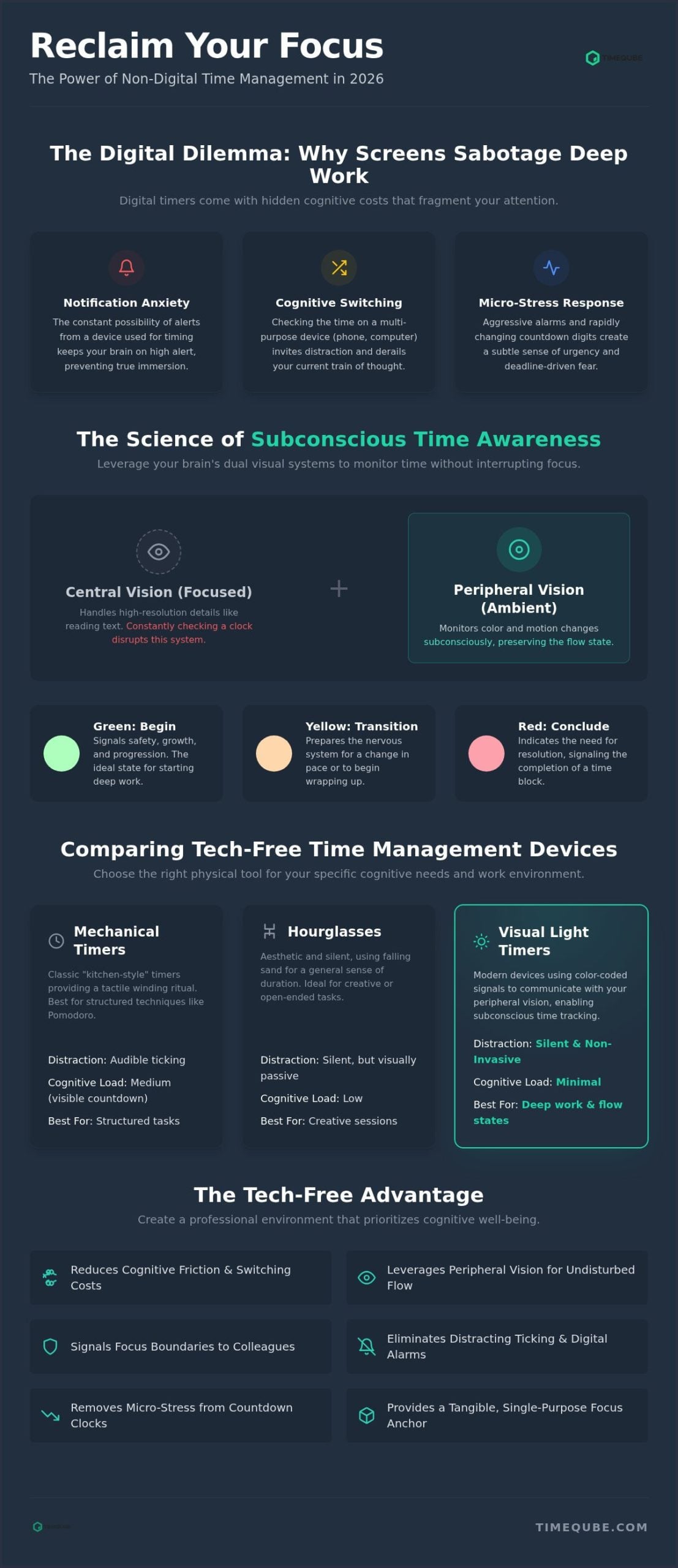
- Mechanical Timers: These are the classic kitchen-style devices that inspired The Pomodoro Technique. They’re reliable and offer a physical “winding” ritual that signals the start of work.
- Hourglasses: These use falling sand to track time. They’re aesthetically pleasing and offer low-precision tracking. This is ideal for creative tasks requiring a general sense of duration rather than exact seconds.
- Visual Light Timers: These modern non-digital time management devices use color-coded signals to communicate time status through your peripheral vision. This method allows your subconscious to monitor the session without breaking your central focus.
The Science of Subconscious Time Awareness
Peripheral awareness is the brain’s ability to process environmental changes without shifting focus. Humans possess a dual-track visual system. Central vision handles high-resolution details, such as reading text or writing code. Peripheral vision monitors the surroundings for motion and color changes. When you use non-digital time management devices that rely on light rather than numbers, you leverage this biological hierarchy. You stay immersed in your work while your brain subconsciously registers the passage of time. This method respects your mental space and prevents the disruption of your flow state.
Digital clocks present a constant stream of changing data. This “flicker” effect forces the brain to re-evaluate the environment every second. These micro-adjustments trigger subtle stress responses. They pull your attention away from deep work to process the disappearing digits. In contrast, a steady glow or a slow-moving physical object provides a stable sensory anchor. It removes the urgency of a ticking clock and replaces it with a calm, professional presence. Integrating non-digital time management devices into your workspace allows you to reclaim your mental space from these digital interruptions.
The brain responds to color with primal efficiency. Our nervous systems are hardwired to recognize specific chromatic signals:
- Green: Signals a state of safety, growth, and steady progression.
- Yellow: Prepares the nervous system for a transition or a change in pace.
- Red: Indicates the need for resolution and the completion of a task.
These are universal biological cues. They don’t require conscious translation or numerical analysis. They simply speak to the subconscious mind.
Reducing Cognitive Load with Sensory Cues
Digital interfaces compete for your limited working memory. Every time you check a phone clock, you inadvertently process notifications and UI elements. This creates cognitive friction. The Zeigarnik Effect suggests that unfinished tasks create mental tension. Physical timers help close these loops by providing a visible end-point to a session. For deeper insight, you can explore The Science of the Professional Meeting Timer. If you want to maintain professional harmony in clinical settings, consider using a Timeqube for Mind/Body Therapies.
Time Management for Neurodiversity
For individuals with ADHD, “time blindness” makes abstract numbers difficult to process. Traditional alarms are often jarring and intrusive. They cause an “alarm fatigue” that leads to avoidance. Visual, tech-free cues offer a gentle nudge instead. They make the abstract concept of time tangible and visible in the periphery. This approach is highly effective for Time Management for Neurodiversity because it reduces the anxiety of transitioning between tasks.
Comparing Non-Digital Time Management Devices
Selecting the right tool requires a careful evaluation of your cognitive environment. While the goal is to remove screen-based friction, the physical tool you select must not introduce new distractions. Three primary factors determine the effectiveness of these tools: distraction level, precision, and ease of use. A tool that requires constant manual adjustment or creates intrusive noise can be just as detrimental to deep focus as a smartphone notification. High-performance environments demand solutions that integrate seamlessly into the background of your awareness. The focus should remain on the work, not the device.
Professional settings are increasingly moving away from cheap analog alternatives in favor of high-end hardware. This shift reflects a desire for professional harmony. A plastic kitchen timer might function, but it lacks the minimalist elegance and clinical precision required for a sophisticated workspace. The quality of non-digital time management devices signals the value you place on your own mental space. In corporate boardrooms, the choice of hardware impacts the collective focus of the group. A sophisticated device fosters an atmosphere of intentionality and calm authority.
Sand Timers vs. Mechanical Clocks
Traditional hourglasses offer a beautiful, tactile experience for deep work sessions. They are completely silent. They provide a clear visual representation of time passing. However, they lack precision. You cannot easily adjust the duration, and there is no signal when time has expired. This requires you to check the device frequently. Frequent checking disrupts your flow state. Mechanical clocks are more precise but often introduce the hidden cost of ticking. This rhythmic sound distracts. The brain naturally syncs to the beat, pulling your attention away from complex tasks. In a quiet office, a mechanical tick can feel like a relentless countdown. It increases anxiety rather than reducing it.
Visual Light Timers: The Modern Hardware Choice
Visual light timers represent the evolution of time management hardware. These devices bridge the gap between analog simplicity and modern precision. By using color-coded signals instead of ticking hands or digital numbers, they provide a silent transition between work phases. This is particularly beneficial in open offices or sensitive environments where silence is essential. A gentle change from green to yellow allows for a subconscious adjustment to your pace. There is no jarring alarm to break your concentration. For organizations looking to improve productivity during collaborations, Timeqube for Business Meetings offers a sophisticated way to manage group dynamics. This approach ensures that the focus remains on the discussion rather than the clock. It creates a stress-free environment for all participants.
Implementation: How to Use Physical Timers in Professional Settings
Effective implementation of non-digital time management devices requires more than simply placing an object on a desk. It involves a deliberate reorganization of your physical and social environment. By following a structured approach, you can maximize the psychological benefits of tech-free timing. This process ensures that the device supports your focus rather than becoming another source of sensory clutter. Using non-digital time management devices correctly turns a simple tool into a powerful anchor for deep work.
Step 1: Identify your ‘Zone of Focus.’ Position the device within your peripheral vision, approximately 30 to 45 degrees from your central line of sight. This placement allows your brain to monitor the passage of time subconsciously. You don’t need to look directly at the timer to understand your progress. Step 2: Set boundaries with colleagues. A physical timer serves as a clear, non-verbal “Do Not Disturb” signal. When the device is active, it communicates that you’re in a deep work session. This reduces interruptions and protects your mental space. Step 3: Align signals with meeting phases. During collaborative sessions, use color transitions to guide the group. Assign green to the introduction, yellow to the core discussion, and red to the wrap-up. This creates a natural rhythm for the conversation. Step 4: Conduct a ‘tech-free’ audit. Remove competing digital cues from your immediate workspace. Turn off secondary monitors and place your smartphone out of reach. A clean, focused desk reinforces the authority of your physical timer.
Strategies for Mind/Body Therapies
In clinical settings, maintaining a tranquil atmosphere is paramount. Therapists must track time without breaking the empathetic connection with a client. Checking a watch or phone is often perceived as dismissive or hurried. Using gentle light transitions allows you to stay informed while remaining fully present. This method signals the conclusion of a session without the jarring intrusion of an audible alarm. It respects the client’s mental state and preserves the flow of the session. To create a more supportive environment for your practice, consider the Timeqube for Mind/Body Therapies.
Branding and Corporate Culture
Physical devices are powerful symbols of a company’s commitment to mental well-being. They demonstrate that the organization values deep focus over constant availability. Integrating these tools into the office landscape helps establish a culture of intentionality. You can further reinforce this identity by customizing the hardware. This ensures the device feels like a natural extension of the workspace. Discover how to align your productivity tools with your brand through Custom Logo Meeting Timers. This approach fosters professional harmony across the entire team and signals a sophisticated approach to time management.
The Logical Choice: Why Timeqube Leads the Tech-Free Revolution
Hardware-only solutions represent the final frontier of cognitive focus. Digital productivity apps fail because they reside on the very devices that generate distractions. True focus requires a physical separation between your work and your time management tools. By delegating temporal awareness to non-digital time management devices, you eliminate the possibility of notification-induced friction. This shift acknowledges the biological limitations of the human brain. It prioritizes mental space over digital complexity and fragmented attention.
The design of Timeqube follows a philosophy of stress-free productivity. Traditional timers often introduce secondary distractions that derail deep work. As discussed, mechanical ticking can break concentration, while numerical countdowns trigger micro-stress responses. Timeqube removes these variables entirely. There are no ticking sounds. There are no aggressive numbers. There are no screens to check. It provides a pure, chromatic signal that communicates through your peripheral vision. This minimalist design ensures that your central focus remains undisturbed. You maintain professional harmony throughout your deepest work sessions.
Professionals can choose between standard models and customized versions to suit their specific environment. Standard models offer a clean, unobtrusive presence for individual home offices or therapy rooms. Organizations often opt for versions featuring their corporate logo. This reinforces a brand’s commitment to mental well-being and intentionality. Both options deliver the same clinical precision. They transform time management from an active task into a subconscious background process. Reclaiming your mental space starts with non-digital time management devices designed specifically for the human brain.
A Minimalist Approach to Professional Mastery
Timeqube is more than a simple timer. It is a statement on intentionality. A desk cluttered with competing digital cues leads to a fragmented mind. Removing these cues creates a sanctuary for high-level thinking. A clean, hardware-focused workspace reduces cognitive load and fosters a sense of calm authority. When you Explore the Timeqube Range, you choose a tool that respects your mental boundaries. This minimalist approach is essential for mastering complex professional tasks in an age of constant noise.
Next Steps for a Distraction-Free Workspace
Transitioning from digital apps to physical hardware is a fundamental shift in your productivity strategy. Start by replacing your computer’s timer with a dedicated physical object. Observe how your anxiety levels decrease when you no longer fear the “flicker” of a digital clock. The long-term benefits include reduced eye strain and a more effortless transition between tasks. Your awareness of time becomes more natural and less forced. It’s time to move beyond the limitations of screen-based tracking. Get your Timeqube today and experience the clarity of a distraction-free environment.
Cultivating a Sanctuary for Deep Work
True productivity stems from a tranquil mind and a workspace free from digital friction. We’ve explored how non-digital time management devices leverage peripheral awareness to maintain your flow state without the stress of numerical countdowns. By removing screens and ticking sounds, you allow your brain to process time through natural sensory cues. This approach is already a standard for professionals in mind/body therapies who require presence and professional harmony. It’s a sophisticated shift from reactive notification-checking to intentional mastery of your mental space.
Whether you choose a model customizable with corporate logos or a standard version for your home office, the benefit remains the same. You gain a strictly hardware-only tool that ensures zero digital distractions. It’s time to align your environment with your biological needs. Reclaim your focus with a distraction-free Timeqube visual timer. Embracing a tech-free timing system is the most direct path to sustainable, high-performance work. You have the power to create a workspace that works for you.
Frequently Asked Questions
Are non-digital time management devices better for ADHD?
Non-digital time management devices are highly effective for ADHD because they make the abstract concept of time tangible. Individuals with ADHD often experience “time blindness,” where the passage of time is difficult to perceive. Visual cues provide a gentle, non-intrusive nudge that helps manage task transitions. This method reduces the anxiety associated with jarring digital alarms. It allows the user to stay present in their work while subconsciously monitoring the session’s progress.
How do visual timers work without an app or software?
These devices function as standalone hardware and don’t require external software or internet connectivity. They utilize internal electronic circuits or mechanical mechanisms to track duration. While certain specialized tasks, such as running a transaction simulation system, require specific software environments—about which you can learn more—the timer itself should remain an independent physical object. For example, a light-based timer uses pre-programmed color transitions to signal time phases. This hardware-only design ensures there are no digital notifications to disrupt your focus. You simply set the desired duration on the device itself. This maintains a completely distraction-free environment for your most important tasks.
Physical timers are ideal for professional business meetings because they establish a shared, non-verbal awareness of time. Instead of an individual checking their watch, the entire group can see the current phase through a subtle light signal. This creates professional harmony and keeps the discussion on track. It prevents meetings from overrunning without the need for an aggressive verbal interruption. It fosters a culture of respect for everyone’s time in a corporate setting.
What is the benefit of a light-based timer over a standard clock?
A light-based timer leverages peripheral vision, whereas a standard clock requires central focus. Reading numbers on a clock forces the brain to shift attention and process abstract data. This often triggers a micro-stress response. Light signals communicate through color, which the brain processes subconsciously. This allows you to monitor time without breaking your flow state. It’s a more sophisticated approach that respects the biological limitations of human perception and reduces cognitive fatigue.
Do physical timers help with screen fatigue and digital burnout?
Integrating non-digital time management devices significantly reduces screen fatigue by removing time tracking from the digital interface. Constant glancing at a computer clock or phone screen adds to the cognitive load of a digital workday. It keeps the brain in an “always-on” state that leads to burnout. Moving this function to a physical object on your desk creates a mental boundary. It allows your eyes to rest on a non-emissive surface, reducing overall digital overwhelm.
Is it possible to customize non-digital timers with a company logo?
It’s possible to customize these devices with a company logo to align with your corporate identity. This practice reinforces a company’s commitment to mental well-being and focused work. Branded timers serve as a functional symbol of intentionality in the office. They help establish a unified professional environment where deep focus is valued. Customization options allow the hardware to blend naturally into a sophisticated boardroom or a modern, professional open-office workspace. To ensure this level of branding carries over to external industry events, Zodiac Event Displays offers inspiration for high-impact banners and signage that maintain a consistent professional image.
Choosing the right duration depends on the specific cognitive demands of your task. For high-intensity focus, many professionals use 25-minute intervals. Longer sessions of 45 or 55 minutes are better suited for deep, creative work that requires extended immersion. The goal is to match the timer’s signal to your natural energy cycles. This ensures you take necessary breaks before cognitive fatigue sets in. It helps you maintain a steady, productive pace throughout the day.
Why should I avoid digital timers during therapeutic sessions?
Digital timers should be avoided during therapeutic sessions because they can disrupt the empathetic connection between therapist and client. Checking a phone or digital clock is often perceived as a sign of disengagement. It breaks the client’s state of presence. Light-based transitions offer a tranquil alternative. They provide a silent signal for the end of a session. This allows for a graceful wrap-up that respects the clinical environment and the client’s mental space.