
Unproductive meetings cost U.S. businesses an estimated $399 billion annually. This loss reflects a failure to respect the biological limitations of the human brain. You recognize the symptoms in your own office: meetings that never end on time and the persistent stress of digital countdowns. Implementing bulk meeting timers for business allows you to move beyond these digital distractions. Screens and notifications often create more anxiety than they solve.
By adopting a unified, physical approach to time, you can reduce the cognitive load on your presenters and foster a culture of natural punctuality. This 2026 guide explains how to scale visual, hardware-based timing across your entire organization. You’ll learn how to implement distraction-free cues that signal time through peripheral vision. We’ll show you how to reclaim cognitive bandwidth and create a professional, branded environment that prioritizes mental well-being. The result is an office space defined by intentionality rather than friction.
Key Takeaways
- Quantify the hidden financial losses of unproductive meetings and the psychological toll of transition fatigue.
- Apply cognitive science to time management by leveraging peripheral vision and subconscious color-coded cues.
- Streamline your organizational workflow by implementing bulk meeting timers for business across diverse meeting environments.
- Compare the high-performance ROI of dedicated hardware against the friction and fatigue caused by digital notification cycles.
- Elevate corporate identity with customized hardware that functions as a sophisticated executive wellness tool.
The Hidden Cost of Meeting Overruns in Modern Business
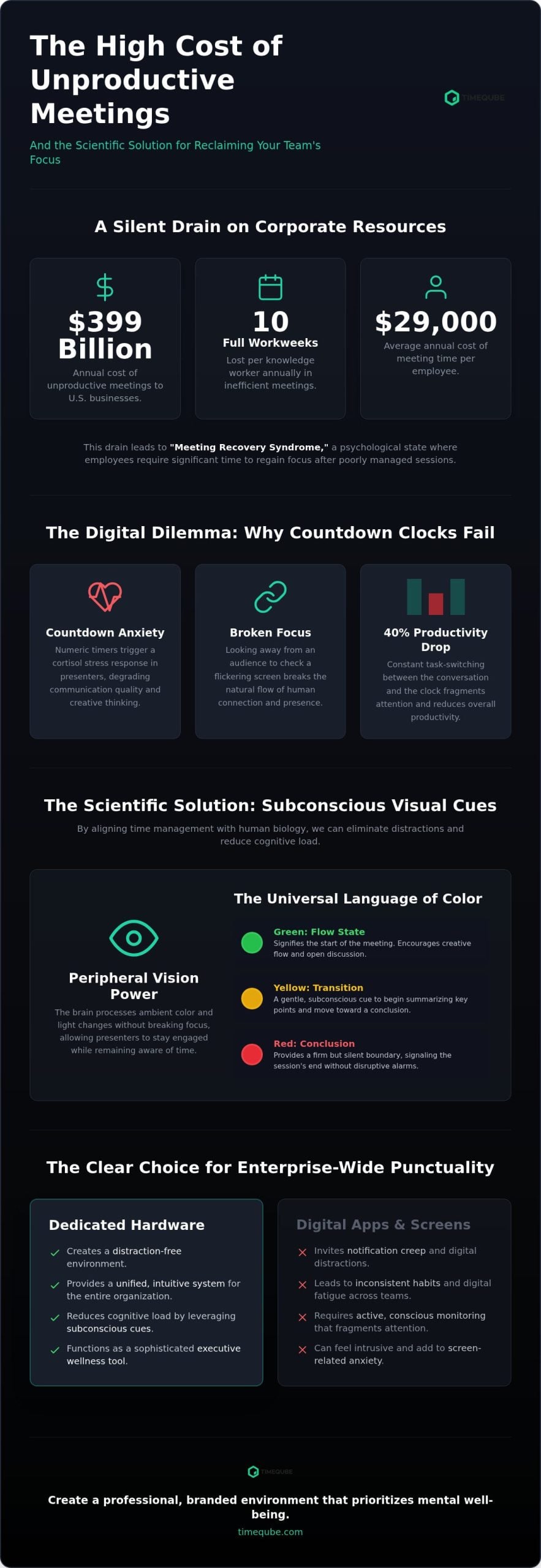
Unproductive meetings are a silent drain on corporate resources. According to Speakwise data from March 2026, these inefficiencies cost U.S. businesses an estimated $399 billion annually. For the average knowledge worker, this translates to 392 hours spent in sessions every year, or ten full workweeks. When meetings overrun, the cost isn’t just financial. It triggers “meeting recovery syndrome,” a psychological state where employees require significant time to regain focus after a poorly managed session. Research indicates that the average employee’s meeting time costs their company $29,000 per year, making time management a critical executive priority. Traditional wall clocks fail to solve this because they require active, conscious monitoring. This creates a cognitive tax that modern 2026 corporate cultures are looking to eliminate through mindful time management.
The Problem with Digital Countdowns
Digital countdowns often exacerbate the very problem they aim to solve. Numeric timers trigger a cortisol response in presenters, leading to “countdown anxiety” that degrades the quality of communication. Looking away from an audience to check a flickering screen breaks the natural flow of human connection and presence. While many organizations attempt to apply timeboxing principles to their agendas, the tools used often introduce unnecessary friction. A timer should support the biological limitations of the human brain, not distract it with aggressive notifications or blinking digits. True productivity is found in the removal of these digital stressors.
Scaling Punctuality Across the Enterprise
Achieving organizational efficiency requires a consistent approach across every department. The challenge lies in implementing tools that work as effectively in a huddle room as they do in an executive boardroom or a therapy space. Relying on a fragmented mix of software apps often leads to digital fatigue and inconsistent habits across teams. Implementing bulk meeting timers for business provides a unified visual language that everyone understands intuitively. This hardware-led approach removes the need for complex training or recurring software logins. When the entire enterprise shares a single, calm method for tracking time, punctuality becomes a subconscious habit rather than a forced mandate. It allows teams to focus on the substance of their work while the environment handles the logistics of the schedule.
Why Visual Cues Outperform Digital Countdown Clocks
Human perception is optimized for environmental awareness. While digital clocks require central vision and active decoding, visual cues leverage the power of the peripheral field. This allows the brain to process information without breaking focus on the speaker or the subject matter. Subconscious timing is the ability to perceive duration through ambient light changes. By moving the awareness of time to the periphery, you reduce the cognitive load that typically accompanies strict scheduling. This shift is essential because poorly managed sessions have severe consequences for teams and organizations, often leading to deep-seated frustration and lost productivity.
Digital timers force the brain to switch tasks constantly. Every time a participant glances at a numeric countdown, their flow is interrupted. This task-switching can lead to a 40% decrease in productivity according to 2026 workplace studies. Implementing bulk meeting timers for business provides a solution that aligns with human biology. Instead of a jarring alarm or a ticking clock, teams receive a gentle, persistent signal that guides the conversation toward its conclusion without a single word being spoken.
The Psychology of Color-Coded Time
Color is a universal, subconscious language. A transition from green to red mimics natural biological signals, creating a smooth arc of awareness. This progression allows presenters to wrap up naturally. It eliminates the need for awkward verbal interruptions that often derail the momentum of a high-level discussion.
- Green: Signifies the start of creative flow and open discourse.
- Yellow: Acts as a gentle transition, signaling the need to summarize key points.
- Red: Provides a firm but silent boundary for the session’s end.
Distraction-Free Environments
The presence of screens often invites notification creep. Even a simple tablet running a timer app can become a source of distraction. Hardware-only solutions maintain the sanctity of the meeting space by removing these digital temptations. This is particularly vital in sensitive environments like mind/body therapy sessions or high-stakes strategic planning. A dedicated physical tool creates a tranquil atmosphere, ensuring that the focus remains entirely on professional discourse and presence. By standardizing these visual cues, you build an environment where focus is the default state. You can explore how these visual timers for business transform room dynamics by prioritizing mental space.
Evaluating Bulk Meeting Timer Solutions: Software vs. Hardware
Choosing the right time management tool involves more than comparing features. It requires an understanding of how tools interact with the human environment. Many organizations struggle with the decision between enterprise software licenses and hardware deployments. Implementing bulk meeting timers for business through physical hardware eliminates the administrative burden of managing user seats and recurring subscription fees. Hardware offers a predictable, long-term ROI. A durable physical device requires only minimal maintenance, while software costs accumulate indefinitely. Beyond the balance sheet, physical objects drive higher adoption rates. An app is easily buried under open windows or ignored when a notification appears. A physical timer exists in the shared reality of the room, acting as a persistent anchor for collective focus. It becomes a permanent part of the office landscape rather than a fleeting digital icon.
Security is another vital consideration for modern enterprises. Non-connected hardware provides a level of privacy that cloud-based software cannot match. In high-stakes strategic meetings or sensitive therapeutic sessions, the absence of a microphone or internet connection is a significant advantage. This removal of digital risk allows participants to engage fully without concerns about data harvesting or background processes. It fosters an environment of trust, where the only thing being monitored is the duration of the session itself. By removing the need for network connectivity, hardware ensures that your meeting data remains entirely within the physical walls of your office. For compliance departments that require similar precision and focus when tracking global regulatory changes, QuickBrief provides a structured way to manage multi-jurisdiction sanctions updates without the usual information overload.
Digital timers often introduce friction at the moment focus is most needed. Opening a browser or authenticating an app during a presentation creates a visible break in momentum. Compatibility issues between different operating systems or meeting room displays frequently lead to technical delays. These tools also suffer from an “out of sight, out of mind” problem. Once a window is minimized, the awareness of time vanishes. This leads to the very overruns the software was intended to prevent. Relying on pixels for punctuality often fails because the screen is already overcrowded with competing stimuli.
The Case for Physical Meeting Timers
A physical object provides a sense of presence that a screen cannot replicate. It occupies a specific place on the table, signaling that the meeting has a clear structure and a defined end. Operation is stripped of complexity; a single button press replaces a multi-step software configuration. This simplicity ensures that even the most tech-averse team members can manage time effectively. To understand the psychological foundations of this approach, you can explore The Science of the Professional Meeting Timer. By choosing hardware, you prioritize the mental well-being of your staff over the convenience of a digital download. Physical tools create lasting habits because they are tangible reminders of the organization’s commitment to respecting everyone’s time.
Implementation Strategy for Enterprise-Wide Time Management
Scaling productivity across an organization requires a systematic blueprint rather than a fragmented rollout. It isn’t enough to place a single device in a boardroom. To transform corporate culture, you must implement bulk meeting timers for business with a clear strategy for adoption. The first step involves a comprehensive audit of your physical workspace. Categorize rooms by their primary function, such as high-intensity huddle rooms, formal boardrooms, or quiet wellness spaces. This allows you to standardize the visual language of time so that every employee understands the signal, regardless of which department they are visiting. Consistency is the foundation of habit formation.
Once the audit is complete, training should focus on the concept of passive time awareness. Unlike traditional clocks that demand active attention, visual hardware allows participants to monitor duration through their peripheral field. Measuring the impact of this change is essential for long-term success. Organizations often find that 72% of meetings are considered ineffective before a standardized timing solution is introduced. By tracking the reduction in meeting overruns and gathering feedback on employee stress levels, you can quantify the return on your investment in mental well-being.
Choosing the Right Model for the Space
Different environments require specific hardware configurations to remain effective. For standard corporate environments and conference rooms, Timeqube for Business Meetings provides the ideal balance of visibility and minimalist design. In contrast, wellness rooms and clinical environments benefit from the specialized settings of Mind/Body Therapies, which offer a more tranquil transition of light. When calculating the quantity needed for a multi-floor office, ensure every collaborative space is equipped. A gap in the rollout can undermine the goal of a unified corporate culture. You can streamline this process by ordering customized bulk timers to ensure every room reflects your brand’s commitment to punctuality.
Integrating Timers into Corporate Culture
Success depends on setting clear expectations for how these tools are used. Timers should be viewed as an unobtrusive ally for the presenter, not a rigid enforcer. This approach is particularly beneficial for creating inclusive environments. Hardware-based visual cues support time management for neurodiversity, as they provide a clear, non-verbal structure that reduces the anxiety associated with time blindness. By removing the need for verbal interruptions, you foster a more respectful and focused dialogue across your entire team. The goal is to create a workspace where time is respected as a finite, shared resource.
Scaling Productivity with Timeqube for Business
A commitment to punctuality is a commitment to employee well-being. Visionary organizations recognize that time is a finite cognitive resource. Implementing bulk meeting timers for business signals a shift toward a more intentional workplace. Unlike software solutions that disappear when a screen is closed, physical hardware remains a permanent fixture of your professional environment. It acts as an unobtrusive ally, fostering a culture where focus is protected and mental space is respected. Choosing dedicated hardware demonstrates a sophisticated understanding of human perception and sensory stimuli. It moves the organization away from the stress of digital notifications and toward a state of professional harmony. This same focus on ease and connection is vital during company celebrations, where Bestever.pics allows for effortless photo sharing among guests. By removing the friction of technical setup, you allow teams to enter a state of flow immediately.
Your boardroom aesthetic should reflect your corporate values. Integrating Timequbes with Your Logo ensures that your brand identity is synonymous with efficiency and respect. A physical logo on a design-led device provides a tangible sense of presence that digital icons cannot replicate. It transforms a functional tool into a permanent brand asset that won’t be ignored or minimized. This integration reinforces the value of time at every level of the enterprise, from entry-level huddles to executive boardrooms. For a deeper look at harmonizing design and function, consult the Definitive Guide to Custom Logo Meeting Timers. A branded timer is more than a tool; it is a statement of organizational intentionality and professional elegance.
Next Steps for Procurement
Scaling these solutions across a national footprint requires a streamlined procurement process. Requesting a quote for bulk corporate orders allows for a tailored approach to your specific office needs. Lead times for customized hardware are managed with clinical precision to ensure timely deployment across multi-floor rollouts. You don’t have to worry about the complexities of software seat management or recurring licenses. Beyond office use, these devices serve as a high-end executive wellness gift. They offer a unique way to support the mental well-being of partners and leadership teams outside the traditional office setting. By positioning Timeqube as a central part of your productivity strategy, you remove the friction of meeting overruns and reclaim collective bandwidth. It’s time to transition from chaotic, notification-heavy schedules to a unified, visual language of time.
Reclaiming the Narrative of Time
The future of organizational efficiency depends on the removal of digital friction. By standardizing bulk meeting timers for business, you move beyond the anxiety of numeric countdowns. You embrace a human-centric approach to time management that respects the brain’s biological limits. This transition allows your teams to reclaim their cognitive bandwidth and focus entirely on the substance of their work. Every session becomes an opportunity for intentionality rather than a source of stress.
Visionary leaders and therapists worldwide already rely on this subconscious color-coded technology to maintain professional harmony. The minimalist, Red Dot-inspired design aesthetic ensures that these tools enhance your boardroom without adding to digital fatigue. It’s time to foster a unified corporate culture defined by punctuality and mental well-being. Reclaiming your focus starts with a single, elegant change to your environment. You don’t need more software; you need better awareness.
Elevate your office productivity with Timeqube for Business and transform how your organization perceives every minute. The path to a tranquil and efficient workspace is within reach.
Frequently Asked Questions
How do bulk meeting timers improve organizational productivity?
Implementing bulk meeting timers for business establishes a unified visual language across diverse departments. This consistency eliminates the confusion of varying schedules and creates a subconscious habit of punctuality. When every room uses the same color-coded signals, employees transition between sessions with less anxiety. This organizational alignment reduces the time wasted on transition fatigue and ensures that collective focus remains on high-value tasks rather than logistical overruns.
Can I customize Timequbes with my company logo for bulk orders?
Yes, customization is a core feature for enterprise clients through the Timequbes with Your Logo program. Adding a corporate logo transforms a functional tool into a permanent brand asset that reinforces your company’s commitment to respecting time. This branded hardware serves as a constant, physical reminder of professional intentionality. It provides a sophisticated look for boardrooms while maintaining the minimalist elegance required for a distraction-free work environment.
What is the benefit of a physical timer over a digital app?
Physical timers leverage peripheral vision to provide time awareness without requiring direct focus. Unlike digital apps that often cause notification fatigue, a hardware solution exists in the shared reality of the room. It eliminates the need for task-switching and prevents the stress response often triggered by numeric countdowns. A physical object anchors the meeting, providing a tranquil and steady signal that software icons cannot replicate in a busy digital landscape.
Are visual timers suitable for employees with ADHD or neurodiversity?
Visual timers are highly effective for neurodiverse employees, particularly those managing ADHD or time blindness. The non-verbal, color-coded signals provide a clear structure that is easier to process than abstract numeric clocks. This approach reduces the cognitive load and anxiety often associated with strict timeboxing. By offering a gentle, ambient transition of light, these tools create an inclusive environment where everyone can stay aware of duration without feeling overwhelmed.
Do Timeqube timers require any software installation or Wi-Fi?
Timeqube hardware is entirely standalone and does not require Wi-Fi, Bluetooth, or any software installation. This simplicity ensures that the device is ready for immediate use in any environment. The lack of connectivity also provides a significant security benefit for sensitive corporate discussions. You don’t have to worry about data privacy, network compatibility, or background updates, allowing the focus to remain entirely on the professional discourse at hand.
How long does the battery last on a professional meeting timer?
A professional meeting timer is designed for high-frequency use and typically lasts for multiple full workdays on a single charge. This long battery life ensures that the device remains reliable throughout back-to-back sessions without needing constant attention. Recharging is handled via a standard connection, maintaining the simplicity of the hardware. This durability contributes to a high long-term ROI, as the device remains functional for years without recurring maintenance.
Is there a specific model recommended for therapy or counseling sessions?
The Timeqube for Mind/Body Therapies is specifically designed for counseling and clinical environments. This model focuses on tranquil transitions of light that respect the sensitive nature of therapeutic work. It allows practitioners to monitor session duration through their peripheral vision, ensuring that the human connection with the client remains unbroken. The quiet, non-intrusive nature of the device helps maintain a calm and safe atmosphere for healing and professional reflection.
What is the typical lead time for customized bulk orders?
Lead times for customized bulk orders depend on the specific requirements of the branding and the size of the rollout. To ensure clinical precision in the customization process, it’s best to request a quote for a detailed timeline. This allows for the careful integration of your corporate logo and the preparation of the hardware for your office deployment. Standard lead times are managed efficiently to align with your organization’s productivity goals.