
What if the most effective way to track time was to stop looking at the clock? For many high-performance professionals, the traditional countdown is a source of constant stress. You’ve likely felt the spike of cortisol when a digital alarm interrupts a breakthrough. By using a non distracting office timer, you replace these jarring interruptions with a more harmonious way to stay on schedule.
It’s a common struggle to balance punctuality with deep work. You want to remain present, yet the fear of overrunning a meeting often leads to clock-watching that drains your cognitive resources. This behavior creates unnecessary friction in your day. Modern visual technology allows your brain to process time through peripheral sensory cues rather than disruptive alerts. It transforms time management from an active task into a subconscious background process.
In this guide, you’ll discover how to manage your schedule subconsciously and eliminate meeting anxiety using the latest visual tools. We’ll examine the science of peripheral perception and provide clear answers on using light to maintain your flow state. It’s time to reclaim your mental space and lead with quiet confidence.
Key Takeaways
- Move from active clock-watching to subconscious awareness by utilizing a non distracting office timer that leverages peripheral vision.
- Identify why numerical displays and audible ticking sounds create unnecessary cognitive friction and anxiety during deep work.
- Differentiate between direct visual cues that require focus and peripheral light signals that your brain processes in the background.
- Apply ergonomic positioning strategies to integrate visual timing tools into your professional environment at the ideal field of view.
- Transition to hardware-only solutions that prioritize mental well-being and eliminate the distractions of digital notifications.
What Defines a Truly Non-Distracting Office Timer?
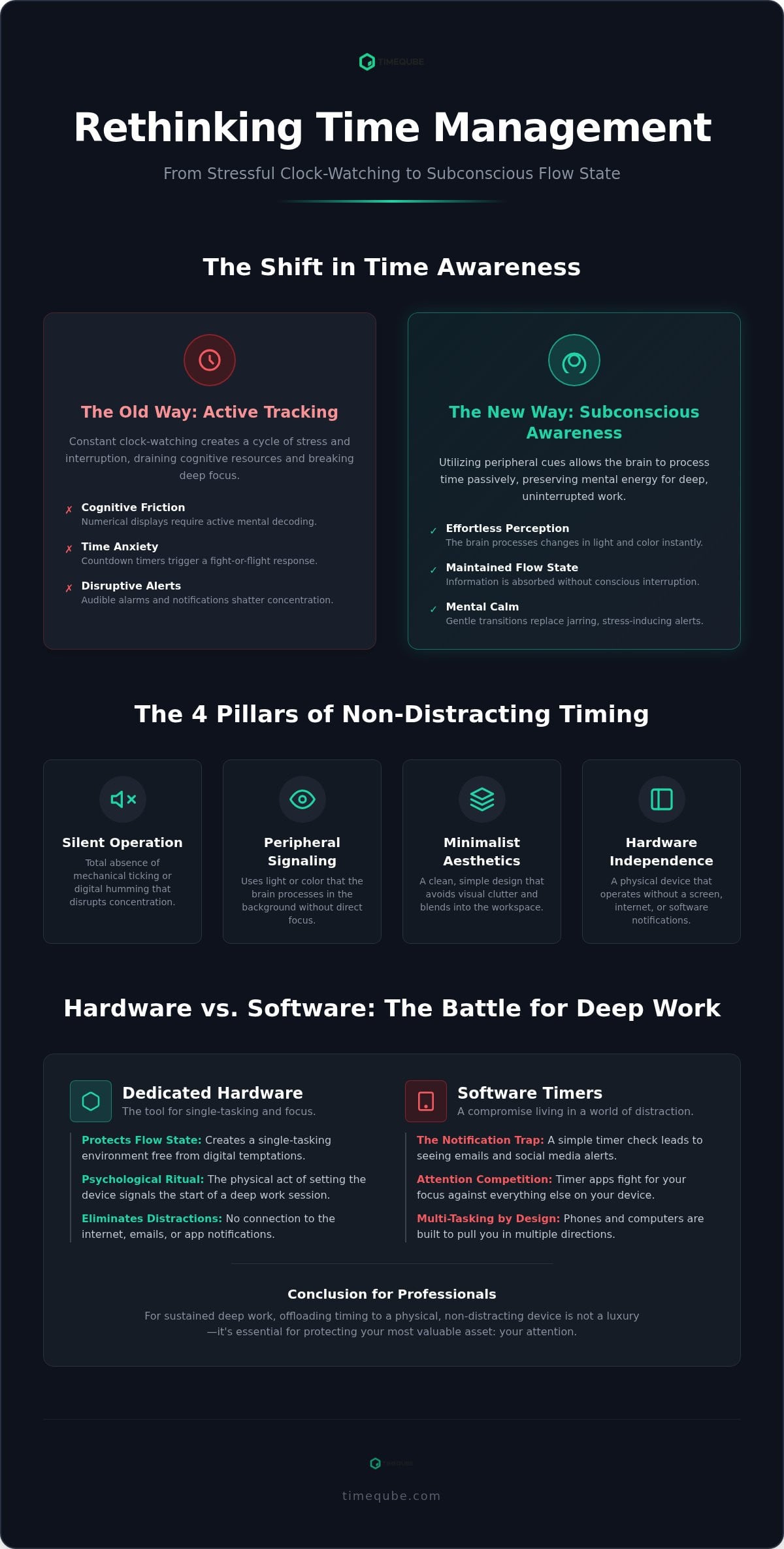
A non distracting office timer must prioritize sensory neutrality to be effective in a high-stakes professional environment. Most traditional timing devices fail because they demand too much active attention. A professional tool should exist in the background of your consciousness, providing information without stealing your focus. True non-distraction is achieved by eliminating auditory ticking and abrupt alarms that startle the nervous system. Instead of loud interruptions, a sophisticated device uses subtle visual transitions to communicate the passage of time.
To qualify as a professional-grade tool, the device must meet several criteria:
- Silent Operation: Total absence of mechanical ticking or digital humming.
- Peripheral Signaling: The use of light or color that the brain processes without direct ocular focus.
- Minimalist Aesthetics: A design that avoids visual clutter and fits into a clean workspace.
- Hardware Independence: A physical form factor that doesn’t require a screen or an internet connection.
The Psychology of Time Anxiety in the Workspace
Traditional countdowns often trigger a subtle fight or flight response. When you watch seconds disappear on a screen, your brain perceives time as a diminishing resource. This creates time anxiety, which actively erodes your ability to perform complex tasks. Active monitoring requires you to stop your primary work to decode numerical data. Human biology is better suited for passive awareness. Our brains process color and light significantly faster than numbers. Seeing a soft change in hue is a natural signal that bypasses the analytical mind. It speaks directly to our spatial awareness, allowing us to feel the time rather than track it.
Why Hardware Beats Software for Deep Work
Digital applications are inherently distracting. They reside on screens filled with notifications, emails, and browser tabs. Using a phone or desktop app for the Pomodoro Technique often leads to what experts call the notification trap. You check the timer and stay for the unread messages. Dedicated hardware creates a single-tasking environment that software cannot replicate.
Tactile interaction serves as a psychological ritual for focus. Placing a physical device like the Timeqube on your desk signals to your brain that a deep work session has begun. This physical presence anchors your attention. It removes the friction of digital multitasking and ensures that time management remains a support function. By choosing a physical tool, you protect your flow state from the constant pull of the digital world.
Why Digital and Analog Clocks Fail the Focus Test
Most office clocks are designed for telling time, not for managing duration. This distinction is critical for professional productivity. A standard clock provides a data point about the time of day, but it does little to help you visualize the remaining portion of a task. When you use a non distracting office timer, you move away from tracking hours and toward protecting your mental energy. Conventional devices often introduce more noise than they resolve.
Digital clocks require active cognitive decoding. When your eyes hit a numerical display, your brain must translate those symbols into a meaningful concept of time. It compares the current digits against your deadline. This micro-calculation is a deliberate mental act that shatters a fragile flow state. It’s an unnecessary friction point in a deep work session. You can explore these concepts further in our analysis of Beyond the Tick: Why an Analog Focus Timer is Your Best Productivity Ally in 2026. Analog clocks present a different set of challenges. Even those marketed as silent often feature a rhythmic mechanical movement that the subconscious mind detects. This visual or auditory ‘tick’ acts as a persistent, low-level disruption to concentration.
The Hidden Cost of Digital Notifications
Using a smartphone or computer as a timer is a compromise that often fails. These devices are designed to capture your attention through a constant stream of alerts. A simple timer notification often appears alongside an unread email or a social media update. This creates a notification trap. Effective time management strategies suggest that offloading these functions to physical hardware is essential for maintaining a clean digital workspace. Persistent blue light and screen glare from digital devices contribute to ocular fatigue. A dedicated physical tool removes this sensory load entirely.
The Problem with Traditional Alarms
Sound-based alarms are inherently aggressive. They trigger an auditory startle response, which releases cortisol and interrupts the neural pathways required for creative thinking. In environments like therapy rooms or open-plan offices, a sudden beep is jarring and unprofessional. It creates a sense of urgency rather than a sense of awareness. A sophisticated professional tool should guide the user through a transition. It should move from alerting to guiding. By using subtle color shifts, you can maintain professional harmony without the shock of an alarm. To bring this level of calm to your workspace, you might consider how professional visual timers can refine your daily rhythm.
Comparing Visual Timers: Direct vs. Peripheral Cues
Selecting a non distracting office timer requires an understanding of how the human brain interacts with different visual stimuli. Most visual timers on the market rely on direct cues, such as a disappearing red disk or a digital countdown. While these tools are superior to jarring alarms, they still create a cognitive break. You must physically shift your gaze to the device to gauge the remaining time. This movement forces the brain to disengage from deep work to decode a specific visual data point. In contrast, peripheral cues utilize color-changing light to communicate duration without requiring you to look away from your task.
The transition between colors taps into universal psychological associations that we process subconsciously. This system removes the need for active monitoring through a simple color-coded logic:
- Green: Signifies the start and the maintenance of a productive flow state.
- Orange: Provides a gentle transition, signaling that the session is approaching its final phase.
- Red: Indicates the conclusion of the task, allowing for a calm wrap-up.
For a deeper look at how these different technologies stack up in a professional setting, you can read about The Best Time Timer Alternative for Professionals: A 2026 Comparison.
The Science of Peripheral Vision in Productivity
Human biology is optimized for detecting light shifts through the periphery. Our retinas are highly sensitive to changes in hue even when we aren’t looking directly at the source. By using light instead of numbers, you reduce the cognitive load associated with time management. You no longer need to calculate minutes or interpret symbols. Ambient awareness is a productivity technique that enables the subconscious monitoring of environmental data without requiring a shift in direct attention. This method ensures that your primary focus remains entirely on your creative or analytical output while your brain maintains a background sense of time.
Choosing Between Mechanical and Light-Based Timers
Professional office hardware must balance durability with aesthetic integration. Many mechanical timers feature plastic designs that feel out of place in a sophisticated boardroom or a therapy session. Light-based hardware, such as the Timeqube, offers a minimalist cube form factor that complements a modern workspace. These devices prioritize silent, vibration-free transitions. Mechanical components are prone to wear and often produce a faint, distracting hum that disrupts a quiet office. High-quality LED technology ensures longevity and provides a clean, flicker-free light source. Choosing a device made from premium materials reinforces a professional atmosphere while protecting your mental space from unnecessary friction.
Implementation: Setting Up Your Distraction-Free Workspace
To maximize the benefits of a non distracting office timer, strategic placement is essential. You should position the device within your peripheral field of view, ideally 30 to 45 degrees off-center from your primary monitor or workspace. This specific angle ensures that your brain processes color changes through the retina’s rods, which are highly sensitive to movement and light shifts. It allows you to maintain your flow state without requiring a deliberate, focus-breaking shift in your gaze. By keeping the device in your periphery, you stay informed of your progress while your analytical mind remains dedicated to the task at hand.
Establishing a rhythm of work requires consistency and intentionality. You can set standard durations for recurring tasks to build a predictable internal pace. For example, 25 minutes might be reserved for administrative duties, while 50 minutes is dedicated to deep analytical work. This structure integrates seamlessly with the Pomodoro technique, providing a physical anchor for your focus sessions. Over time, your brain begins to associate specific colors with these work intervals, reducing the mental effort needed to manage your day.
Non-Distracting Timing for Meetings
Introducing a visual timer to a group setting creates a silent social contract. It eliminates the need for a designated human timekeeper, a role that is often awkward or inconsistent. When everyone in the room can see the gentle transitions of light, the group naturally regulates its pace. The ‘Gentle Red’ phase provides a tranquil signal to conclude discussions, preventing the common frustration of over-running sessions. For corporate environments, choosing Timequbes with Your Logo allows you to maintain brand consistency while fostering a professional culture of punctuality and respect for time.
Optimizing for Neurodiversity and ADHD
Visual cues are exceptionally effective for professionals who experience time blindness, a common challenge in neurodiversity and ADHD. Abstract numbers on a digital clock often fail to register as meaningful deadlines until it’s too late. A non distracting office timer translates the abstract concept of time into a tangible, sensory experience. Soft light changes reduce the fight-or-flight anxiety often associated with sudden, loud deadlines. This approach creates a stress-free environment where productivity feels natural rather than forced. You can find a deeper analysis of these benefits in our Physical Pomodoro Timer for Work: The 2026 Comparison Guide.
Implementing these tools is about designing an environment that respects human biology and mental well-being. To achieve this level of professional harmony, you can enhance your workspace with a professional visual timer today.
The Timeqube Solution: Subconscious Timing for Professionals
Timeqube is a dedicated hardware solution that rejects the toy-like aesthetic common in traditional classroom tools. It is a non distracting office timer engineered specifically for executive boardrooms and clinical environments. The device utilizes high-quality LEDs to produce a steady, flicker-free glow that is easy on the eyes. Its minimalist cube form factor serves as a sophisticated addition to any modern workspace. This design prioritizes professional harmony over high-energy distraction, ensuring the tool complements a high-end office aesthetic.
The hardware-only design ensures that there are zero digital distractions. You won’t find notification icons, software updates, or complex configuration menus here. You simply choose your duration and focus on your output. This zero-configuration setup allows the tool to disappear into the background. It supports your presence rather than demanding your active attention. It’s a tool for those who value mental space and intentionality in their daily workflow.
The Mind/Body Therapy Advantage
In a clinical setting, the relationship between therapist and client is the primary focus. Checking a watch or a wall clock can unintentionally break the therapeutic bubble. It may signal a lack of presence or a rush to finish the session. The Timeqube for Mind/Body Therapies addresses this by providing a silent, visual signal that exists in the practitioner’s periphery. These gentle light transitions respect the client’s emotional space while ensuring session punctuality. It allows the therapist to remain fully present, knowing that the session’s rhythm is being managed subconsciously.
The Business Meeting Standard
Professional meetings often suffer from a lack of shared time awareness, which leads to overrun sessions and collective fatigue. Using the standard Timeqube fosters a culture of respect for everyone’s schedule. It reduces meeting fatigue by making the duration of the session visible to everyone in the room simultaneously. This shared visual data encourages concise communication and more natural transitions between agenda items. For organizations seeking a cohesive office environment, Timequbes with Your Logo offer a way to integrate productivity tools into your corporate identity. This customization ensures that your commitment to efficiency and mental well-being is a visible part of your professional culture.
Reclaiming Your Mental Space
Mastering your daily rhythm requires a shift from active monitoring to subconscious awareness. By choosing a non distracting office timer, you protect your flow state and reduce the cognitive friction of time management. You have learned that hardware-only solutions eliminate the notification trap of digital apps; peripheral cues respect the biological limitations of the human brain. This approach transforms time from a source of anxiety into a silent, supportive ally.
Timeqube offers a sophisticated, minimalist design that fits any executive office or clinical space. It is a dedicated hardware-only device that remains 100% distraction-free, ensuring your focus stays entirely on your output. Join the 10,000+ professionals worldwide who have already refined their workspace and improved their session punctuality. Reclaiming your mental space is the first step toward a more harmonious career. It’s time to lead with quiet confidence and work with true intention.
Upgrade your workspace with a Timeqube visual timer today
Frequently Asked Questions
What is the best non-distracting office timer for ADHD focus?
A hardware-only visual timer is often the most effective choice for managing ADHD focus. These devices replace abstract numbers with peripheral light cues in Green, Orange, and Red. This approach helps individuals manage time blindness without the stress of a ticking clock. Because it’s a physical device, it eliminates the digital notifications that often disrupt concentration. It allows for a calmer, more intentional focus session.
Why are digital timers considered distracting for deep work?
Digital timers require active cognitive decoding of numbers, which pulls your brain out of a flow state. They often reside on screens where notifications and emails compete for your attention. This creates a notification trap that shatters focus. A dedicated non distracting office timer offloads this function to a physical tool. It removes screen glare and the constant temptation to check other digital applications during work.
How does a light-based visual timer work without a screen?
These devices use high-quality LEDs to transition through color-coded phases. The logic follows a universal traffic light pattern: Green for the start, Orange for the transition, and Red for the conclusion. This hardware-only design ensures zero digital noise or light pollution. You simply select a duration and the device manages the timing subconsciously. It uses ambient light shifts to keep you aware of your progress.
Can I use a visual timer for professional therapy sessions?
The Timeqube for Mind/Body Therapies is specifically designed to maintain a therapeutic bubble. Standard clocks can feel intrusive or signal a lack of presence to the client. A silent, light-based tool allows the therapist to stay fully present in the moment. It ensures session punctuality without the jarring interruption of an audible alarm. This respects the emotional space of the client while providing necessary structure.
Does a non-distracting timer help with meeting overruns?
It acts as a silent social contract that helps groups regulate their own pace. When time is visible to everyone in the room through gentle color changes, the need for a designated human timekeeper is eliminated. This shared awareness reduces collective meeting fatigue. It encourages participants to wrap up discussions naturally as the device transitions into the Red phase. It fosters a professional culture of respect for time.
What is the difference between a visual timer and a standard alarm clock?
A standard alarm clock uses a startling auditory signal to indicate time is up, which can trigger a cortisol spike. A visual timer focuses on duration and awareness rather than a single alert. It provides a continuous, silent stream of information through light. This allows for smoother transitions and reduces the anxiety associated with sudden interruptions. It guides the user toward a conclusion rather than shocking them.
Are there timers that use peripheral vision instead of a countdown?
Sophisticated hardware is engineered specifically to leverage human peripheral vision. Our retinas are highly sensitive to light and color shifts in our periphery even when we aren’t looking directly at the source. This enables ambient awareness, where the brain processes the passage of time subconsciously. Your analytical mind remains focused on the primary task while your brain maintains a background sense of the session duration.
How do I choose between a physical timer and a phone app?
Professionals often choose physical hardware to ensure a single-tasking environment. Phone apps are inherently tied to notification-heavy ecosystems that invite distraction. A physical non distracting office timer provides a tactile ritual that signals the start of a focus session. It removes blue light strain and ensures that your time management tool doesn’t become a source of digital noise. It’s a commitment to a cleaner workspace.