

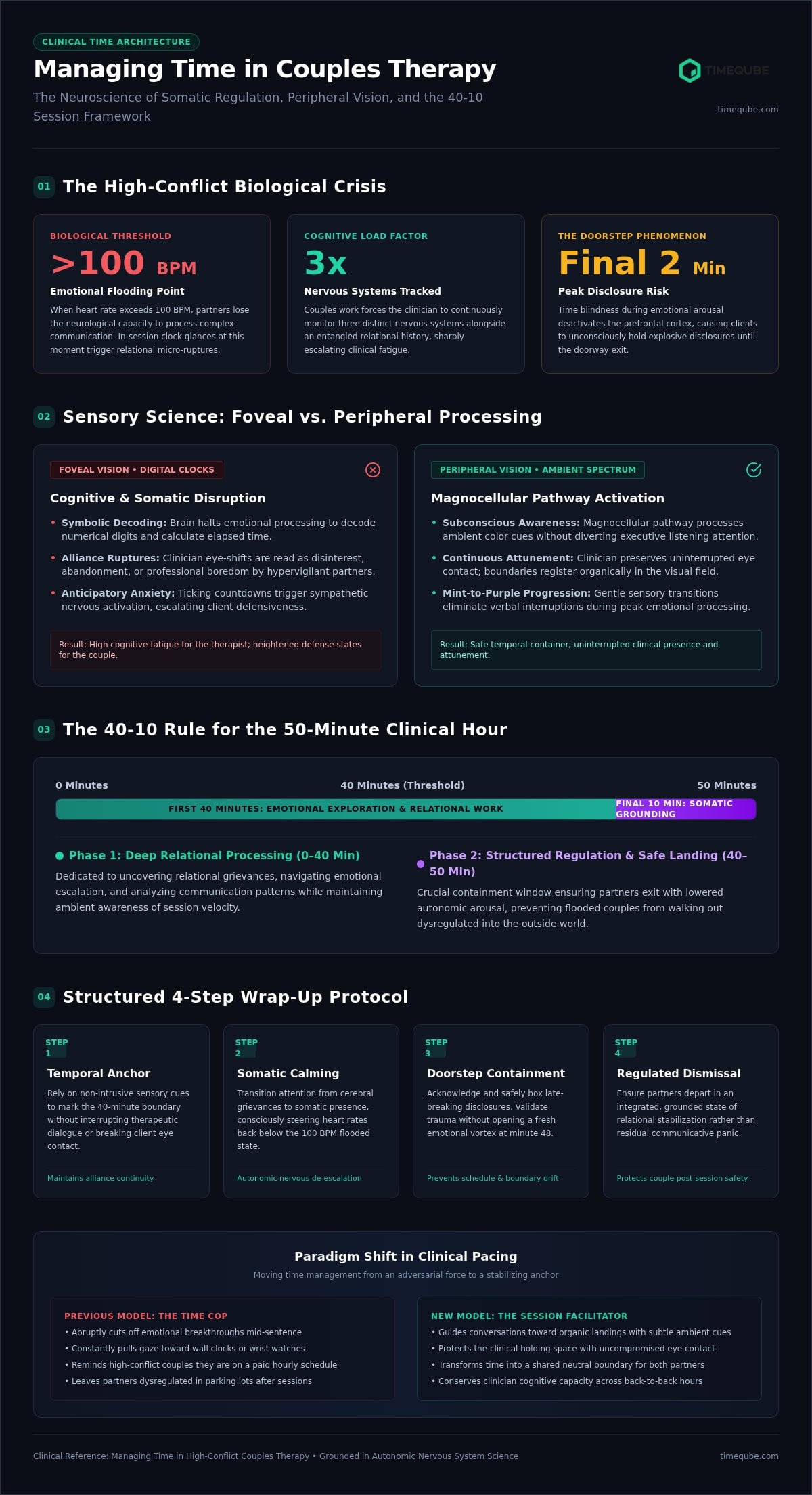
You’ve likely experienced the “doorstep phenomenon” where a client drops a life-altering bombshell in the final moments of a session. It forces a difficult choice between cutting off a breakthrough or running late and sacrificing your own professional boundaries. Effectively managing time in couples therapy shouldn’t feel like a constant battle against the clock. When a partner’s heart rate exceeds 100 beats per minute, they enter a state of emotional flooding and lose the ability to process complex information. Interrupting that physiological state to check a wall clock creates a micro-rupture that can stall progress for weeks.
We understand that maintaining a calm, holding space is your priority, yet cognitive fatigue from constant clock-watching is a real threat to your clinical presence. This article demonstrates how to master the emotional flow of your sessions using non-intrusive visual cues that preserve the therapeutic alliance. You’ll learn to leverage peripheral vision to maintain attunement while ensuring every session lands safely. We’ll explore how shifting to a sensory-first approach, using a gentle mint-to-purple color progression, reduces stress and eliminates the need for verbal interruptions during intense emotional work.
Key Takeaways
- Learn to transform time from a personified enemy into a neutral, stabilizing presence that anchors high-conflict sessions.
- Utilize the neuroscience of peripheral vision to signal boundaries without breaking eye contact or triggering a client’s stress response.
- Apply the 40-10 rule for managing time in couples therapy to balance intense emotional peaks with a necessary period of somatic grounding.
- Master a structured four-step wrap-up that contains late-session bombshells and ensures partners leave the room in a regulated state.
- Reduce cognitive fatigue by integrating Timeqube for Mind/Body Therapies, a silent tool designed for the specific sensory needs of a counseling environment.
The Psychology of Time in High-Conflict Couples Sessions
Couples work demands a higher level of cognitive processing than individual counseling. You aren’t just tracking one narrative; you’re managing three distinct nervous systems and a complex web of relational history. Managing time in couples therapy becomes a primary challenge because the session often feels faster and more chaotic. When conflict escalates, the biological response of the clients shifts. Their perception of time distorts, making 50 minutes feel like ten. Clinicians practicing couples therapy often find that the standard clinical hour feels compressed under the weight of active grievances.
In high-conflict dynamics, time frequently becomes a “Third Party” in the room. It’s personified as an enemy that cuts off vital conversations or an unfair judge that favors one partner’s story over the other’s. To better understand how clinicians structure these complex sessions, watch this helpful video:
Maintaining a “holding space” requires you to balance empathy with firm professional boundaries. However, the cognitive cost of constant clock-watching is significant. Every time you glance at your watch, you momentarily withdraw your presence. This micro-withdrawal can be perceived by hypervigilant clients as boredom or dismissal. Your empathy suffers when your brain is forced to multitask between deep listening and mental math. Tools like Timeqube Mind help maintain this focus by removing the friction of manual time tracking.
The Doorstep Phenomenon in Couples Work
Clients often save their most explosive disclosures for the final two minutes of a session. This doorstep phenomenon isn’t always a conscious manipulation. When partners are in a state of high emotional arousal, they experience “time blindness.” Their prefrontal cortex goes offline, making them lose track of the session’s rhythm. This creates a therapist’s dilemma: do you validate the new trauma or respect the next client’s schedule? Managing time in couples therapy effectively means preventing these late-session spikes before they occur by providing clear, non-verbal temporal anchors throughout the hour.
Time Anxiety and the Therapeutic Alliance
The therapeutic alliance is built on the foundation of safety and presence. Checking a phone or a ticking clock signals a lack of attunement. It reminds the couple that they’re on a paid schedule, which can trigger feelings of abandonment or urgency. Abrupt endings can even be re-traumatizing for high-conflict pairs, leaving them flooded as they walk to their car. You must transition from being a “Time Cop” who interrupts breakthroughs to a “Session Facilitator” who uses sensory cues to guide the couple toward a regulated conclusion. This shift preserves trust and ensures the session ends on a note of containment rather than chaos.
Sensory Science: Why Peripheral Cues Beat Digital Clocks
Digital clocks demand foveal vision; they require the brain to stop processing emotional data to decode numerical symbols. In the context of managing time in couples therapy, this cognitive shift is fundamentally disruptive. It pulls the clinician away from the “here and now” of the relational dance. Peripheral vision works through a different neurological architecture. It processes ambient light and movement through the magnocellular pathway, a system that operates subconsciously. This allows the brain to register temporal shifts without diverting executive attention from the couple. You stay present while your brain tracks the hour.
Data from the American Psychological Association indicates that effective conflict resolution depends on maintaining a low-arousal environment. When a client sees a digital countdown, it often triggers a sympathetic nervous system response. The “ticking clock” becomes a source of anticipatory anxiety rather than a tool for pacing. For neurodivergent clients, specifically those with ADHD or sensory processing sensitivities, these digital stimuli can lead to hyper-fixation on the remaining minutes. This effectively ends the therapeutic work long before the hour is over.
Subconscious Time Awareness
The human brain interprets shifts in light more naturally than it processes text. Ambient cues allow for a gentle, rhythmic transition of awareness. Chromotherapy-inspired timekeeping is an emerging professional standard for high-conflict clinical settings because it provides a “neutral observer” that doesn’t judge or interrupt. This method significantly reduces the startle response that occurs when a session ends abruptly. Instead of a jarring alarm or a sudden verbal interruption, a soft shift in color signals the need to synthesize the conversation. You can maintain your deep work focus while staying subconsciously aware of the schedule through your peripheral field.
Eliminating Digital Distractions
Using a smartphone as a timer is a common clinical error that compromises the therapeutic frame. It introduces the risk of intrusive notifications and signals a lack of professional intentionality to the couple. Physical hardware creates a more sacred therapeutic space, reinforcing the idea that this hour is dedicated solely to their healing. You can explore more about the psychology of silent timers in clinical practice to understand how physical objects influence the room’s energy. A dedicated device like Timeqube for Mind/Body Therapies serves as an unobtrusive ally. It removes the friction of digital interfaces, allowing you to remain fully present while managing time in couples therapy. By choosing physical hardware over digital software, you prioritize the sensory integrity of the consultation room and reduce your own cognitive load. You can learn more about how sensory-first design supports clinical excellence.
Practical Strategies for Managing the 50-Minute Hour
Managing time in couples therapy requires a deliberate clinical architecture. The most effective framework for this is the 40-10 Rule. You dedicate the first 40 minutes to the affective arc, including emotional exploration and relational enactment. The final 10 minutes are strictly reserved for the cool-down, synthesis, and somatic grounding. This structure prevents the “spillover” effect, ensuring partners don’t leave the room in a state of high physiological arousal. By establishing this rhythm, you protect the session’s integrity while respecting your professional boundaries.
A physical timer acts as a neutral anchor in the room. It de-escalates time-based arguments by shifting the “blame” for transitions away from you. If a partner feels they haven’t had enough space, the timer, not the therapist, signals the end of the phase. This preserves your rapport and positions you as an ally rather than a gatekeeper. Using a device like Timeqube for Mind/Body Therapies facilitates this by providing a shared, objective reality for both partners.
Verbal vs. Visual Time Signaling
Verbal warnings often create a sudden conversational rupture. A “five-minute warning” can feel like an intrusion during a vulnerable breakthrough. Visual cues allow the couple to self-regulate their pacing instinctively. They see the transition approaching and begin to land their own emotional planes without external pressure. The table below illustrates how different signaling methods impact the therapeutic environment.
| Feature | Verbal Warnings | Digital Timers | Ambient Visual (Timeqube) |
|---|---|---|---|
| Interruption Level | High (Auditory) | Medium (Visual) | Low (Subconscious) |
| Stress Response | Startle | Anticipatory Anxiety | Calm Awareness |
| Eye Contact | Broken | Broken | Maintained |
Setting the Frame During Intake
Introduce the timer during the initial intake session. Explain its role as a boundary for safety, not a constraint on expression. Frame the clinical hour in three distinct phases: Opening, Middle, and Closing. By normalizing these transitions early, you reduce the anxiety associated with the yellow and purple light phases later. This approach is similar to using a Visual Timer for Deep Work, where the objective is to protect the mental space from external friction. Managing time in couples therapy becomes a collaborative effort once the couple understands that the timer’s gentle 4-stage color progression (mint, yellow, orange, and purple) is there to ensure they leave regulated and safe.
The 4-Step Wrap-Up: Navigating the Final 10 Minutes
The final ten minutes of a session are often the most clinically sensitive. This is the period where the work is either integrated or lost to the chaos of an abrupt ending. Managing time in couples therapy effectively requires a structured exit strategy that protects the therapeutic frame. By following a four-step wrap-up, you ensure that partners transition from deep emotional work back to the requirements of their daily lives without feeling discarded. This process begins the moment the environment shifts from the “work” phase to the “synthesis” phase.
Step one involves acknowledging the “Yellow” phase. When the ambient light changes, it serves as a shared signal to begin landing the conversation. You don’t need to interrupt a partner mid-sentence; the visual cue allows them to find a natural stopping point. This subtle awareness reduces the cognitive load on both you and the couple, moving the session from exploration toward a necessary period of reflection.
The Synthesis Phase
During the synthesis phase, your role shifts from facilitator to summarizer. As the light transitions, you should begin highlighting the progress made during the hour. Instead of asking “What else is wrong?”, which invites new conflict, ask “What is one insight you’re taking away today?” This question forces a cognitive shift from the amygdala to the prefrontal cortex. Using visual cues to signal the start of this summary ensures that both partners are aware that the time for new grievances has passed. It creates a rhythmic, predictable end to the session that fosters a sense of accomplishment.
Managing the “Bombshell” Moment
High-conflict couples frequently use “doorknob disclosures” to test boundaries or avoid the vulnerability of ending a session. Step two of the wrap-up is the containment technique. When a partner drops a major revelation with only minutes remaining, you must validate the importance of the topic while firmly postponing it for the next session. You might say, “That feels vital to address, and I want to give it the full attention it deserves next week.” A red or purple light acts as a neutral boundary for the therapist, providing an objective reason to stop without appearing dismissive or biased. This sensory limit allows you to maintain the role of a supportive ally while the hardware enforces the schedule.
Step three is the administrative transition. You should handle scheduling and payment during the final minutes while the couple is in a regulated state. This prevents the “transactional” nature of the business from breaking the emotional mood of the work. Finally, step four is the “Clear Exit.” This involves a brief somatic grounding exercise or a simple breath to ensure the couple leaves the room regulated. They should walk out as a team, not as two individuals still reeling from an unfinished argument. To achieve this level of clinical precision, you can integrate Timeqube for Mind/Body Therapies into your practice to manage these transitions effortlessly.
Enhancing Presence with Timeqube for Mind/Body Therapies
Managing time in couples therapy is a sensory task as much as a clinical one. Timeqube Mind was developed in collaboration with over 100 psychotherapists to solve the friction of the clinical hour. It offers six universal presets, including 50, 60, and 90-minute options. This flexibility is essential for clinicians who alternate between standard sessions and extended couples intensives. The device sits on your desk as a piece of aesthetic gear, projecting professional value while remaining an unobtrusive ally. It serves as a sophisticated partner that values your mental space and the couple’s emotional safety.
The “Mindful” color palette is designed to protect the nervous systems in the room. Unlike standard timers that use aggressive red lights, this edition utilizes a gentle four-stage progression. It transitions from mint to yellow, orange, and finally a calming purple. These shifts are processed by the peripheral vision, allowing for a subconscious awareness of the session’s arc. You stay attuned to the couple’s emotional state without needing to break eye contact to check a clock. This removal of friction ensures that the therapeutic flow remains uninterrupted until the natural conclusion of the hour.
A Tool for Clinician Longevity
Clinician burnout often stems from the high cognitive load of managing intense relational conflict. Using Timeqube for Mind/Body Therapies reduces the mental “tab-switching” between deep empathy and scheduling logistics. It prevents the “run-over” effect that frequently eats into your personal breaks. When you outsource the boundary-keeping to a neutral physical object, you preserve your mental energy for the work that matters. This intentional approach to managing time in couples therapy improves your professional work-life balance and long-term sustainability in the field. It allows you to enter every session with quiet confidence and professional harmony.
Creating a Sensory-Friendly Office
In trauma-informed care, silent operation is a non-negotiable requirement. Any ticking sound or sudden alarm can startle a hyper-vigilant client, disrupting the safety of the holding space. This hardware-only design ensures there are no digital distractions, phones, or invasive notifications. For neurodivergent therapists, these visual cues are especially helpful in managing their own time blindness. It provides a steady, logical rhythm to the day that feels natural and effortless. You can enhance your practice with a Timeqube Mind to create a distraction-free environment that prioritizes mental well-being. By focusing on sensory stimuli rather than digital countdowns, you foster a space of presence and awareness for every couple you serve.
Mastering the Art of Clinical Pacing
Mastering the art of clinical pacing transforms the session from a race against the clock into a structured journey toward healing. By prioritizing sensory awareness over digital distractions, you protect the therapeutic alliance and reduce your own cognitive load. Effectively managing time in couples therapy requires a shift from being a gatekeeper to becoming a facilitator of regulated endings. You’ve explored how peripheral cues, structured wrap-ups, and the 40-10 rule create a safe environment for high-conflict pairs to synthesize their work.
Integrating these techniques ensures that every breakthrough is honored and every boundary is respected. The Timeqube Mind offers a 100% silent, hardware-only design specifically for this purpose. It’s a distraction-free tool used by thousands of therapists globally to reduce session-end anxiety and maintain clinical presence. Discover the Timeqube Mind for your practice to elevate your clinical environment. Embodying this level of professional intentionality allows you to focus entirely on the relationship in front of you. Your presence is your most valuable asset; protect it with a sensory-first approach to time.
Frequently Asked Questions
How do I handle a couple that refuses to stop talking when the session is over?
You manage persistent talking by utilizing the light as a neutral, objective boundary. When the device transitions to purple, you can acknowledge the shift by saying, “I notice our time is ending, and I want to ensure we land safely.” This shifts the responsibility from you to the tool. It allows you to maintain the therapeutic alliance while firmly containing the session within professional boundaries.
Will using a visual timer make my therapy sessions feel too “business-like”?
A visual timer actually reduces the clinical, “business-like” feel of the room by removing the need for digital clocks or smartphones. These high-end hardware devices function as aesthetic desk gear rather than cold office equipment. Because they operate via peripheral vision, they allow for a more human connection. You spend less time acting as a timekeeper and more time being a present, attuned healer.
How do I introduce a visual timer to long-term clients who aren’t used to it?
Introduce the tool by emphasizing your commitment to their experience. You might say, “I’m using this to ensure I stay fully present with you without needing to check my watch.” Explain that the gentle color shifts help both you and the couple manage time in couples therapy subconsciously. Most long-term clients appreciate the added focus and the predictable, calm rhythm it brings to their deep emotional work.
Can visual timers help with couples who have ADHD or time blindness?
Visual timers are exceptionally effective for neurodivergent individuals who experience time blindness. Digital digits often cause anxiety or hyper-fixation, whereas ambient light is processed through the magnocellular pathway. This allows clients with ADHD to maintain a subconscious awareness of the session’s progression. They can engage in the affective work without the sudden shock of a session ending abruptly, which supports better emotional regulation.
What is the best way to manage time during a 90-minute couples intensive?
For a 90-minute intensive, use the specific 90-minute preset on your Timeqube Mind. This expands the mint and yellow phases, allowing for deeper exploration while still protecting the final portion for synthesis. Managing time in couples therapy during intensives is about pacing the emotional load. The 4-stage color progression ensures you have a clear, non-verbal signal to begin de-escalating conflict well before the session concludes.
Should the timer be visible to the clients, the therapist, or both?
Position the device so it is visible to both you and the couple to create a shared temporal reality. When everyone in the room can see the ambient shift, it acts as a neutral “third party” that manages boundaries. This shared awareness encourages the couple to begin self-regulating their pacing. It eliminates the secrecy of the therapist checking a hidden watch and fosters a sense of collaborative transparency.
What happens if a client feels anxious seeing the light change to red?
The Timeqube Mind specifically addresses this by using a calming purple light instead of a stress-inducing red. Research into sensory stimuli suggests that purple facilitates a more tranquil transition into the “land the plane” phase. If a client expresses anxiety, you can validate their feeling while explaining that the light is a tool for their safety. It ensures they aren’t left in a flooded state when the hour ends.
Is it better to use a silent visual timer or a gentle chime?
Silent operation is the professional standard for trauma-informed care and mind/body therapies. Auditory signals like chimes or beeps can trigger a startle response in hyper-vigilant clients, potentially rupturing a moment of vulnerability. A silent, light-based system provides a gentle transition that respects the nervous system. This allows for a distraction-free environment where the focus remains entirely on the relational work and somatic grounding.