
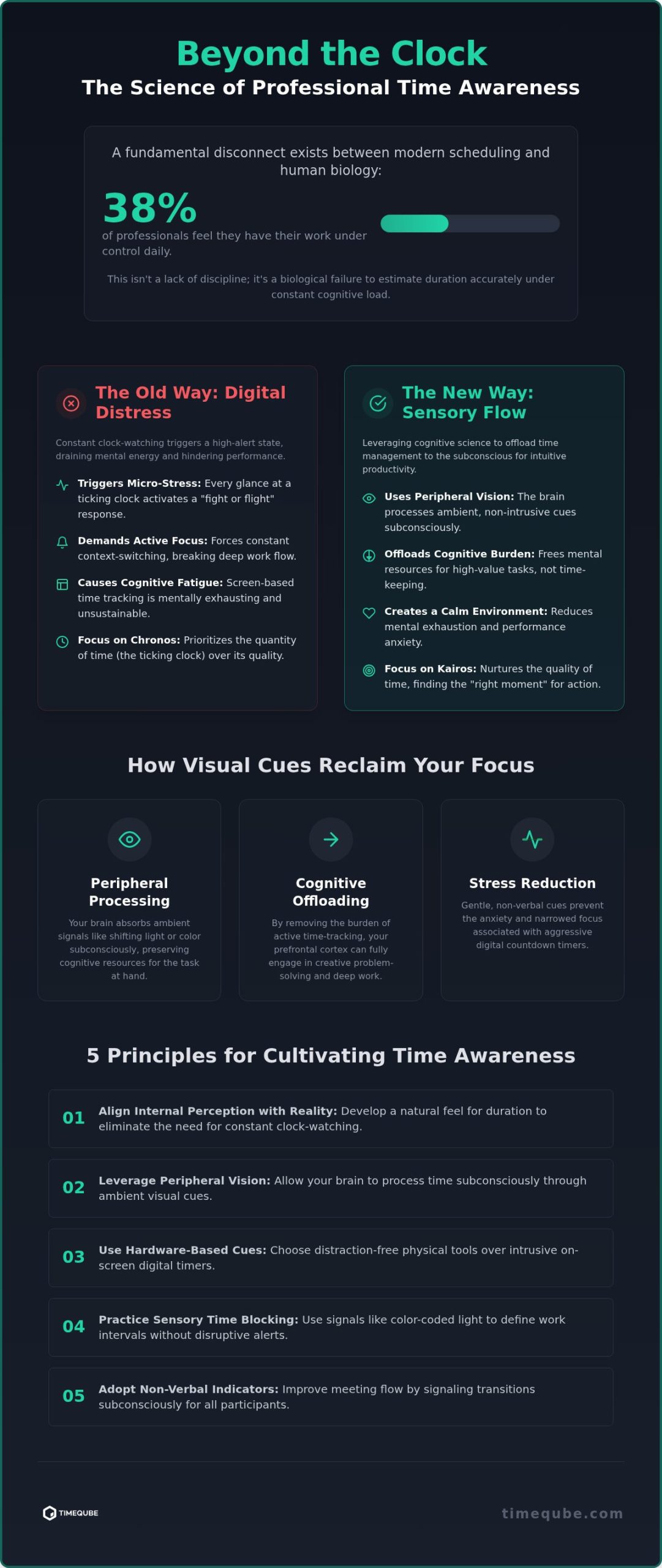
Only 38% of professionals feel they have their work under control on a daily basis. This statistic highlights a fundamental disconnect between modern scheduling and human biology. Most high-performers rely on digital countdowns and precise clocks to manage their schedules. However, these tools often trigger a state of constant high-alert rather than genuine focus. Developing a natural sense of time awareness for professionals requires a shift in how the brain processes duration.
You likely recognize the frustration of a meeting that drifts past its limit or the cognitive fatigue that follows hours of screen-based time tracking. It’s an exhausting way to work. This article promises to show you how to move beyond manual timekeeping by leveraging cognitive science and sensory-first tools. You will learn to offload time management to your subconscious, allowing for better meeting flow and a significant reduction in mental exhaustion. We will explore how visual cues can create a stress-free environment where productivity feels intuitive rather than forced.
Key Takeaways
- True time awareness for professionals requires aligning internal perception with reality to eliminate the stress of constant clock-watching.
- Peripheral vision allows the brain to process temporal information subconsciously, preserving cognitive resources for high-value tasks.
- Hardware-based visual cues provide a distraction-free alternative to digital timers, reducing mental exhaustion and performance anxiety.
- Sensory time blocking uses color-coded light signals to define productive intervals without the friction of intrusive alerts.
- Non-verbal timing indicators improve meeting flow and professional presence by signaling transitions through subconscious perception.
What is Time Awareness for Professionals?
Time awareness for professionals is the cognitive alignment of internal perception with external reality. It’s the difference between knowing how long a task takes and constantly checking a digital clock. Clock-watching is an active, anxiety-driven behavior that drains mental energy. True awareness is a passive state that allows you to feel the rhythm of your workday. When your internal sense of duration matches the objective clock, you achieve professional harmony.
To better understand how these cognitive patterns influence your day, watch this helpful video:
The human brain doesn’t have a single dedicated organ for measuring seconds or minutes. Instead, time perception emerges from a complex network of neural processes. Professionals who suffer from “time blindness” often struggle in high-stakes environments. This isn’t a lack of discipline; it’s a biological failure to estimate duration accurately. The cost is high. It manifests as disrupted schedules, meeting overruns, and a persistent sense of being behind.
The Executive Function Connection
Your prefrontal cortex is the engine of productivity. It manages task sequencing and predicts how long a project will last. Stress and high cognitive load impair these functions. When you’re overwhelmed, your brain struggles to process temporal data. This leads to poor professional reliability. You can’t manage what you can’t perceive. Strengthening this executive function requires offloading the burden of timekeeping to non-intrusive, sensory cues that don’t compete for your attention.
Chronos vs. Kairos: A New Professional Framework
Ancient Greeks distinguished between Chronos and Kairos. Chronos is quantitative time. It’s the ticking clock and the strict deadline. Kairos is qualitative time. It’s the “right” moment for a specific action. Professionals often focus exclusively on Chronos. This leads to burnout and mechanical performance. Mastering both allows you to identify when to push and when to pause. It creates a more intentional approach to the workday. Time awareness for professionals is a biological rhythm that functions best when freed from the friction of digital constraints.
The Neuroscience of Time Perception and Cognitive Load
The brain doesn’t just record time; it constructs it through a complex interplay of neural systems. Central to this is the suprachiasmatic nucleus, which governs our primary biological clock. Dopamine pathways then act as the internal metronome, adjusting our sense of speed based on interest and stress. When these pathways are hijacked by high-pressure environments, our accuracy fades. Research into how the perception of time can affect productivity shows that perceived “time pressure” often leads to lower decision-making quality. It forces the brain into a reactive state, prioritizing speed over precision. Developing a sophisticated sense of time awareness for professionals requires understanding how these biological rhythms regulate our internal clock.
The Stress of the Digital Countdown
Digital countdowns are aggressive by design. They demand active gaze, which forces the brain to switch contexts repeatedly. Every glance at a ticking clock triggers a micro-stress response. This “fight or flight” reaction narrows the prefrontal cortex’s capacity for creative problem-solving. It’s a high cognitive cost for a low-value activity. When you’re constantly monitoring a shrinking number, you aren’t focused on the work; you’re focused on the scarcity of time. This anxious time-keeping effectively breaks the deep work focus necessary for high-level professional performance.
Subconscious Cues and Peripheral Awareness
Peripheral vision is an underutilized asset in time awareness for professionals. Unlike the foveal vision used for reading digits, peripheral vision processes movement and color subconsciously. Sensory-first cues, such as shifting light, provide temporal data without breaking your flow. This offloads the cognitive burden of timekeeping. You don’t have to look away from your task to know where you are in the hour. Your brain simply absorbs the information through ambient light.
This approach is particularly vital for practitioners using Timeqube for Mind/Body Therapies, where maintaining presence is the primary objective. By using light to signal transitions, you remove the friction of manual tracking. It’s a sophisticated way to stay present while respecting the schedule. You can explore how these visual hardware timers restore mental space and professional harmony in your own workspace.
Why Visual Cues Beat Digital Clocks in Professional Settings
Digital and analog clocks require an active gaze. This is a deliberate, conscious act. You must look away from your work, read the digits, and calculate the remaining time. This process creates a cognitive stutter. It breaks your flow. In contrast, passive awareness uses light and color to transmit information. This method preserves mental space. Hardware-only solutions are essential here. They eliminate the notification-heavy environment of digital screens. By moving timekeeping to the periphery, you foster a natural sense of time awareness for professionals.
Universal psychological triggers make color-coded signals highly effective. Green signals a safe, productive start. Yellow provides a gentle prompt to conclude. Red indicates a firm end. These associations are deeply embedded in human behavior. They don’t require conscious translation. When time is expressed through a spectrum of light, it becomes a felt experience rather than a calculated one. This reduces the interruptive nature of traditional timekeeping in high-stakes environments.
The Science of Professional Meeting Timers
Shared visual cues transform group dynamics. A private watch only informs the wearer. This often leads to awkward verbal interruptions. One person usually has to play the “timekeeper” role, which disrupts the collaborative atmosphere. A visual timer provides a shared reality. Everyone in the room sees the same signal. It maintains the professional flow. You can explore the deeper mechanics in The Science of the Professional Meeting Timer.
Visual Countdown vs. Digital Distraction
A fading or changing color is inherently less intrusive than a flashing number. Numbers demand attention. They represent a hard, technical boundary. Light represents a transition. For example, therapists often use these visual cues to end sessions gracefully. It allows them to maintain eye contact and presence with a client while knowing exactly when to wrap up. It removes the friction of looking at a clock. Professionals can implement these same benefits using Timeqube for Business Meetings. This tool ensures that time awareness for professionals remains a background process, not a primary distraction.
Strategies to Cultivate High-Level Time Awareness
Cultivating high-level time awareness for professionals is a systematic process. It begins with data rather than discipline. Manual logging is often a high-friction activity that professionals eventually abandon. Instead, audit your perception using a non-intrusive timer. Start a task and guess when 30 minutes have passed. Then, check the actual duration. many high-performers discover their internal estimation is off by 20% or more. This simple check identifies the gap between your internal clock and reality, providing a baseline for improvement.
Once you understand your baseline, implement sensory time blocking. This technique uses color-coded light to define deep work periods. You effectively offload the burden of time-keeping to your environment. Your brain is no longer required to monitor a ticking clock or a shrinking digital number. This reclaimed mental energy is redirected toward deep, meaningful work. Finally, use transition cues. A shift from green to yellow provides a subconscious signal to wrap up. It prepares the prefrontal cortex for the next scheduled activity, significantly reducing the cognitive exhaustion of context switching. Mastering time awareness for professionals means making time a felt presence rather than a managed metric.
Building a Sensory-First Workspace
A sophisticated workspace should prioritize mental well-being over aggressive hustle metrics. Physical hardware offers a tactile anchor that digital software cannot replicate. It provides a distraction-free signal that respects your mental space and limits cognitive fatigue. Choosing tools that emphasize sensory input helps maintain a state of professional harmony and intentionality. By surrounding yourself with hardware that signals time through light, you create a sanctuary for focus. For a comprehensive look at modern workspace design, explore The Best Executive Office Productivity Tools for 2026.
Time Awareness for Neurodiverse Professionals
Visual cues are particularly effective for managing ADHD and executive function challenges. Time blindness is a biological reality that often creates a cycle of anxiety and professional shame. Supportive environmental design breaks this cycle by making time visible without being intrusive. By externalizing the passage of time through light, you remove the need for constant, exhausting mental calculation. This approach allows neurodiverse individuals to navigate their day with quiet confidence and improved reliability. You can find detailed strategies for these challenges in Time Management for Neurodiversity.
You can start mastering these rhythms today by incorporating a Timeqube for Business Meetings into your professional environment.
Integrating Visual Timers into Your Professional Routine
Setting up a visual timer for a deep work session is a ritual of intentionality. You place the hardware within your peripheral vision, set the desired interval, and let the device handle the cognitive load. This simple act transforms your relationship with the clock. You move from managing time as a series of stressful deadlines to experiencing time as a natural flow of energy. This shift is essential for maintaining tranquil authority in a high-stakes environment. Time awareness for professionals becomes a background process, allowing your conscious mind to focus entirely on the task at hand.
The physical presence of a high-quality object on your desk serves as a tactile anchor. Unlike digital apps that vanish when you switch tabs, hardware remains a constant, reassuring signal. It represents a commitment to mental well-being and professional harmony. Choosing a dedicated device like Timeqube signals to yourself and others that your focus is a protected resource. It’s a sophisticated solution for those who value presence over constant digital distraction.
Branding and Productivity: The Custom Timeqube
Customized hardware does more than track duration; it reinforces corporate values. When a team uses Customized Timequbes for Your Brand, it creates a shared culture of time-respect. The psychological effect of a high-quality, branded object is significant. It elevates the office aesthetic while providing a functional tool for subconscious productivity. This integration of design and psychology ensures that time management remains a seamless part of the professional identity. It’s an investment in both brand presence and team focus.
The Future of Professional Time Awareness
The professional world is moving toward a sensory-first office environment. By 2026, the most effective workspaces will prioritize the removal of digital friction and the preservation of mental space. True professionalism is defined by presence. Presence requires freedom from the constant, anxious monitoring of a digital clock. When you offload timekeeping to the subconscious, you reclaim your ability to lead with clarity and intention. You can Explore the Timeqube Range to begin this transition in your own workspace. It’s a sophisticated step toward a more balanced and productive professional life.
Embracing a New Standard of Professional Focus
Professionalism is defined by presence, not by the frequency with which you check a clock. Transitioning from active tracking to passive perception allows your brain to function at its highest capacity. When you offload the burden of time-keeping to sensory-first cues, you eliminate the micro-stresses of digital countdowns. This approach fosters a natural sense of time awareness for professionals, creating an environment where focus is the default state rather than a struggle.
The move toward a sensory-first office is a commitment to your mental well-being. By utilizing distraction-free hardware and subconscious color-coded light signals, you preserve the cognitive resources needed for complex problem-solving. This method is trusted by therapists and executives globally to maintain flow and professional harmony. It’s a sophisticated way to respect both your time and your mental space.
Discover the tranquil way to manage your time with Timeqube. Reclaim your focus by choosing a system that understands the biological limitations of the human brain. You deserve a workspace that supports your peak performance without causing exhaustion. Start your journey toward intuitive productivity today.
Frequently Asked Questions
What exactly is time awareness for professionals?
Time awareness for professionals is the cognitive alignment of internal perception with objective duration. It represents a passive state where you sense the passage of time without actively monitoring a clock. This skill allows you to maintain presence during high-stakes tasks while staying synchronized with your schedule. It moves timekeeping from a conscious, stressful calculation to a subconscious, intuitive rhythm that preserves mental energy.
How does a visual timer improve time awareness better than a phone?
Phones are primary sources of digital distraction and notification fatigue. A dedicated hardware timer uses color-coded light to signal transitions through peripheral vision. This method doesn’t require you to break focus or look away from your work. By removing the friction of digital screens, you offload the cognitive burden of timekeeping to your environment, allowing for deeper concentration and reduced mental exhaustion.
Can time awareness be learned, or is it an innate skill?
Time awareness is a cognitive skill that can be cultivated through environmental design. While some individuals possess a stronger natural sense of duration, most can improve their time awareness for professionals by using non-intrusive sensory cues. Training the brain to recognize light-based transitions helps recalibrate your internal clock. This reduces reliance on stressful digital countdowns and builds a more reliable sense of professional presence over time.
Why do digital clocks cause anxiety during professional meetings?
Digital clocks present time as a shrinking numerical value, which the brain often perceives as a threat. This triggers a micro-stress response that narrows your capacity for creative problem-solving. Constant monitoring of precise digits creates a high-pressure atmosphere that disrupts the natural flow of conversation. Replacing these aggressive countdowns with gentle, light-based signals helps maintain a tranquil and authoritative environment for all participants.
What are the best executive office productivity tools for improving focus?
The most effective executive tools prioritize mental well-being and sensory-first design over aggressive hustle metrics. Hardware-based visual timers, tactile desk anchors, and distraction-free workspace elements are essential for high-level focus. These tools help maintain professional harmony by removing the cognitive stutter caused by digital software. A sophisticated office should act as a sanctuary for deep work, using physical objects to protect your mental space.
How does peripheral vision help with time management?
Peripheral vision is highly sensitive to changes in light and color but doesn’t require active focus. When you place a visual timer in your periphery, your brain processes temporal data subconsciously. This allows you to stay fully engaged in a task while receiving subtle signals about the remaining time. It is a highly efficient way to manage sessions without the interruptive nature of looking directly at a clock.
Is a visual timer helpful for professionals with ADHD?
Visual timers are exceptionally helpful for managing the “time blindness” often associated with ADHD. They provide a physical, external representation of time that the brain can process without exhausting its executive functions. This supportive design reduces the anxiety and shame of losing track of duration. By externalizing the schedule through light, neurodiverse professionals can navigate their workday with improved reliability and quiet confidence.
How do I start using a visual timer in a corporate setting without it being distracting?
Introduce the visual timer as a shared tool for improving meeting flow and professional presence. Placing a device like a Timeqube in a central location provides a non-verbal cue that all participants can see. This eliminates the need for awkward verbal interruptions about the remaining time. Using branded hardware also helps the tool blend into the professional aesthetic, making it a sophisticated addition to corporate culture.