
The most precise way to track time is often the most destructive to your focus. While a digital countdown offers accuracy, it also creates a persistent source of cognitive friction. Every flickering digit demands active attention. This pulls your brain away from deep work and into a state of constant, subtle anxiety. You’ve likely felt this tension when a phone notification interrupts your flow or a clunky minimalist desk timer hardware setup ruins the aesthetic of your professional space.
Achieving a high-performance environment requires a shift in how we perceive duration. This transition involves moving from active clock-watching to passive ambient awareness. We agree that your tools should serve your concentration, not compete for it. In this guide, you’ll learn why light-based hardware outperforms digital clocks by leveraging peripheral vision. We’ll examine the leading 2026 selections, including award-winning designs that prioritize mental well-being and professional harmony. You’ll gain a clear framework for implementing these tools to maintain a clean desk and a calm, intentional workflow.
Key Takeaways
- Functional minimalism in hardware prioritizes the removal of digital bloat to protect your focus and mental space.
- Light-based signals engage your peripheral vision, allowing for subconscious time awareness without the stress of a numeric countdown.
- Choosing high-quality minimalist desk timer hardware requires a focus on tactile, intuitive controls and a strict “no-number” design rule.
- Strategic positioning of your device within your peripheral sightline ensures you remain aware of time transitions without breaking your concentration.
- Shifting from active clock-watching to passive awareness transforms time management into a silent, professional ally that reduces session anxiety.
What Defines True Minimalist Desk Timer Hardware?
Minimalist desk timer hardware represents a departure from the data-heavy environment of modern computing. It consists of physical devices engineered specifically to facilitate time awareness without the interference of digital bloat. While aesthetic minimalism focuses on clean lines and neutral colors, functional minimalism addresses the underlying mental burden of the user. True minimalism in this category seeks to remove every element that doesn’t contribute to a state of deep focus. It prioritizes the user’s mental space by offering a calm, unobtrusive presence on the professional desk.
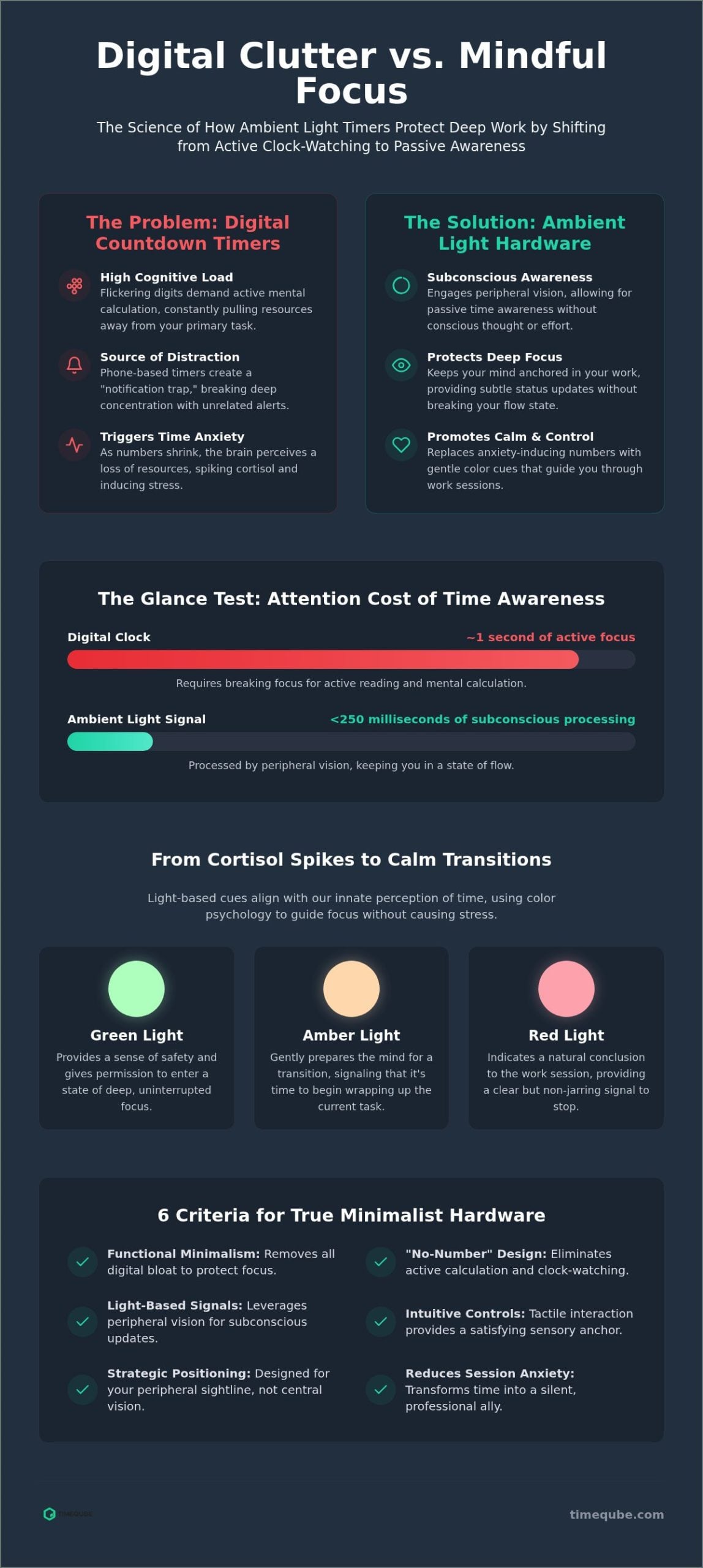
The removal of numeric displays marks the ultimate evolution of this hardware. Numbers require active computation. When you see “14:52,” your brain must calculate the distance from zero and the remaining duration of your task. This process is a subtle but persistent drain on your cognitive resources. By replacing digits with light or simple physical indicators, the hardware allows for subconscious recognition. This shift is essential for a “digital detox” workspace. In such an environment, the goal is to reduce the constant stream of sensory stimuli and reclaim mental clarity through intentional design.
The Problem with Digital and Phone-Based Timers
Notification-heavy devices are the primary enemies of flow. Using a smartphone as a timer introduces the “one more thing” trap. You check the remaining time and inadvertently see a high-priority email or a social media alert. This split-second distraction can destroy twenty minutes of deep concentration. Software-based timers also prove unsuitable for professional therapy environments. A therapist glancing at a phone appears disengaged. A dedicated piece of minimalist desk timer hardware signals intentionality and professional respect for the session’s boundaries.
Hardware vs. Software: The Cognitive Load Argument
The physical presence of a dedicated device creates a “time-work” boundary that software cannot replicate. When you physically interact with a timer, you signal a commitment to a specific block of work. This is particularly effective for those practicing the Pomodoro Technique. There is a profound tactile satisfaction in hardware-only interaction. It provides a sensory anchor that digital interfaces lack. Cognitive minimalism is the absence of active data processing. By offloading time tracking to a dedicated physical object, you free your mind to inhabit the present moment. This reduction in friction allows for a more natural transition between tasks without the fatigue of constant monitoring.
The Science of Subconscious Time Awareness
The human brain is not optimized to process digital countdowns during high-concentration tasks. Central vision manages the work at hand. Peripheral vision monitors the environment for changes. When you use numeric timers, you force your brain to switch its central focus away from the task. This creates a mental stutter. High-quality minimalist desk timer hardware leverages the peripheral field instead. It allows the mind to stay anchored in the work while receiving subtle status updates from the environment.
The “Glance Test” measures how quickly you can register your progress. A numeric clock requires about one second of active reading and calculation. A light-based signal is processed in under 250 milliseconds. This speed allows for subconscious awareness. You know exactly where you stand without ever leaving your state of flow. This efficiency is why visual hardware is becoming a staple in high-performance professional environments.
Countdown digits often trigger a fight-or-flight response. This phenomenon is known as time anxiety. As numbers dwindle, the brain perceives a loss of resources, which spikes cortisol levels. Shifting to color-coded cues resolves this stress. Green provides a sense of safety and permission to focus. Amber prepares the mind for a transition. Red signals a natural conclusion. This system aligns with our innate perception of time as a fluid rhythm rather than a series of shrinking blocks.
Visual Cues and the Human Brain
Ambient light signals bypass the analytical prefrontal cortex. They are processed by more primitive visual systems that don’t require conscious thought. This allows you to maintain deep work while remaining aware of your schedule. It’s the difference between being interrupted and being guided. You can explore the biological mechanisms behind this in The Science of the Ambient Time Awareness Device.
Eliminating the “Ticking” Distraction
Auditory distractions are particularly harmful in sensitive environments. In therapy or meditation, a ticking clock is a persistent stressor. Silent minimalist desk timer hardware ensures that the focus remains on the person, not the device. For professional settings, visual cues help entire teams synchronize their pace without the jarring effect of an alarm. This shared awareness fosters a more collaborative and less anxious atmosphere. If your office needs a calmer rhythm, a Timeqube for Business Meetings can provide that essential visual anchor.
Minimalist Timer Selection Checklist: 6 Essential Criteria
Selecting the right minimalist desk timer hardware is a strategic decision to protect your mental environment. It’s more than a visual choice. A professional tool must meet specific functional standards that prioritize focus over features. When hardware is designed with clinical precision, it becomes an unobtrusive ally rather than another source of noise. Use the following criteria to evaluate whether a device truly supports a high-performance workspace.
- Requirement 1: No Digital Display. Numbers trigger the analytical brain and invite active calculation. A true minimalist device uses light or physical transitions to signal time, adhering to the “no-number” rule for cognitive ease.
- Requirement 2: Tactile, Intuitive Controls. The interaction must be physical and immediate. One-touch starts or simple physical adjustments are superior to navigating complex menus or sub-screens.
- Requirement 3: Professional Build Quality. High-end workspaces require durable, premium materials. Avoid lightweight, “toy-like” plastics that degrade the professional aesthetic of an executive desk.
- Requirement 4: Hardware-Only Operation. The device must function independently. If it requires a smartphone connection or Bluetooth, it reintroduces the very notifications and distractions you’re trying to eliminate.
- Requirement 5: Ambient Visibility. The signal must be clear from your peripheral vision. This ensures awareness without requiring you to break your gaze from your primary task.
- Requirement 6: Silent Operation. Auditory alarms are often jarring and intrusive. A professional timer uses silent light transitions to signal the end of a session, preserving the tranquility of the room.
The “No-Software” Advantage for Professionals
Corporate environments often have strict security protocols that forbid unauthorized software. Hardware-only devices bypass the need for IT approval because they don’t connect to networks or store sensitive data. This “air-gapped” approach is vital for therapy sessions or legal consultations where privacy is a non-negotiable requirement. Reliability is another significant factor. A physical timer doesn’t suffer from software crashes, battery-draining background syncs, or forced firmware updates. It works the moment you touch it, providing a consistent experience every day.
Aesthetic Integration with Professional Desks
Your workspace reflects your professional identity and commitment to quality. A minimalist tool should complement high-end materials like wood, glass, or stone. A non-intrusive footprint ensures that the device doesn’t clutter your setup or cause visual friction. Timequbes for Business Meetings provide a professional, hardware-first solution that fits seamlessly into modern executive environments. Choosing hardware that values durability and understated leadership ensures your focus remains undisturbed. By prioritizing these six criteria, you create a desk setup that values mental well-being and intentionality.
Implementation: Using Minimalist Timers in Professional Workflows
Effective integration of minimalist desk timer hardware requires a transition from manual tracking to environmental awareness. It isn’t just about owning the tool. It’s about how the tool interacts with your field of vision and your team’s expectations. Successful implementation follows a clinical, five-step process designed to protect your cognitive resources.
- Step 1: Positioning the device for optimal peripheral awareness. Place the timer 30 to 45 degrees off-center from your primary monitor. This ensures the brain registers color changes without requiring a conscious shift in focus or eye movement.
- Step 2: Pre-setting session lengths to avoid mid-task adjustments. Choose your duration before the work begins. Touching the hardware once establishes a psychological boundary that prevents further fiddling or distraction.
- Step 3: Communicating the visual cues to clients or team members. Briefly explain that green signifies “flow,” amber indicates “wrap up,” and red means “session end.” This shared vocabulary removes the need for verbal interruptions during deep work.
- Step 4: Using the “Green Zone” for peak creative output. Treat the green light as a signal of safety. It’s your time to inhabit the deep work state with the confidence that you won’t miss your next commitment.
- Step 5: Respecting the “Red Zone” for graceful session conclusions. When the light turns red, use those final moments to summarize thoughts or document progress. It prevents the jarring realization that you’ve run out of time.
Visual Timers in Mind/Body Therapy
Therapeutic presence is fragile. Frequent clock-watching by a practitioner can make a client feel rushed or unheard. Timeqube for Mind/Body Therapies allows therapists to stay entirely present. By using color to signal transitions, the practitioner maintains eye contact and rapport while staying aware of the schedule. This reduces the “clock-watching” behavior that often breaks the therapeutic alliance and helps create a seamless transition between therapeutic stages.
Streamlining Corporate Meetings
Meetings often drift because participants lack a shared sense of duration. A dedicated meeting leader can use light to keep the agenda on track silently. This method reduces meeting fatigue by providing a clear, visual boundary for every discussion point without the stress of a ticking clock. For those looking to master individual productivity, The Ultimate Guide to Using a Visual Timer for Deep Work offers advanced strategies. If you’re ready to bring this calm to your office, consider implementing professional minimalist desk timer hardware for your next board meeting.
Why Timeqube is the Gold Standard for Minimalist Hardware
Timeqube represents the pinnacle of minimalist desk timer hardware by prioritizing the biological needs of the human brain. Most productivity tools demand more of your attention to help you manage it. Timeqube operates on the opposite principle. The core philosophy is that time should be felt, not watched. By removing the ticking clock and the numeric countdown, it eliminates the cognitive friction associated with traditional timekeeping. This approach allows you to maintain a state of unhurried presence while remaining fully aware of your schedule.
The physical build of the device reflects this commitment to professional harmony. It’s designed for daily use in high-stakes environments, from executive boardrooms to therapy offices. There are no cheap plastics or toy-like components. Instead, you find a robust, elegant piece of hardware that anchors your desk setup. The “no-distraction” guarantee is a fundamental part of the design. It’s a pure hardware solution. There are no apps to install, no Bluetooth connections to drop, and zero digital interference from notifications. It’s a silent partner that respects your mental space.
Designed for Performance, Not Just Aesthetics
The device uses science-backed color transitions optimized for the human visual system. These specific wavelengths of light are easily detected by your peripheral vision, ensuring you never need to look directly at the unit to know your status. For professionals with demanding schedules, the long-lasting battery life ensures the tool is ready when needed. Timeqube is a tool for the subconscious, not another screen to monitor. It provides a steady, logical flow to your day without the fatigue of active data processing.
Branding Your Productivity
Professional-grade hardware has a profound impact on company culture. It signals a commitment to mental well-being and intentional work. For organizations looking to unify their aesthetic, Custom Logo Timequbes balance brand identity with focused productivity. This customization allows companies to provide their teams with a sophisticated tool that reinforces professional values. It transforms a simple timer into a symbol of a distraction-free environment. Explore the Timeqube collection and reclaim your mental space.
Reclaiming Your Mental Space
Selecting professional minimalist desk timer hardware is a strategic investment in your cognitive health. By removing numeric countdowns, you eliminate the constant mental calculation that fuels time anxiety. This shift to ambient, light-based awareness allows you to remain anchored in your work while staying synchronized with your schedule. You’ve learned that true minimalism isn’t just a visual style. It’s a functional commitment to removing digital friction and protecting your state of flow. High-quality hardware ensures that your tools respect your mental boundaries rather than competing for your attention.
Upgrade your desk with the Timeqube Professional Visual Timer to experience a distraction-free environment trusted by therapists and executives globally. It’s a pure hardware solution that leverages subconscious time awareness technology to restore professional harmony. Your focus is your most valuable resource. Protecting it starts with choosing tools that value your tranquility as much as your productivity. Embrace a calmer way to work today.
Frequently Asked Questions
Does minimalist desk timer hardware require an app to function?
No. True minimalist desk timer hardware operates entirely without the need for an app, Bluetooth, or Wi-Fi connectivity. This hardware-only design ensures that your focus remains on the task at hand rather than being interrupted by phone notifications or software updates. By eliminating the digital layer, these devices provide a reliable and secure experience that is ideal for sensitive professional environments where data privacy is a non-negotiable priority.
Why is a light-based timer better than a digital clock for focus?
Light-based timers leverage peripheral vision to provide status updates without requiring you to break your gaze. Unlike a digital clock that forces your brain to calculate remaining minutes, a visual signal is processed subconsciously in milliseconds. This reduction in cognitive load prevents the time anxiety often triggered by watching a numeric countdown. It allows you to maintain a deep state of flow while staying aware of your session’s progress without active data processing.
Can I use a minimalist hardware timer for Pomodoro sessions?
Yes, these timers are highly effective for managing intervals like the Pomodoro Technique. By setting a specific duration, you create a physical boundary for your work session. The transition from green to amber and red provides a gentle, non-intrusive reminder to wrap up your tasks before a scheduled break. This tactile interaction with a physical device often leads to a stronger psychological commitment to the work interval than using a distracted phone app.
Are these timers suitable for a professional therapy office?
Professional hardware timers are specifically engineered for therapeutic settings where eye contact and rapport are essential. A therapist can monitor session progress through peripheral light cues without the disengaged appearance of checking a phone or watch. This helps maintain the holding space for the client. The silent operation ensures that the therapeutic environment remains tranquil, preventing jarring alarms from interrupting sensitive emotional moments or meditative practices that require a high degree of presence.
How long does the battery last on a professional hardware timer?
Modern minimalist desk timer hardware is designed for long-term reliability in busy schedules. While specific battery performance varies by model, many high-end visual timers feature rechargeable batteries that last for several days of continuous professional use. This durability ensures that the tool is always ready for back-to-back meetings or therapy sessions. You can typically charge these devices via standard USB-C connections, making them a low-maintenance addition to any executive desk setup.
Do visual timers make ticking sounds?
True minimalist hardware is designed to be completely silent. Auditory ticking can increase cortisol levels and serve as a persistent distraction in quiet offices or therapy rooms. By relying on light-based signals rather than mechanical movements or digital beeps, these timers provide a stress-free way to track time. This silence is a core requirement for practices that prioritize mental well-being and a calm, intentional workspace where every sensory stimulus is carefully curated.
Can I customize a desk timer with my company logo?
Yes, customization is a key feature for organizations looking to integrate productivity tools into their brand identity. Professional providers offer the option to feature corporate logos on the hardware itself. This turns a functional tool into a symbol of company culture and a commitment to focused work. Branded timers are often used as executive gifts or as standard equipment in corporate meeting rooms to ensure all participants share a unified, professional sense of time.
Is hardware more reliable than phone-based timers for meetings?
Hardware is significantly more reliable for professional meetings because it’s immune to the distractions of a multi-purpose device. Phone-based timers often fail when a call comes in or a notification covers the screen. A dedicated physical timer provides a constant, unmoving visual anchor that everyone in the room can see. This shared awareness keeps agendas on track without the technical friction or privacy concerns associated with using personal mobile devices in a high-stakes boardroom environment.