

You can end therapy at any time and for any reason. When possible, planning the ending with your therapist gives you space to review your progress, discuss anything that feels unfinished, and consider what support you may need next. Knowing how to end therapy sessions gently starts with an honest conversation, not a perfect goodbye.
It’s understandable to feel relief, sadness, uncertainty, or several emotions at once. You don’t need to make a final decision before raising the possibility of ending. The conversation can help you consider whether your goals have shifted, whether therapy still meets your needs, and what a thoughtful final session might look like.
This guide explains how to assess the timing, prepare for closing sessions, and make space for emotions without rushing them. You’ll also learn how to reflect on what has changed, identify the skills and insights you want to carry forward, and plan for future support. The aim is a considered transition that recognizes both the work you’ve done and what comes next.
Key Takeaways
- Bring up the possibility of ending therapy before you’ve made a final decision, and discuss what a planned ending could involve.
- Choose a way to communicate that feels manageable, then use the conversation to share concerns and agree on next steps.
- Make room for mixed emotions during the final session. A slower pace and open conversation can help you stay present.
- Use the closing sessions to recognize changes, name useful skills, and consider what support may help you maintain progress.
- Build a clear ending into the session by leaving time to reflect, summarize, and discuss future care.
Ending therapy by email, text, voicemail, or in person
A planned ending starts with a clear conversation, whether you raise it by message or during a session. These steps can help keep the discussion direct, collaborative, and focused.
-
Start the Ending Conversation
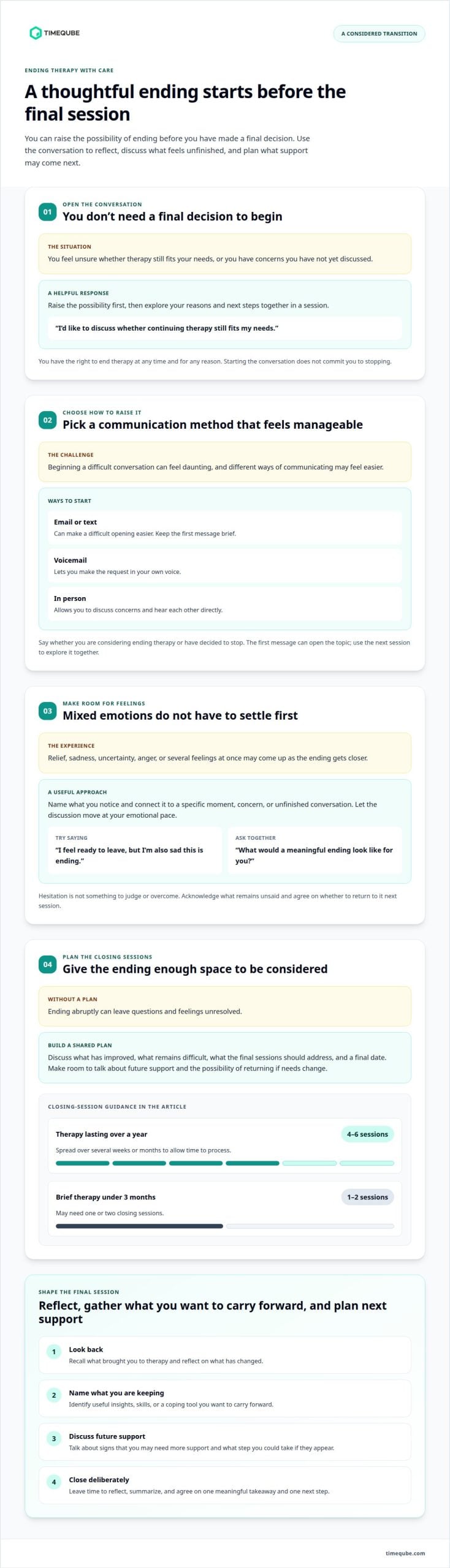
Raise the possibility of ending therapy before making a final decision. You might write, “I’d like to discuss whether continuing therapy still fits my needs.” An email, text, voicemail, or in-person conversation can open the topic. Keep your first message brief, then use the next session to explore your reasons and possible next steps together.
- Choose the communication method that helps you begin honestly. A text can make a difficult opening easier, while a voicemail lets you make the request in your own voice. An in-person conversation allows you to discuss concerns and hear each other directly. Whichever method you choose, explain whether you’re considering ending therapy or have decided to stop. You have the right to end therapy at any time and for any reason, and you can raise the possibility without having made a firm decision.
-
Offer Empathic Insight
Acknowledge feelings about ending without treating them as proof that therapy should continue. For example, say, “It makes sense that part of you feels ready and part feels unsure.” Invite the client to reflect on what the relationship has meant and what feels unfinished. Avoid judging hesitation or treating a defense as resistance to overcome.
- If a client’s thought runs over the session, acknowledge what remains unsaid and hold the time boundary with care. Try, “I can hear this matters; let’s decide how we’ll return to it.” If the client resists ending, ask what feels difficult about stopping today. Don’t cut off the discussion abruptly. Agree on whether to revisit the topic next session, while keeping the ending plan in view.
- Use a direct, open starter in person, such as, “What would a meaningful ending look like for you?” or, “What would you like us to discuss before our final session?” A termination plan can review what went well, what the ending will involve, and the final session date. For therapy lasting over a year, 4-6 sessions spread over several weeks or months can allow time to process. Brief therapy under 3 months may need one or two closing sessions.
Regulating emotions during the final session
Discuss what has changed, what remains unresolved, and what support may help after therapy. You can also name your feelings about the ending and decide what would make the final session useful.
- Request a final session when you’re ready to focus on closure. Tell your therapist what you hope to address, such as your progress, lingering concerns, or what comes next. If you’re unsure about ending, say so directly. Learning how to end therapy sessions gently can begin with acknowledging uncertainty, rather than waiting until every feeling has settled.
- Before the meeting, make a short list of priorities: a change you’ve noticed, a skill you want to keep using, and a question about future support. For example, setting boundaries may have become easier, while conflict at work still feels difficult. The list gives the session direction without requiring you to plan every word.
- Let the conversation move at your emotional pace. If sadness, relief, anger, or several feelings arise, name what you notice and pause before moving on. Ask, “What feels most important to say before we finish?” This open question can help you stay with the present feeling instead of rushing toward a polished goodbye.
- Give the final session a clear shape. Start by discussing what brought you to therapy, then reflect on changes, useful insights, and skills you want to carry forward. Make time for practical mental health planning: discuss what signs might suggest you need more support and what step you could take if they appear.
- Make space for mixed feelings about the therapeutic relationship. You might feel proud of your progress and still miss the regular sessions. Try saying, “I feel ready to leave, but I’m also sad this is ending.” Discussing both responses can clarify what matters to you without requiring you to change your decision.
- Close by choosing one meaningful takeaway and one next step. You might identify a coping tool to use during stress or a trusted person to talk with. If a new concern arises near the end, tell your therapist what needs attention. For a client considering how to end therapy sessions gently, a deliberate closing exchange can make the transition feel considered rather than abrupt.
Exploring emotional themes associated with termination
Ending abruptly can leave unanswered questions and feelings of anxiety, sadness, or anger. If your therapist ends treatment unexpectedly, ask to discuss why, what ongoing needs you have, and what steps could come next.
-
Plan Termination Collaboratively
Ask to shape the ending together, even if you’re still deciding whether to stop. Discuss what has improved, what remains difficult, and what the final sessions should address. A shared plan can include a final date and a conversation about returning if your needs change. Mixed feelings don’t mean either person has made the wrong choice.
- Notice which emotions arise as termination gets closer. You might feel relief about managing daily life independently, sadness about losing a trusted relationship, or anger about unresolved conflict. Name the feeling and connect it to a specific moment, such as a goodbye, a change in routine, or an earlier separation. That gives you and your therapist something concrete to discuss.
-
Review the Risks of Abruptly Stopping
Ask what could remain unresolved if sessions stop without a closing conversation. An abrupt ending can leave both client and therapist with unanswered questions and difficult emotions. If your therapist ends treatment unexpectedly, describe the support you still need and ask how the transition will be handled. In cited clinical guidance, abandonment means failing to meet a client’s ongoing treatment needs appropriately.
- Distinguish an urgent ending from one that can be planned. Therapy may stop because of illness, a move, lost insurance coverage, or dissatisfaction with the therapist or treatment direction. If continuing feels harmful or you no longer want therapy, say so clearly. When circumstances allow, discuss practical next steps and immediate treatment needs rather than leaving important concerns unspoken.
-
Avoid New Interpretations
Keep final conversations grounded in themes already explored during treatment. If a new interpretation comes up, ask how it connects to your earlier work and whether there’s time to explore it. Avoid presenting a fresh clinical explanation as settled fact during the goodbye. For example, discuss a familiar pattern you’ve examined together rather than assigning a new meaning to your decision to leave.
- Use a simple termination checklist or worksheet to organize the conversation. Include what prompted therapy, changes you’ve noticed, insights or skills worth keeping, unresolved questions, and support to consider afterward. Treat each item as a prompt, not a test of progress. If an answer brings up strong emotions, pause to explore that response before moving on.
How early should you start wrapping up a therapy session?
For a standard session, begin winding down 5 to 10 minutes before the scheduled end. Use that time to shift from intensive work toward reflection and a clear goodbye.
- Set a time boundary that fits the session length. A typical therapy session lasts about 45 to 55 minutes, and a sample 50-minute structure offers one practical model. Longer sessions may need 10 to 15 minutes for winding down. The aim is to leave room for emotional processing, not to stop a meaningful conversation mid-thought.
- Use a brief time check before the final minutes. In a sample 50-minute session, the check falls around minutes 38 to 40. The earlier portion, minutes 5 to 38, is available for core work. A simple reminder, such as “We have about ten minutes left,” lets both people adjust focus without an abrupt shift.
- Reserve the closing minutes for a deliberate transition. In the same sample, minutes 40 to 45 are for summarizing and reflecting, followed by minutes 45 to 48 for next steps and scheduling. The final minutes, 48 to 50, can hold a short closing ritual. This structure gives the goodbye a place without turning every session into a rigid script.
- Notice verbal and nonverbal cues before changing pace. If a client becomes distracted, hesitant, confused, resistant, or stuck, slow down and clarify what’s happening. A short question such as “What feels most important to take from this today?” can bring the conversation back to the client’s needs. Don’t treat silence or a pause as automatic agreement to stop.
- Review treatment goals when considering whether it may be time to end therapy. Goals set early on can change as circumstances and insight evolve, so revisit them together. Reduced symptoms, improved relationships or daily functioning, more positive body language, and a brighter outlook may suggest readiness. Weigh these signs alongside ongoing treatment needs, rather than using them as a checklist that decides on its own.
- Make the transition collaborative when signs of readiness appear. Ask what has improved and what still needs attention, then discuss whether another focus remains. If the client seems uncertain, explore that feeling before planning a goodbye. A careful conversation can distinguish readiness to end from temporary relief, a difficult week, or reluctance to begin new work.
Reviewing progress and consolidating learning
Use closing sessions to make progress visible and turn useful insights into practical next steps. A written summary can help you hold on to key ideas after therapy ends.
-
Summarize Progress and Next Steps
Ask your therapist to help summarize what prompted treatment, what has changed, and which insights or skills feel useful now. Name specific examples, such as speaking up in a difficult conversation or using a coping skill during stress. Then identify remaining questions and discuss how to address them in your next steps. Don’t measure progress only by whether every difficulty has disappeared.
- Record the methods you want to keep practicing. For example, note a grounding exercise, a boundary-setting phrase, or a routine that supports your mental health. Beside each one, write when it helped and when you might use it again. Concrete reminders make skills easier to recall in a demanding moment, instead of relying on a general promise to “keep improving.”
-
Plan to Maintain Progress
Build a realistic plan for life after therapy with actions that fit your routine. You might pause before responding during conflict, set aside time to reflect, or reconnect with supportive people. Discuss what changes in mood, relationships, or daily functioning could signal a need for more support. Keep the plan flexible and include how you could return to therapy if circumstances change.
- Write a short goodbye letter or progress note with your therapist. It can capture key understandings, strengths you’ve noticed, and areas you may want to keep exploring. Include a personal example, such as recognizing a familiar thought pattern before it shaped your response. The aim isn’t to preserve every session, but to leave with a clear record of what feels meaningful and useful.
- Close by identifying one next action and one source of support. Your action could be practicing a skill in a specific situation; support could mean talking with someone you trust. Discuss what you’ll do if a new crisis, trauma, or major life transition affects your mental health. Ending therapy doesn’t erase your progress, and reconnecting can remain part of your future care plan.
Timeqube
Timeqube offers physical visual timers that can support clear time boundaries in therapy without digital distractions. For therapists, a color-coded light signal makes the approach of a session’s end visible, leaving more attention for reflection and a considered goodbye. The timer can complement the clinical conversation, not replace discussion of feelings, progress, or future care.
Turn to Timeqube for Mind/Body Therapies when a visual time cue could help structure sessions. Timeqube also offers options for business meetings and customized timers with a logo, suited to other professional settings.
If you’d like to explore whether Timeqube fits your practice, contact Timeqube.
Carry the Work Forward
A thoughtful ending doesn’t need to resolve every question. It can mark a shift: therapy has helped you notice patterns, make choices, and respond with greater intention. Learning how to end therapy sessions gently also means letting the transition be personal, rather than measuring it against someone else’s idea of a perfect goodbye.
As you move forward, let your next steps respond to your life. A useful practice may be to pause, notice what you need, and draw on the tools that fit the moment. For therapists, a clear time boundary can make session endings more predictable without dictating what a client should feel.
Contact Timeqube to talk about supporting a more intentional rhythm in your practice. The work you’ve done can continue to guide you, one considered step at a time.
Frequently Asked Questions
When Is the Right Time to End Therapy?
The right time is when therapy no longer meets your needs, or when continuing may cause harm. The American Psychological Association’s 2017 ethics code identifies these as reasons psychotherapy should end. Consider whether your original goals still matter, whether your circumstances have changed, and whether you’re gaining value from treatment. A change in symptoms alone doesn’t decide the question; discuss how therapy fits your current needs.
How long should the ending process take?
The ending process can take several meetings or just a brief closing conversation. For therapy lasting over a year, 4-6 sessions spread over several weeks or months can make room to process the transition. For brief therapy under 3 months, one or two closing sessions might suffice. Use the time to address what remains important, rather than following a schedule that doesn’t fit your treatment history or circumstances.
Is it ever okay to ghost your therapist?
You have the right to end therapy at any time and for any reason. If it feels safe and manageable, send a brief message rather than disappearing. For example: “I’ve decided to stop sessions for now. Thank you for the work we’ve done.” You don’t need to defend your decision. A short note can make clear that you’re ending treatment and give you a point of closure.
What If You Need to Come Back?
You can discuss returning to therapy if your needs change. A new crisis, trauma, or major transition such as bereavement may prompt you to seek support again. Before ending, consider asking, “What might tell me it’s time to reconnect?” This gives you a personal signal to remember, such as difficulty managing a familiar challenge. Returning later doesn’t erase the work or progress you made during earlier treatment.
How can I gently bring up ending therapy with my therapist?
Start with a simple statement that leaves room for discussion: “I’ve been thinking about ending therapy, and I’d like to talk it through.” You can say this in a session or send a short message beforehand. If you’re unsure, make that clear. For example, explain that your needs or priorities have shifted and you want to consider what continuing treatment might offer.
What are the steps for a planned therapy termination session?
Begin by naming what you want the meeting to accomplish. Reflect on what brought you to therapy, identify changes that matter to you, and name any concerns still on your mind. Close by discussing what support or resources you may use afterward. If an important topic feels too large for the time remaining, tell your therapist so you can decide how to address it.
How much notice should I give before ending therapy?
You can end therapy at any time, so you don’t need to give notice to exercise that right. If you can plan ahead, tell your therapist when you want to stop and discuss whether a closing appointment would be useful. If you need to stop immediately, communicate that decision plainly. Your reason for ending, current needs, and whether another meeting feels appropriate can guide your next step.
How many sessions are usually recommended for a therapy ending?
There isn’t one session count that fits every ending. Therapy lasting over a year may use 4-6 meetings across several weeks or months; shorter treatment under 3 months may use one or two closing sessions. A planned ending can also follow an agreed set of four final sessions. The useful number depends on how much time you need to reflect, address open concerns, and prepare for care after therapy.