
The most memorable desk gift may be the one people use without thinking about it. A branded desk timer makes time visible at an individual workstation while keeping your logo in view. Its value as a corporate gift comes from pairing a practical time cue with a lasting brand presence.
Choosing one still takes thought. The style, logo placement, order quantity and delivery schedule all shape whether a timer fits your recipients and your campaign. A useful gift should feel considered, not like another item competing for attention.
This guide explains which timer styles suit different workplaces, what affects logo visibility and how pricing and delivery decisions work. You’ll also learn what to consider when comparing order quantities, and how Timeqube’s visual timers can suit business meetings or branded gifting.
Key Takeaways
- Choose a timer style and logo placement that keep the imprint visible in the recipient’s workspace.
- Understand how order quantities and customization choices shape a promotional order.
- Plan delivery around the production and shipping steps that affect when gifts arrive.
- Compare product prices with the features and presentation your campaign needs.
- Explore visual timers with custom logos when you want a practical gift that supports calmer time awareness.
Custom imprint and logo options
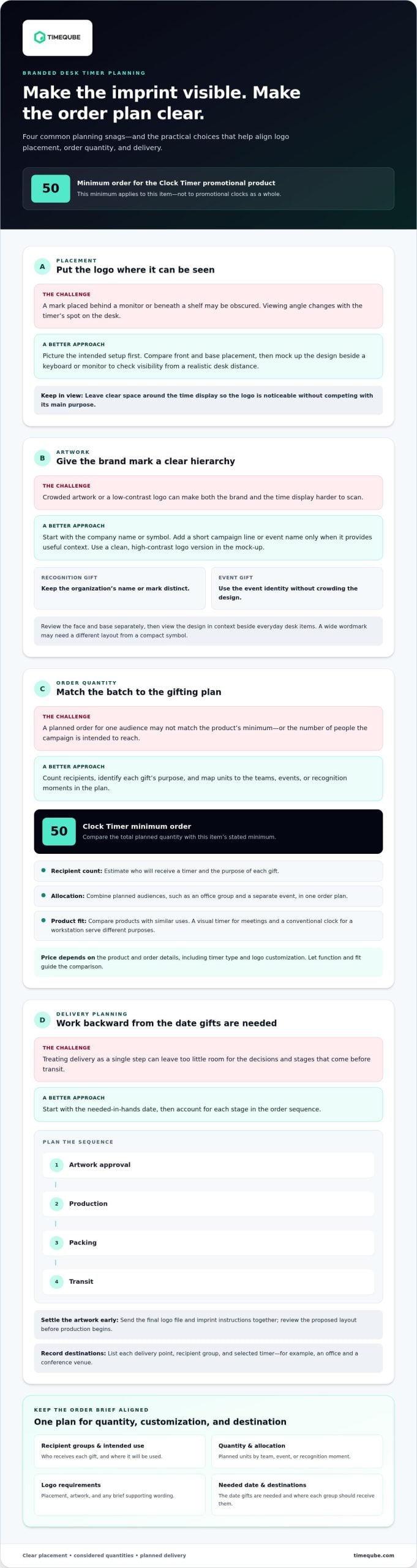
Plan the imprint around where the timer will sit and how recipients will see it. A desk timer keeps time visible at a workstation, so logo placement can shape how easily people notice your brand.
Custom Imprint Options
Picture the timer in its intended spot before choosing logo placement. A mark on the front or base may be easy to see, while one behind a monitor or beneath a shelf can be obscured. A timer beside a keyboard, for example, has a different viewing angle from one tucked behind a screen.
Leave clear space around the time display so the logo is noticeable without competing with the timer’s main purpose. Mock up a compact mark and a larger design on the intended surface. Viewing the design at a realistic desk distance helps you judge whether it remains legible.
Give the artwork a clear visual hierarchy. Start with the company name or symbol, then decide whether a short campaign line adds useful context. For a recognition gift, a restrained layout keeps the logo distinct. For an event gift, the event name may help identify the occasion without crowding the design.
Logo Options
Logo decisions cover more than choosing a file. Review the mark’s shape, color, and background against the timer’s visible area. A wide wordmark may need a different layout from a compact symbol. Use a clean, high-contrast version in the mock-up so the design can be assessed at its intended size.
Decide what recipients should recognize first. An employee appreciation gift might lead with the organization’s name, while an event keepsake could emphasize the event identity. Keep secondary wording brief: a crowded design makes both the logo and the time display harder to scan.
Review the complete design in context before approving it. Assess the face and base separately, then place the timer in a mock-up beside a monitor, notebook, or desk calendar. This shows whether the logo stands out among everyday desk items and helps your team compare proposed layouts consistently.
Match the imprint to the timer’s purpose. A charger clock, for example, may sit among cables and personal devices, while a visual timer may support time awareness during work. For either format, keep the brand mark clear and the time display easy to see. The goal is a practical desk object with a logo that earns attention through placement, not visual clutter.
Minimum order quantities and pricing
Minimum order quantity sets the smallest batch available for a promotional product. For the Clock Timer promotional product, the minimum order is 50 units. Treat that figure as specific to this item, not as a universal rule for promotional clocks. A gift plan for a smaller employee group may need a different product or a revised distribution plan.
Start by counting the intended recipients and matching the quantity to the campaign. A company recognizing one department may need a different order plan from a business preparing welcome gifts for new employees. This step helps avoid ordering more units than the program can use.
Then divide the planned quantity among the relevant audiences or occasions. A company might allocate units for employee recognition, a conference, and a client thank-you program. Keep those allocations in one order plan so the total is clear, and compare any minimum order quantity with the number of intended recipients across those uses.
Price depends on the product and order details, including the timer type and logo customization. Choose based on function and fit: a visual timer for meetings serves a different purpose from a conventional clock for a workstation. Compare products with similar uses rather than treating every timer as interchangeable.
- Recipient count: Estimate who will receive a timer and the purpose of each gift.
- Minimum quantity: Compare the planned order with the product’s stated minimum.
- Customization: Decide whether the logo or other imprint is central to the campaign.
- Allocation: Map units to teams, events, or recognition moments before ordering.
For example, if a team plans gifts for a single office and a separate event, combine both audiences before comparing the total with the Clock Timer’s 50-unit minimum. Then review whether the chosen model fits both settings. A branded desk timer may suit individual workspaces, while a kitchen timer may serve a shared break area. The intended function should guide the choice.
Use a written order brief to keep quantities and customization aligned. Include the recipient groups, intended use, logo requirements, and the date the gifts are needed. A clear brief gives the order a consistent basis for pricing and helps your team spot a mismatch between the planned quantity and the gifting program.
Order and delivery timing
Delivery planning begins with the date gifts need to be in recipients’ hands. Work backward from the corporate event, employee welcome, or travel departure, allowing time for artwork approval, production, packing, and transit. These stages affect the schedule, so treating delivery as a single step can leave too little time for the earlier decisions.
Record the date gifts are needed and each destination. A company sending gifts to an office and a conference venue has two delivery points to plan. Note the recipient groups and selected timer for each destination. A clear order brief helps prevent a branded timer shipment from being assigned to the wrong audience or location.
Make artwork approval an early milestone. Send the final logo file and imprint instructions together, then review the proposed layout before production begins. A corporate recognition gift may need only the company mark, while an event gift may also include the event name. Settle those choices before approving the design to avoid late changes.
Product selection also shapes the order sequence. A desk timer, an alarm clock, and watches are different gift choices, and each may follow its own preparation and shipping process. Keep each type separate in the order brief. If a campaign combines desk gifts for employees with travel gifts for attendees, label quantities and destinations by group.
Use this planning sequence to keep decisions visible:
- Set the required arrival date. Use the event or distribution date, not the date the order is placed.
- Confirm the destination. Separate office, event, or other delivery locations in the plan.
- Finalize the design. Gather the logo, imprint wording, and approval before production.
- Organize each batch. Match timer type, recipient group, and destination.
- Allow time for transit. Include shipping in the schedule rather than treating production as the final step.
For a conference gift, first establish when the venue can receive the order, then finalize the logo design and attendee quantity. Next, identify the timer and delivery address. Keep a separate schedule for employee gifts going to the office. This makes it easier to track both timelines without mixing artwork or destinations.
Build an internal buffer by settling artwork and destination details early. That gives your team time to review a proof, correct an address, or coordinate separate shipments. It also makes a branded desk timer order easier to manage alongside travel arrangements, event materials, and other corporate gifts from providers like SwagStore.NET.
Timer product prices
Compare timers by product type, function, and logo requirements. A visual desk timer for a meeting serves a different role from a clock for a shared room. Start by matching the item to its setting, then compare products with similar uses rather than judging a basic timer against a model with unrelated features.
Focus on features that serve the intended use. Timeqube uses color-coded light signals to show remaining time without sound or alarms, making it a visual time cue for meetings and therapy settings. Consider whether recipients need a conventional clock display or a gentle visual signal, and avoid paying for functions that do not fit the gift’s purpose.
The product’s look and finish also matter. Consider how the timer will sit in the recipient’s workspace and whether its design suits the occasion. Compare the complete product, including its use, appearance, logo placement, and presentation, rather than judging by one feature alone.
Customization can also shape the product quote. A logo, additional wording, or a different imprint location may affect the production work. Compare the same artwork requirements across the options under consideration. For instance, review a logo-only design beside one that includes an event name. That keeps the design decision connected to the quoted product.
Use a consistent comparison checklist:
- Purpose: Decide whether the timer is for an individual desk, reception counter, or shared room.
- Function: Separate essential timekeeping from extras such as a wireless charger.
- Material: Compare finishes, such as bamboo or glass, against the gift’s intended presentation.
- Imprint: Keep logo placement and artwork requirements consistent across options.
- Order plan: Compare the quantity and delivery needs alongside product details.
A practical example: a company choosing gifts for individual workstations could compare desk models with similar time displays and logo requirements. If the audience will use phone charging at their desks, include a wireless charger option in the comparison. If the gifts are for a reception area, consider whether wall clocks fit the space better than individual desk pieces.
Compare like with like, then decide which function and presentation matter most to recipients. A straightforward gift may call for a simple, useful time cue, while a meeting-focused gift can serve a specific workplace routine. This makes comparisons more meaningful than treating every clock or timer as the same product.
Cost of custom logo desk timers in the United States
The cost of a branded desk timer depends on the product and order details. A visual timer and a conventional desk clock serve different purposes, so start by choosing the function recipients will use. Then compare products within that category to keep the budget focused on practical value.
Product design is one factor. A compact timer for an individual workstation differs from a larger desk clock chosen for reception. Materials, display design, and included functions also shape the product being priced. For example, compare two desk models with similar time displays before deciding whether a different finish or added feature justifies the higher quote.
Logo customization can affect the total. A logo-only imprint may require different artwork preparation from a design that includes a campaign line or event name. Placement matters too. A front-face imprint and a base imprint use different visible areas, so the final artwork can affect production requirements. Keep the design consistent while comparing product quotes.
Order quantity is another key factor. A promotional product may have a minimum batch size, and the Clock Timer promotional product has a 50-unit minimum. Compare that minimum with your planned recipient groups. For example, combine employee recognition gifts and event gifts in one order plan only when the same product and artwork suit both audiences.
Use a clear cost comparison rather than relying on a headline figure. Compare the product, customization, quantity, and delivery requirements included in each quote:
- Product: Record the timer style, material, and selected functions.
- Quantity: Match the order size to the product’s minimum and recipient plan.
- Imprint: Specify the logo artwork, wording, and chosen placement.
- Delivery: Include the destination and required arrival date in the order details.
For example, compare a conventional desk clock with a visual timer as separate products. Use the same logo requirements and intended quantity for both. This helps your team understand how the product choice and customization shape the overall comparison.
In the United States, plan the budget around the complete order, not just the timer. Product choice, logo treatment, quantity, and delivery requirements all matter. A focused brief helps you weigh these factors together and choose a gift that fits the recipient’s desk and the campaign’s purpose.
Timeqube: Timeqube for Mind/Body Therapies
Timeqube offers a visual timer for mind/body therapy settings, where a calm time cue can support session awareness without digital distractions. Its color-coded light signals make time visible without relying on a screen. For corporate gifts, Timequbes with your logo connect that visual function with a company identity. They can suit recipients who value intentional timekeeping at a desk or in a professional setting.
For workplaces, Timeqube for Business Meetings offers a related option focused on meeting environments. Choose the offering according to where recipients will use the timer: therapy spaces, individual desks, or business meetings. Visit Timeqube to explore the visual timer options for your gifting needs.
Make the Gift Part of the Workday
A thoughtful corporate gift can become part of someone’s everyday routine. Before choosing a timer, decide what you want it to represent: appreciation, focus, or a more intentional pace. That purpose gives your team a useful filter for the final design and helps connect the gift to your workplace culture.
A branded desk timer can bring that intention into a recipient’s everyday environment. Choose one that suits its setting and reflects the message you want to share. Consider how it will sit alongside the recipient’s daily tools, not only how its logo looks.
Timeqube offers options for mind/body therapies, business meetings, and custom logo gifting. If you’re ready to explore visual timers for your organization, explore logo timers with Timeqube.
Choose with purpose, and let a practical gift carry a calm, clear message into the workday.
Frequently Asked Questions
Why should you buy and give away promotional table timekeepers?
A branded desk timer pairs a useful time cue with a visible company identity. It can suit employee appreciation, onboarding, or a business event where recipients need a practical item for their workspace. For example, a team could include timers in a welcome gift for new hires. Choose one when time awareness fits recipients’ routines better than a keepsake used only once.
What is a branded desk timer and what features are available?
A branded desk timer is a tabletop timekeeping device customized with a company identity. Features vary by model. Some clocks combine time display with a wireless charger, while Timeqube uses color-coded light signals to indicate remaining time without sound or alarms. Consider whether recipients need a conventional clock display, an added desk function, or a visual cue during meetings. Match the feature to the setting rather than selecting extras by default.
What types of desk timers can businesses choose from?
Businesses can consider compact tabletop clocks, visual timers, and clock models that include a wireless charger. The right format depends on where recipients will use it. A compact item may fit an employee’s personal desk, while a visual timer can suit a meeting space where participants need a shared time cue. Timeqube also offers visual timers for mind/body therapies and business meetings, plus logo customization for corporate gifting.
What are the minimum order quantities for personalized desk timers?
Minimums depend on the specific promotional item. The Clock Timer promotional product has a minimum order quantity of 50 units. Treat that threshold as product-specific when planning a campaign. For example, a company with several departments can map intended recipients across teams before deciding whether one shared order makes sense. Keep the model and imprint consistent across the batch so the quantity plan reflects a single, coherent gift.
How do you customize a desk timer with a company logo?
Start with your approved logo artwork and decide which brand elements should appear. Keep the design clear at the timer’s viewing distance, particularly if recipients will see it from across a desk. For multiple departments, use a consistent logo treatment across distributions. Review the complete layout, including any campaign wording, before approving it.
How long does production and shipping take for custom desk timers?
Plan the schedule around artwork approval, production, packing, and the delivery destination. Work backward from the date recipients need their timers. For a conference, account for the venue’s receiving arrangements; for employee gifts going to multiple locations, organize destinations before shipment. Finalize the logo design and address details early, and include transit time rather than treating dispatch as arrival.
What should businesses check before ordering desk timers?
Check that the timer suits its recipients, the logo follows your brand guidelines, and the quantity matches the order plan. Review delivery locations and the date the gifts are needed, too. An order for an office and a conference may require separate destination details. A concise order brief keeps product choice, branding, and distribution aligned.
How do branded desk timers compare with other promotional office gifts?
Branded desk timers bring a practical time cue to an individual workstation while keeping your brand visible. Timeqube’s color-coded visual timer offers an alternative to conventional desk clocks, using light signals to show the time remaining without sound or alarms.