

A deadline can create pressure, but every worried thought is not a reliable sign of danger. Deadline anxiety is stress and worry linked to an approaching due date, often shaped by fear of falling behind or failing to meet expectations. Reducing stress about deadlines starts with separating the task from the thoughts and physical tension around it.
When a due date keeps occupying your attention, deciding what to do first can feel difficult. The pressure is real, but it doesn’t have to dictate your next move. A clear plan can make the work feel more manageable and help bring your attention back to the present.
This article explains how to recognize deadline anxiety and respond with realistic planning, smaller steps, breathing, and grounding techniques. It also covers how to distinguish self-imposed pressure from an external deadline, and how clarifying a deadline’s purpose can make expectations easier to understand.
Key Takeaways
- Notice when worry about a due date is affecting your focus, sleep, or sense of control.
- Turn a large assignment into manageable steps, then leave room in your schedule for unexpected delays.
- Use breathing and sensory grounding to bring your attention back to the task in front of you.
- Separate externally set deadlines from pressure you may be placing on yourself.
- Clarify what a deadline is meant to achieve so you can discuss priorities and expectations more clearly.
1. What is deadline anxiety?
Deadline anxiety is stress associated with an approaching date for submitting work or completing a task. It may start with fear of missing the due date or failing to meet expected standards. For example, an employee might reread a report repeatedly because “finished” feels less safe than “perfect.” Someone else might freeze because the first step is unclear. These reactions can make a deadline feel threatening before work begins, even when the task is manageable.
Stress and anxiety can feel similar, but they follow different patterns. Stress typically responds to a specific demand and eases when the pressure passes. Anxiety may continue after external pressure has eased, fueled by perceived threats without a clear resolution. At work, signs can include disrupted sleep, irritability, persistent worry, feeling overwhelmed, headaches, or muscle tension. For example, someone may finish a presentation but keep worrying about criticism long after submitting it.
Workplace anxiety can also affect performance. Procrastination, avoidable mistakes, and reduced productivity may follow when worry consumes attention. To manage stress, identify the immediate task, write down the next action, and share a genuine obstacle with a supervisor or coworker. If a project feels too broad, define one concrete deliverable, such as drafting the report’s opening section. Many workplaces also offer Employee Assistance Programs that can provide confidential support, counseling referrals, or stress-management resources.
Ask for an extension as soon as a specific obstacle makes the original deadline unrealistic, rather than waiting until the due date. Explain what is complete, what remains, why you need more time, and propose a realistic revised date. For example: “I’ve completed the research, but the analysis needs more time. Could we move delivery to Thursday?” A clear request gives a manager useful information for weighing priorities and adjusting plans.
Consider professional help when deadline-related anxiety persists, disrupts sleep, or interferes with work and daily functioning. According to the National Institute of Mental Health, generalized anxiety disorder involves excessive, uncontrollable worry that persists for six months or more and significantly affects functioning. That criterion describes generalized anxiety disorder, not every episode of deadline worry. A mental health professional can assess ongoing symptoms and discuss appropriate support. Reducing stress about deadlines can begin with practical changes, but persistent anxiety deserves attention beyond workplace planning.
2. Setting realistic goals and breaking assignments into smaller steps
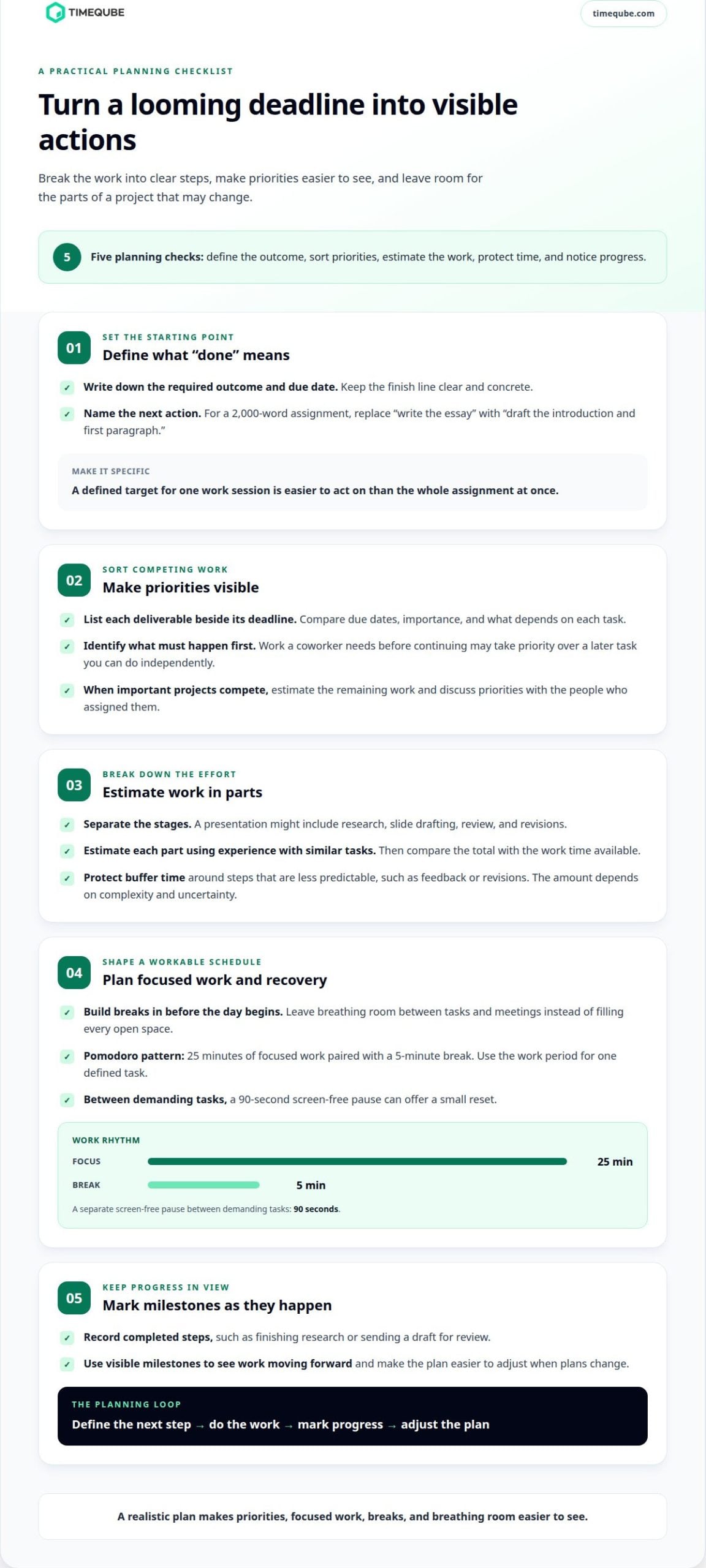
A clear plan turns a looming deadline into visible actions. Start by writing down the required outcome, the due date, and the next step. For a 2,000-word assignment, “write the essay” is too broad to guide a work session. “Draft the introduction and first paragraph” gives attention a defined target. Smaller actions make it easier to begin and show progress without requiring the whole project to feel manageable at once.
To prioritize several deadlines, compare due dates, importance, and dependencies. A task a coworker needs before continuing may take priority over a later task you can complete on your own. List each deliverable beside its deadline, then identify what must happen first. If two important projects are both due soon, estimate the remaining work and discuss competing priorities with the people who assigned them. This makes the trade-off visible instead of leaving every task to compete for your attention.
Estimate how long work will take by breaking it into parts and considering what each part requires. For a presentation, list research, slide drafting, review, and revisions separately. Use experience with similar tasks to estimate each part, then compare the total with your available work time. Leave a buffer for likely interruptions, feedback, or revisions. The amount depends on the work’s complexity and uncertainty, so protect time around the least predictable steps rather than filling every open space in your calendar.
Build breaks into the timetable before the day begins. The Pomodoro Technique pairs 25 minutes of focused work with a 5-minute break. Use the work period for one defined task, then step away briefly before starting the next. A 90-second screen-free pause can also offer a small reset between demanding tasks. Regular breaks help prevent a schedule from becoming an uninterrupted block that is difficult to sustain.
Make progress visible by marking completed steps, such as finishing research or sending a draft for review. Recognizing each milestone helps show that your effort is moving the assignment forward. Leave breathing room between tasks and meetings instead of scheduling every minute. These practical choices support reducing stress about deadlines by making priorities, work periods, and recovery time easier to see and adjust.
Set deadlines for the work that matters most and leave buffer time for contingencies. A realistic plan can make progress easier to recognize and completing work on time feel more rewarding.
Take regular breaks, since working continuously without them can increase stress and reduce productivity. Leave breathing room between tasks and meetings rather than packing your calendar, so the schedule is easier to manage when plans change.
3. Breathing and grounding techniques
When a deadline draws your attention to everything unfinished, pause before choosing what to do next. A brief breathing or grounding exercise gives your mind a specific focus, such as the rhythm of an exhale or the feeling of your feet on the floor. These methods won’t complete the task, but they can help you notice rising tension and return to one manageable step. Try them at your desk, before opening a difficult email, or between work periods.
Try box breathing by moving through four equal stages. Breathe in for 4 seconds, hold for 4 seconds, exhale for 4 seconds, then wait for 4 seconds before the next breath. Repeat the sequence at a comfortable pace while following each stage. If holding your breath feels uncomfortable, stop the exercise and use ordinary breathing or sensory grounding instead. The aim is steady attention, not forcing your body into a particular response.
A sensory grounding exercise shifts attention from predictions about the deadline to your present surroundings. Notice something you can see, such as a window frame, then something you can feel, such as your hands resting on the desk. Continue with a sound, a smell, and a taste. Quietly naming each sensation gives your attention a sequence to follow. In a meeting room, you might notice the table’s surface, a colleague’s voice, and the taste of water.
Before a meeting, spend 1-2 minutes breathing deeply and evenly. Sit with both feet supported, relax your shoulders, and let each exhale finish before the next inhale. This short pause can help you enter the discussion with more awareness of your physical state. If a deadline concern comes up during the meeting, write one keyword in your notes instead of mentally rehearsing the entire task list.
Choose a method that suits the setting. At a shared desk, silently naming five sensory details may feel more practical than counting breaths. Before a presentation, a few slow breaths can mark a clear transition from preparing to speaking. If tension rises while reviewing a draft, pause and notice the screen’s edge, your posture, and your feet touching the floor.
Use these techniques as brief cues, not as another task to perform perfectly. For example, take a grounding pause after receiving an urgent message, then identify the next work action. Notice whether your attention or tension shifts without judging the result. If a method feels distracting, try another. Supporting mental health at work can include small, repeatable pauses that restore awareness before you respond to a demanding deadline.
4. Recognizing self-imposed deadlines
A work deadline can feel urgent even when nobody else set that exact date. People may experience a work deadline as self-imposed pressure rather than pressure from others. For example, you might decide to finish a draft before lunch, although your manager asked for it by the end of the week. The pressure still feels real, but identifying who set the date helps distinguish an external commitment from a personal target.
Start by writing down the deadline that feels most urgent. Beside it, note who set it and what depends on completion. A client delivery date may affect another person’s work, while a private goal to clear every email before starting a report may not. This distinction doesn’t make either task unimportant. It shows which date carries a shared expectation and which may be adjustable.
Next, look for the assumption behind a self-imposed date. “I should finish this today” might come from wanting to impress a colleague, avoid an uncomfortable task, or prevent imagined criticism. Ask what evidence supports the date. If the answer is only “I feel behind,” identify the actual next milestone and compare it with the agreed schedule. A feeling can signal pressure, but it doesn’t establish someone else’s requirement.
Personal deadlines can still help organize work. Keep them when they provide useful structure, such as setting a draft date before a scheduled review. Revise them when they crowd out higher-priority responsibilities or leave no room for feedback. For example, a draft planned for Monday can move to Tuesday if a required report takes priority. Update your calendar so the new plan replaces the old expectation.
If a personal target affects someone else, communicate the change rather than silently shifting shared work. Tell the relevant coworker what is complete, what remains, and when you expect to deliver it. If the target affects only your own workflow, adjust it without treating the change as a failure. This keeps accountability focused on real commitments, not every private rule formed under pressure.
Try a brief deadline review at the start or end of each workday. Mark each date as externally agreed, dependent on another person, or self-set. Then choose one action: keep the target, renegotiate a shared date, or revise a personal plan. For instance, if a polished draft is your preference rather than a team requirement, decide how complete it needs to be for the next review. Clear labels make urgency easier to assess and help preserve attention for work that genuinely depends on you.
5. Clarifying why a deadline was set
A due date can feel arbitrary when its purpose is unclear. It may support a client handoff, coordinate a team review, or help someone prioritize a busy workload. Understanding the reason changes how you assess urgency. A draft needed for tomorrow’s meeting has a different constraint from a personal target to finish early. Ask what decision, handoff, or next step depends on the work. That context helps distinguish essential timing from a date that may be open to discussion.
Start with a neutral question: “What needs to happen by this date?” Then clarify the expected deliverable, its audience, and how complete it needs to be. A manager may need a rough outline for planning, not a polished report. A teacher may need to assess a draft before giving feedback. Knowing the purpose helps you focus on the required result instead of adding work that does not serve the deadline.
When you feel overwhelmed, describe the work involved before deciding whether a date is realistic. Break the request into visible components, such as gathering information, drafting, reviewing, and preparing the final version. Explain which steps need focused time and where you need another person’s input. Clarifying questions help coworkers understand the work, skills, and time involved, then discuss whether the deadline is realistic. Specifics make the conversation practical rather than personal.
If the date seems unrealistic, speak with your manager or teacher early. State the requested deadline, the tasks still required, and the constraint affecting completion. Then offer a workable option, such as delivering a partial draft first or agreeing on a revised date. For example: “I can prepare the analysis by Tuesday, but the full report needs review time. Could we discuss which sections are essential for the meeting?” This gives the other person a clear basis for adjusting priorities.
A workplace example makes the trade-offs clear. Imagine a manager assigns three time-consuming projects, all due the next day. Ask which project has the highest priority and whether each needs a complete final version. Then summarize the agreed order and any changed milestones in writing. If a problem may block a milestone, update stakeholders promptly. Early notice gives the team time to reconsider dependencies, redistribute work, or adjust what is due.
Deadlines can help people prioritize and assess workload honestly. Their value depends on what they coordinate and the work needed to meet them. Before accepting a date, clarify its purpose, the required standard, dependencies, and priority. Those details turn an unclear demand into a shared plan, with fewer assumptions and a clearer next action.
Timeqube
Timeqube offers physical visual timers that use color-coded light signals to make time easier to sense without digital distractions. They can support focused work periods, business meetings, and mind/body therapy sessions when a quiet, visible time cue is useful. Timeqube’s first distraction-free timer uses green, orange, and red cues visible in peripheral vision, with no audible alarms. The Timeqube Home Office Edition includes Pomodoro-style presets for personal productivity. Timeqube also offers timers with company logos. A visual cue can complement realistic planning and clear priorities, but it doesn’t replace them. Explore Timeqube’s visual timers to find an option suited to your work or therapy setting.
Make your next work period more intentional
Reducing stress about deadlines can start with a small experiment, not a complete change to your routine. Choose one upcoming work period and decide how you want it to feel: steady, focused, or easier to pause. That intention gives you a way to notice whether your approach supports the kind of workday you want.
After the work period, take a moment to reflect. Did the pace feel manageable? Was it clear when to begin and stop? Keep what helped and adjust one element next time. This gentle review makes time management an evolving practice rather than another standard you must meet perfectly.
If a visual time cue would support your workspace or meetings, start a conversation with Timeqube about your needs. A thoughtful next step is enough. You can build a calmer relationship with time, one work period at a time.
Frequently Asked Questions
What is deadline anxiety?
Deadline anxiety is worry or tension connected to an approaching work or task due date. It may involve fear of missing the date, making mistakes, or failing to meet expectations. For example, someone may keep checking an unfinished assignment but struggle to begin. The concern becomes more disruptive when it persists after submission or interferes with sleep, concentration, or everyday responsibilities.
Why do deadlines stress me out so much?
Deadlines can feel threatening when the workload seems uncertain or the expected standard feels difficult to meet. Fear of failure, perfectionism, and not knowing where to begin can all intensify pressure. Pause briefly to identify what feels hardest. Is it unclear instructions, limited time, or concern about judgment? Naming the specific concern helps you decide whether to clarify expectations, start a small task, or discuss priorities.
How do I break a large project into manageable steps and set milestones?
Define the finished result, then identify the decisions and deliverables needed to reach it. For a presentation, milestones might include confirming the audience, collecting key information, drafting the main points, and preparing a review copy. Give each milestone a clear completion condition, such as “send the outline for feedback.” Put milestones in a sensible sequence, especially when one person’s input must arrive before the next stage can begin.
What deadline planning techniques help prevent procrastination?
Make the first action small enough to begin without completing the whole project. If you need to prepare a report, open the relevant materials and write down the questions it must answer. Schedule that starting action during a defined work period, then note the next step before stopping. Anticipate likely obstacles, such as missing information or delayed feedback, and raise them early rather than waiting until they block the final stage.
What are quick stress-relief techniques to use when a deadline feels overwhelming?
Pause and choose one brief exercise before returning to work. Try box breathing: inhale, hold, exhale, and pause for four seconds each, stopping if the pattern feels uncomfortable. Or notice one thing you can see, feel, hear, smell, and taste. Then write down the next concrete action, such as opening a document or asking for clarification. These cues can redirect your attention without requiring you to solve the whole task at once.
How does deadline stress affect sleep, concentration, and health?
Deadline-related anxiety may disrupt sleep, increase irritability, and make concentration harder. Some people also experience physical symptoms, including headaches or muscle tension. For example, persistent worry about a presentation may continue at bedtime and leave less attention for the next day’s work. If anxiety keeps interfering with sleep, work, or daily functioning, consider speaking with a mental health professional about support and next steps.