

The clock can feel like a threat even when no deadline is close. Chronophobia is an intense fear of time or its passing, while the fear of running out of time at work can also reflect persistent time anxiety: the sense that time is slipping away and isn’t being used well. Time anxiety isn’t a clinical diagnosis, though it can overlap with other forms of anxiety.
If work pressure makes it hard to focus, rest, or be present outside the office, that strain is real. It doesn’t mean you’ve failed to manage your time. It may be a sign to notice what the pressure is doing and what matters most to you.
This article explains chronophobia and how fear around time can affect work, relationships, and everyday choices. You’ll also see how priorities can help you decide where your attention belongs, and how simple, visible time cues can support a calmer sense of pace.
Key Takeaways
- Distinguish everyday time pressure from chronophobia, and notice when anxiety begins to affect daily life.
- See how constant urgency can strain relationships and make it harder to be present beyond work.
- Use personal values to assess commitments and decide where your attention matters most.
- Recognize when concern about time can prompt meaningful action, rather than just adding pressure.
- Consider how a visible time cue can support a calmer pace in meetings or therapy sessions.
Complications and effects on relationships and daily life
Time anxiety can follow someone from a work deadline into family plans and personal decisions. Its effects often show up in ordinary moments, such as an evening conversation interrupted by thoughts about unfinished tasks.
Feeling Behind in Life
Feeling behind in life means measuring your progress against an imagined schedule for work, relationships, or personal milestones. A promotion, marriage, or home purchase can start to feel like a deadline rather than a choice. During transitions, such as changing careers or becoming a parent, that comparison can intensify anxiety. The pressure may push you toward goals that don’t reflect what you actually value.
Milestones can make time feel especially scarce. Someone who hoped to have a particular job by a certain age may see a career change as failure, even when it better fits their needs. A person hoping to build a relationship may feel pressure to meet someone quickly. Missing a milestone on an expected schedule doesn’t mean life is off track; it’s a chance to examine whose expectations are shaping the timeline.
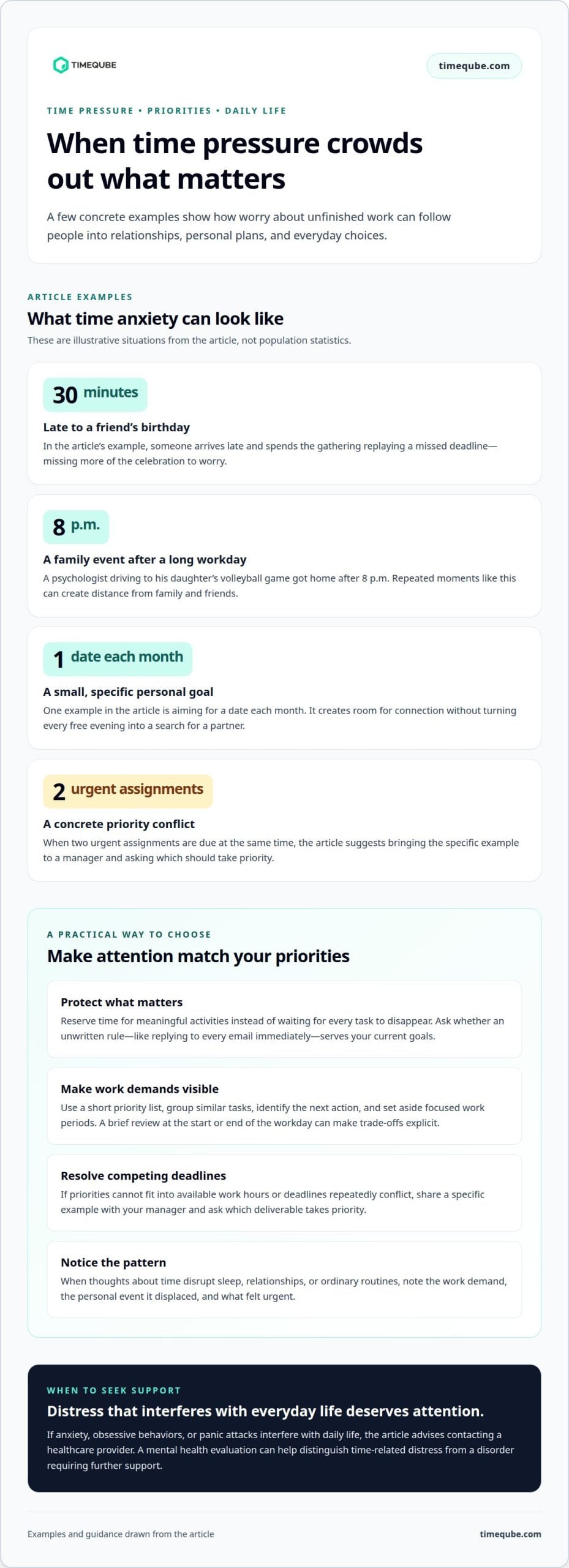
Work anxiety can also take attention away from people who are physically present. Imagine arriving 30 minutes late to a friend’s birthday party and spending the evening replaying a missed deadline. You might miss the beginning of the celebration, then lose more of the gathering to worry. Similarly, a psychologist driving to his daughter’s volleyball game after a long workday got home after 8 p.m. Repeated moments like these can create distance from family and friends.
Workload Pressure and Its Effects
Chronic time pressure means facing ongoing demands that leave too little room to complete work at a sustainable pace. Over time, anxiety about the next deadline can contribute to avoidance, overcommitment, or numbness, making daily tasks harder to approach. Talk to your manager when agreed priorities cannot fit into available work hours or deadlines repeatedly conflict. Bring a specific example, such as two urgent assignments due at the same time, and ask which should take priority.
Life changes can make that conversation feel difficult. A new caregiving responsibility, a move, or a change in health may alter how much energy remains after work. If a job interview matters, fear of arriving late can also take over the day. A practical reminder: if something disrupts your arrival, you can call and explain. That plan doesn’t remove every uncertainty, but it replaces repeated worry with a clear next action.
When thoughts about time start disrupting sleep, relationships, or ordinary routines, notice the pattern instead of treating each episode as a separate failure. For example, write down the work demand, the personal event it displaced, and what felt urgent. If anxiety, obsessive behaviors, or panic attacks interfere with everyday life, contact a healthcare provider. A mental health evaluation can help distinguish time-related distress from a disorder requiring further support.
Making decisions according to personal priorities
Time pressure can make every request feel equally urgent. Personal priorities offer a clearer basis for deciding what deserves your attention.
Making Room for Meaningful Activities
Making room for meaningful activities means deliberately protecting time for what matters, instead of waiting for every task to disappear. If drawing helps you feel restored, reserve a place for it before filling your evening with chores. This matters because enjoyable activities can otherwise become the first commitments dropped whenever work expands. Choosing them intentionally makes personal values part of the calendar, not an afterthought.
Start by noticing the unwritten rules shaping your choices. You might believe every email needs an immediate reply, or that a successful employee never leaves unfinished work. Ask whether each rule serves your current goals. For example, responding to a routine message after a planned family dinner may protect the evening without affecting a genuine deadline.
Meaning also gives decisions context. Douglas Lane recommends asking why you’re spending time on a particular activity. If a weekly meeting supports a project you value, its purpose may justify the time. If it continues out of habit and no longer helps, consider whether it deserves the same place in your schedule. This question can reveal commitments that consume attention without advancing a priority.
Setting a small, specific goal can turn an abstract hope into a choice. Someone who wants a relationship might aim to go on one date each month. That goal creates room for connection without requiring every free evening to become a search for a partner. The useful measure is whether the commitment reflects your values, not whether it matches someone else’s timeline.
Time Management for Work Stress
Time management for work stress means making demands visible, then deciding what can reasonably fit. It matters because a crowded task list can make unrelated duties feel equally urgent. Grouping similar tasks, identifying the next action, and setting aside focused work periods can reduce repeated switching between projects.
What time management techniques help reduce work stress? Choose a short priority list, estimate which tasks need attention first, and reserve time for focused work. If two deadlines compete, ask your manager which deliverable takes priority rather than silently accepting both as equally urgent.
Use a brief review at the start or end of each workday. For example, mark a report as the main task, move routine messages into a set period, and note one item that can wait. This makes trade-offs explicit and helps prevent an unfinished minor task from displacing important work simply because it remains visible.
When a role no longer feels meaningful or aligned with your values, consider whether another role or job may fit better. That decision takes reflection, but noticing the mismatch is useful. Douglas Lane’s question, “Why am I spending time on this?” can help distinguish a temporary busy period from a pattern that conflicts with what you want your work to support.
Time guilt and pressure to make every moment count
Time guilt appears when rest or ordinary tasks feel like wasted hours. It can turn ambition into pressure to make every moment produce visible progress.
Ambitions and Time Pressure
Pressure to achieve personal ambitions is the feeling that every free hour must advance a long-term goal. It becomes a problem when rest starts to feel like evidence of failure. A person pursuing a creative career, for example, may treat a quiet evening as lost momentum. That belief can make ambition harder to sustain, because recovery and relationships also need space.
One filmmaker devoted most of his free time to becoming well known. His example shows how a meaningful ambition can take up time beyond work hours. When success becomes the measure of each day, time with family or friends may seem like a distraction. The cost is not simply a busy calendar; it can be distance from people who matter.
Perfectionism can intensify this cycle. If a presentation must be flawless, someone may keep revising it instead of completing other important work. Time anxiety can then reinforce the urge to perfect every detail, because unfinished work feels like proof of falling behind. Choosing a good-enough standard for a low-stakes task can free attention for work that truly needs care.
People-Pleasing and Competing Demands
People-pleasing adds time pressure when someone accepts requests to avoid disappointing others. Each yes uses time that may already belong to work, rest, or relationships. For instance, an employee might agree to review a colleague’s draft while preparing for a scheduled presentation. The added task can create resentment and make both commitments harder to handle well.
A useful pause is to separate willingness from capacity. Before accepting a request, identify what would need to move: the presentation, a meal with family, or needed downtime. A clear reply such as, “I can review it after I finish this deadline,” makes the trade-off visible. It also sets a realistic expectation without turning every request into an emergency.
Guilt can also follow time spent on activities with no measurable outcome, such as sitting with a friend or taking an unplanned break. But treating every moment as productive can narrow life to tasks and milestones. Notice when an unwritten rule says free time must advance a career. Then ask whether that rule still serves you, rather than following it automatically.
When regret about time builds, remember that the past cannot be changed; adapting is part of life. Bring your attention back to the activity in front of you, such as listening to a friend instead of mentally planning tomorrow’s tasks. This doesn’t erase ambition. It lets one meaningful moment count without requiring every moment to prove its value.
When anxiety motivates useful action
Anxiety about time passing can be useful when it points toward something you genuinely value. Douglas Lane gives visiting an aging grandparent as an example: worry can prompt a call, a visit, or a conversation that might otherwise keep being postponed. The signal matters less than the action it helps you choose. Ask what important connection or commitment the feeling is directing your attention toward.
Then make the next step specific and manageable. If you’re concerned about seeing a grandparent, choose a day to call and arrange a visit. This turns a broad thought, such as “I’m running out of time,” into an action you can take now. The aim isn’t to eliminate uncertainty or rush through the visit. It’s to let concern guide your attention toward a meaningful relationship.
A useful signal can also help you adapt an ambition when circumstances change. The author described fearing that spinal muscular atrophy could cause him to lose an important physical function before he completed his ambitions. That concern reflects a real personal constraint, not a reason to assume every goal must happen immediately. It can prompt a practical question: which part of the ambition matters most, and what form could it take now?
For example, if running a full marathon is no longer feasible, walking for 30 minutes every day is one alternative way to stay active. The value lies in matching the next step to present circumstances, rather than treating the original plan as the only meaningful outcome. A changed route can still serve an underlying priority, such as movement or personal challenge.
Douglas Lane describes an 85-year-old as someone who might focus on what they’ve run out of time to do. That example can clarify priorities at any age. Write down one unfinished ambition, then identify whether it needs action now, a smaller version, or acceptance that circumstances have changed. A list like this separates a meaningful desire from a vague demand to accomplish everything.
Notice what follows the feeling. If concern leads to a call, a realistic adjustment, or a deliberate choice, it has helped direct your behavior. If it leaves you stuck in repeated urgency, pause and return to the next concrete action. Instead of mentally reviewing every future goal, decide whether today’s step is sending a message, choosing a suitable activity, or setting the ambition aside.
Fear of running out of time
Fear that time is running out can narrow your attention to deadlines, unfinished goals, and imagined regrets. The useful distinction is whether the worry points toward a choice or keeps you trapped in repeated urgency.
Worry About Running Out of Time at Work
Worry about time at work is recurring concern that available hours won’t be enough for responsibilities or personal goals. To reduce it, name the next task and focus on it rather than mentally rehearsing everything that might happen later. If perfectionism fuels the worry, decide what “good enough” means for a low-stakes task before you begin.
Time anxiety isn’t a clinical diagnosis. It describes a persistent feeling that time is running out or being spent poorly, and it differs from generalized anxiety, though the two can overlap. If you’re worried about missing a job interview because of a delay, remind yourself that you can call and explain if something affects your arrival. A clear next step can interrupt repeated prediction.
Notice what your behavior leads to. Avoiding a task, accepting every request, or going numb can leave the original concern unresolved. For example, if a report feels overwhelming, identify one small part you can begin, such as outlining its key points. Then return your attention to that step instead of judging the whole day by whether the report is complete.
Anxiety, Burnout, and Time Fear
Fear of running out of time at work can occur alongside anxiety, but the feeling alone doesn’t establish a diagnosis or prove burnout. Chronophobia is a more intense fear of time or its passing. Healthcare providers assess it through a mental health evaluation, rather than a specific test. That distinction matters because persistent distress deserves more than assumptions based on one difficult workday.
If time-related anxiety, obsessive behaviors, or panic attacks affect everyday life, contact a healthcare provider. Psychotherapy is the main treatment for chronophobia anxiety. Cognitive behavioral therapy can help people reconsider the phobia and gain more control over their responses. Hypnotherapy may help reframe concerns, while meditation and yoga can help manage associated anxiety.
There’s no medication specifically for chronophobia, though some medications can help control panic attacks or treat other mental health disorders. A healthcare provider considers the person’s symptoms and needs when discussing care. If anxiety leaves you feeling more stuck than ready to act, consider seeking support from a mental health professional.
For a brief mindfulness practice, give your attention to the activity happening now. While writing an email, notice its purpose and draft one clear response instead of scanning the entire task list. Accepting that some outcomes can be good enough also loosens the link between perfectionism and time anxiety. The aim isn’t to make every minute count, but to choose the next useful action.
Timeqube: Timequbes with Your Logo
Timeqube offers Timequbes with Your Logo for teams that want a physical visual cue during focused work or meetings. Its color-coded light signals make time visible without adding another digital distraction. A shared cue can help a group notice a session’s pace while keeping attention on the discussion.
For professional meetings, Timeqube for Business Meetings brings this visual approach into the room. Timeqube for Mind/Body Therapies offers a related option for sessions where a calm, visible sense of time supports the experience. These tools can structure a session, but they don’t replace personal priorities or mental health care when anxiety disrupts daily life.
If a visible time cue fits your work or sessions, explore Timequbes with Your Logo from Timeqube.
Make your next step intentional
The fear of running out of time at work can make every choice feel urgent. A more useful starting point is smaller: decide what deserves your attention in the next part of your day. That choice doesn’t need to solve every deadline or ambition. It can simply reflect what matters now.
Treat your calendar as a set of decisions, not a test of your worth. Leave space for focused work, meaningful connection, and recovery. When pressure rises, pause and ask whether the next action serves a real priority or an automatic expectation. Over time, that question can create more room to respond deliberately, rather than letting urgency make every decision for you.
If a visible time cue could support a calmer pace in your work or sessions, contact Timeqube to discuss your needs.
You don’t need to make every moment count. You can begin by choosing what counts next.
Frequently Asked Questions
What is chronophobia?
Chronophobia is an intense fear of time or its passing. It can involve distress about time moving forward, aging, or having too little time to reach personal goals. The term describes a specific fear, not simply a busy schedule or occasional deadline stress. If fear of time starts disrupting everyday activities, relationships, or work, a healthcare provider can assess the symptoms and discuss appropriate support.
What is the fear of running out of time at work called?
The fear of running out of time at work is often described as time anxiety, a persistent worry that time is slipping away or being used poorly. Time anxiety isn’t a clinical diagnosis, and it can overlap with generalized anxiety. Chronophobia refers more specifically to an intense fear of time or its passing. The distinction depends on the nature of the fear and how it affects daily functioning.
How can I prioritize tasks when there isn’t enough time?
Start by identifying which task has the clearest consequence if delayed, such as sending a client-ready draft before a scheduled review. Separate essential work from tasks that can wait, then choose one next action. If two important requests compete, explain the conflict to your manager and ask which outcome should come first. This makes the trade-off explicit instead of silently stretching your day to fit everything.
How can I set realistic deadlines and expectations at work?
Define what the finished task needs to include before agreeing to a deadline. For example, clarify whether a report needs a complete analysis or a concise first draft. Identify dependencies, such as waiting for data from a colleague, and raise them early. If the scope changes, revisit the deadline or priority with the person requesting the work. Clear expectations make progress easier to assess and renegotiate.