

What if a session could end on time without making a client feel watched by a countdown? A psychotherapy session timer can help support that balance, but the cue matters. A phone alarm or visible numeric display may draw attention away from a sensitive moment, even when the intention is simply to protect the schedule.
It’s understandable that sessions sometimes run over. A meaningful conversation can be hard to close, yet lost transition time can squeeze breaks, notes, and preparation. The familiar 50-minute hour is a practical convention, not a rigid rule. The aim is to honor agreed boundaries without making clients feel hurried.
This article compares common ways to track session time, from clock-checking and phone alerts to apps and calm visual cues. It also considers how a physical, color-coded timer such as Timeqube may help make elapsed time easier to notice without a digital countdown. You’ll find practical ways to choose an approach that fits your therapeutic setting and supports a more sustainable schedule.
Key Takeaways
- A psychotherapy session timer is a practical timing aid, not a treatment for burnout or a substitute for clinical judgment.
- Compare timers by visibility, setup, accessibility, and how comfortable they feel for each client.
- Introduce timing collaboratively: explain the purpose, agree on how to use the cue, then review whether it feels supportive.
- A physical visual timer can offer a quiet way to track elapsed time without relying on digital software.
- Pair timing tools with protected breaks, realistic scheduling, supervision, and organizational support for a more sustainable routine.
Why psychotherapy session timing matters for therapist well-being
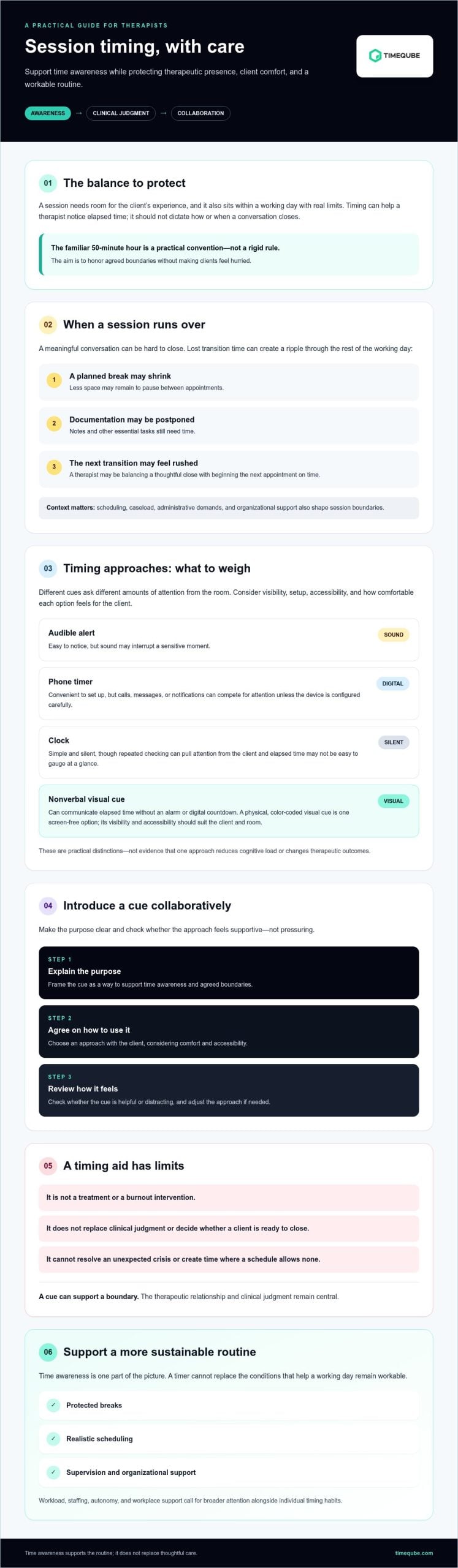
A session needs room for the client’s experience, but it also sits within a working day with real limits. Ending exactly on schedule can feel difficult when a conversation is emotionally charged. Letting it run long may leave less space for a pause, a note, or a prepared transition to the next appointment. The challenge is to protect both therapeutic presence and a workable routine.
A psychotherapy session timer is a timing aid that helps a therapist notice elapsed time. It isn’t a treatment, a burnout intervention, or a signal that a conversation must stop at a particular moment. In Psychotherapy, the therapeutic relationship and clinical judgment remain central. A timer can inform awareness, but it can’t make the decision about how to close a session.
The video below explores time-limited dynamic psychotherapy. That clinical approach is distinct from using a timer to keep track of a session.
How session overruns can affect a therapist’s working day
An overrun can have a quiet ripple effect. A planned break may shrink, documentation may be postponed, and a transition between clients may become rushed. If the next appointment is already waiting, the therapist may need to balance finishing the current conversation with beginning the next one on time.
These effects vary by practice. Session boundaries are shaped not only by individual habits, but also by scheduling, caseload, administrative demands, and organizational support. A timer may make time more visible, but sustainable working conditions also depend on realistic workloads and protected time for essential tasks.
What a timer can, and cannot, do
A timer can offer a reference point while attention is focused on the client rather than repeatedly checking a clock. The cue might be a clock, an alarm, a digital countdown, or a nonverbal visual signal. Each option has a different presence in the room, so client comfort and accessibility matter. A physical visual timer, for example, can use color-coded light signals to communicate elapsed time without a digital countdown.
Still, a cue cannot decide whether a client is ready to close, resolve an unexpected crisis, or create room for notes and rest where the schedule allows none. Therapists can use time awareness alongside clinical judgment, while workload, staffing, autonomy, and workplace support call for broader attention. A timer supports a boundary; it doesn’t replace the conditions needed to maintain one.
How psychotherapy session timers support time awareness without interrupting
Timing cues differ in how much attention they ask from the room. An audible alert is clear, but its sound can interrupt a conversation. A digital countdown makes remaining time explicit, though a lit screen may draw the eye. A wall clock is familiar and silent, but checking it repeatedly can pull attention from the client. A nonverbal visual cue offers another option, without an alarm or numeric countdown.
A physical visual timer, such as Timeqube, uses color-coded light signals to communicate elapsed time without digital software. This may suit clinicians who prefer a quiet, screen-free cue. It isn’t automatically the best fit for every practice: some clients may find any visible timer distracting, while others may appreciate a clear shared reference point. No timer type can guarantee greater therapeutic presence or improved clinical outcomes.
Visual, audible, and phone-based timers compared
- Audible alarms: Easy to notice, but sound may feel abrupt in a sensitive moment.
- Phone timers: Convenient to set up, but calls, messages, or other notifications can compete for attention unless the device is configured carefully.
- Clocks: Simple and silent, though they may prompt repeated checking and don’t always make elapsed time easy to gauge at a glance.
- Visual timers: Can provide a nonverbal cue. Consider whether their visibility, display, and accessibility suit the client and room.
These are practical distinctions, not evidence that one approach reduces cognitive load or changes therapeutic outcomes. Claims about attention, peripheral awareness, or clinical benefit should be supported by relevant research before being treated as established fact.
Using a visual cue while protecting therapeutic presence
Peripheral vision may register a cue without the viewer looking directly at it, but responses vary. Place a visual timer where its purpose is understandable without making it the focal point. Before using it, explain what the signal means and how session time will be handled. Invite the client to share whether the cue feels comfortable, then adjust its placement or stop using it if it becomes distracting.
Time boundaries also sit within wider working conditions. For context on scheduling and broader approaches to therapist burnout recovery, Marymount University discusses the role of workload balance and organizational strategies. A timer is a modest aid, not a substitute for those supports.
For clinicians considering a physical option, visual timers for mind and body therapies offer a way to explore a color-coded cue as part of a broader approach to holding therapeutic space.
Which psychotherapy session timer approach fits your practice?
The right timing cue depends on the room, the session format, and what helps both participants stay engaged. A psychotherapy session timer should make time easier to track without becoming the focus. Use the comparison below as a starting point, then consider client preference and your own workflow.
| Approach | Distraction and comfort | Setup and visibility | Accessibility and context |
|---|---|---|---|
| Visual timer | Quiet, though a visible cue may not suit every client. | Usually simple to position. Visibility depends on placement and display. | Consider whether the cue is easy for everyone in the room to perceive. May suit in-person individual, couples, or group sessions if all understand its purpose. |
| Phone timer | No sound is needed, but the screen or notifications may draw attention. | Quick to set up; the display may be visible only to the clinician. | Can be convenient in varied settings. Configure notifications carefully and consider whether the client needs to see the cue. |
| Clock | Silent and familiar, but checking it repeatedly can interrupt attention. | No setup is needed. Visibility depends on where it’s placed. | Choose a face and position that are legible to the people who need to refer to it. |
| Audible alarm | Hard to miss, but the sound may feel abrupt or intrusive. | Simple to set. It communicates the cue without requiring a visible display. | Sound may not work for every sensory or hearing need. Consider the client and setting before relying on it. |
Choosing between a visual timer and a phone timer
Consider what interrupts your focus. If opening a phone brings messages or other apps into view, a separate physical cue may reduce screen exposure. If a phone is already part of your routine, silence notifications and decide whether the display should remain private or be shared.
For couples or group work, clarify whether everyone should be able to see the cue. Remote sessions need a separate, mutually understood arrangement: a timer in the clinician’s office may not be visible to a client on screen. Agree on how time will be signaled rather than assuming both parties share the same reference.
Questions to ask before choosing a timer
Check whether the cue is legible, quiet enough, and appropriate for the room’s sensory environment. Can the client see or hear it comfortably? Can it be positioned discreetly? Would the client prefer another approach? A physical, color-coded option such as Timeqube for mind and body therapies may suit clinicians seeking a visual cue without a digital countdown. The best choice remains the one that fits the client’s needs and the clinician’s judgment.
How to introduce a psychotherapy session timer without making clients feel rushed
A timer works best as an agreed part of the session structure, not a surprise signal that the conversation is over. Explain its purpose before introducing it, and make clear that the cue supports time awareness while clinical judgment guides how a session closes. A psychotherapy session timer should make boundaries transparent, not pressure a client to finish difficult material abruptly.
Explain the timing arrangement collaboratively
Before the first timed session, describe what the cue indicates and invite questions. Agree whether the client wants to see it and how you’ll handle the transition near the planned end. You might say, “I use this cue to help us stay aware of our session time. It doesn’t mean we have to stop mid-thought. We can check in together as we approach the end.”
Use a simple sequence to introduce the approach:
- Decide: Choose a cue that fits the room, session format, and your practice.
- Explain: Share why you’re using it and what it will signal.
- Agree: Ask whether the client is comfortable with the cue and how they’d like it used.
- Use: Treat it as a reference point, not an instruction to end immediately.
- Review: Check whether the arrangement feels clear and respectful, then adjust if needed.
If urgent or emotionally difficult material arises near the planned end, a timer shouldn’t dictate the clinical response. Use your judgment to decide how to acknowledge the material, support a safe transition, and plan what comes next. The cue is there to inform the conversation, not replace it.
Review whether the approach is working
After trying the arrangement, ask whether the signal felt clear, neutral, and acceptable. A client may prefer not to see it, or you may find that its placement draws too much attention. Be willing to change the setup or choose another timing method.
Also look beyond the individual session. Are transitions consistently too short for notes or a pause? Do scheduling patterns leave adequate time between appointments? Reviewing these demands can reveal whether the challenge calls for a broader workload or organizational response, rather than another timing device. A timer alone can’t prevent or resolve burnout. Workload, autonomy, staffing, supervision, and workplace support matter too.
For a physical visual cue, explore Timeqube for mind and body therapies as one option to consider alongside your practice’s wider approach to time awareness.
A calmer session routine: where a physical visual timer fits
A useful timing approach should make elapsed time easier to notice while respecting client comfort and your clinical judgment. No single cue suits every room or modality. A psychotherapy session timer is one small part of a considered routine, not a measure of therapeutic quality or a remedy for workplace strain.
When a physical visual timer may be worth considering
A physical visual timer may fit a practice where opening a phone risks bringing screens or notifications into the session. Timeqube is physical timer hardware for mind and body therapies. Its color-coded light signals communicate elapsed time without digital software or a distracting countdown. Consider it when a quiet visual cue feels appropriate for the setting and the client is comfortable with it. Check the current product details for the settings and signal sequence that fit your needs.
Keep the cue in perspective. It can support time awareness, but it can’t determine when a conversation should end, guarantee a smoother transition, or independently reduce burnout or improve clinical outcomes. Client preference and clinical judgment still guide how the session unfolds.
Build a sustainable approach beyond the timer
More sustainable session boundaries depend on the conditions around the appointment, too. Consider whether your schedule allows realistic transition time, adequate breaks, and space for documentation. If pressure to run over or work through breaks keeps recurring, discuss the pattern with a supervisor or practice leader. Caseload expectations, staffing, autonomy, supervision, and supportive workplace policies call for attention beyond an individual timing tool.
Think of the timer as one modest element in a wider routine: an agreed time cue, a thoughtful closing process, and protected time between sessions where possible. Review the approach with clients and adjust it when it distracts or doesn’t suit their needs. That keeps the tool in service of the therapeutic relationship rather than making the relationship serve the clock.
If a physical visual cue seems appropriate for your practice, explore the Timeqube therapy timer and review its current details to see whether it may fit your session environment.
Choose a timing approach that supports presence
A thoughtful psychotherapy session timer can make elapsed time easier to notice, but it shouldn’t decide when a meaningful conversation ends. The right approach depends on your practice, your client’s comfort, and your clinical judgment. Whether you choose a clock, phone cue, audible alert, or visual timer, explain the arrangement and adjust it when it doesn’t feel supportive.
Clear session boundaries may help protect time for transitions, documentation, and breaks. Still, a timer is only one small part of therapist well-being. Sustainable schedules, realistic workloads, supervision, and supportive workplace practices matter too.
For clinicians who prefer a physical cue, Timeqube offers timer hardware designed for mind and body therapies. Its color-coded light signals provide time awareness without digital software. Explore the details to see whether this kind of visual cue fits your setting.
Explore a calmer way to track therapy-session time, and choose a routine that helps you remain present while respecting the limits of the working day.
Frequently Asked Questions
What is a psychotherapy session timer?
A psychotherapy session timer is a tool that helps a therapist keep track of elapsed session time. It might be a clock, phone timer, audible alarm, or visual cue. The timer supports awareness, but it doesn’t decide when a conversation should end or replace clinical judgment. Some physical options, including Timeqube, use color-coded light signals to communicate time without digital software or a numeric countdown.
Can a timer make therapy clients feel rushed?
Yes, a timer can feel pressuring if it appears without explanation or uses a startling sound. Client comfort depends on the person, the cue, and how it’s introduced. Explain that timing helps structure the session, not hurry the client. Invite questions and feedback, and be prepared to reposition, change, or stop using the cue if it distracts from the work.
Are visual timers better than phone timers for therapy sessions?
Neither option is best for every practice. A visual timer can offer an at-a-glance cue without opening a screen, while a phone timer may be convenient if notifications are silenced and other apps stay out of view. Consider who needs to see the time, the room’s sensory needs, and client preference. For remote sessions, agree on a timing arrangement both therapist and client understand.
How do therapists end a session on time without cutting clients off?
Set expectations early and use a calm transition rather than treating the timer as a stop command. As the planned end approaches, acknowledge the remaining time, reflect the main point, and collaborate on what needs attention next. If urgent or difficult material emerges, use clinical judgment to decide how to respond and plan a safe, thoughtful transition. A timing cue can inform this process, but it can’t replace it.
Can a session timer prevent therapist burnout?
No. A timer may help a therapist notice elapsed time, but it can’t prevent or treat burnout. Therapist well-being also depends on factors such as workload, scheduling, autonomy, staffing, supervision, and organizational support. If sessions regularly leave too little room for breaks or documentation, review the schedule and workload with a supervisor or practice leader rather than relying on a timer alone.
Should clients be able to see the psychotherapy session timer?
That depends on the client and the purpose of the cue. Shared visibility can make the session structure clear, while a visible display may feel distracting or increase time pressure for some people. Explain what the signal means and ask whether the client would like to see it. For remote sessions, don’t assume the client can see a timer placed in the therapist’s room.
What should therapists look for in a therapy session timer?
Look for a cue that suits the room, is easy to understand, and fits the client’s sensory and accessibility needs. Consider whether it’s quiet, legible, simple to set up, and likely to introduce screen or sound distractions. Timeqube offers physical timer hardware for mind and body therapies, using color-coded light signals to communicate elapsed time without digital software. Check current product details before choosing a specific setup.