

Every glance at your wrist quietly fractures your client’s psychological safety. You already know the delicate tension of holding space for deep vulnerability while internally tracking a 50-minute arc. Glancing at a watch breaks vital eye contact, while checking a phone introduces digital distraction and perceived disinterest. For clients living with anxiety or ADHD, visible countdown numbers often trigger acute panic. Adopting a dedicated visual timer for coaching sessions eliminates this friction, transforming timekeeping from an intrusive disruption into an effortless, ambient rhythm.
You don’t have to compromise conversational intimacy just to keep your practice on schedule. In this guide, you’ll discover how non-intrusive visual timers eliminate clock-watching anxiety and preserve rapport throughout professional coaching conversations. We’ll explore the cognitive science of peripheral sensory processing, highlight screen-free environments that support nervous system regulation, and show you how to conclude sessions smoothly without abrupt or awkward departures.
Key Takeaways
- Integrating a dedicated visual timer for coaching sessions replaces intrusive clock-checking with calm, subconscious pacing.
- Discover how ambient peripheral light preserves emotional safety by preventing prefrontal cognitive fatigue during introspective dialogue.
- Learn why screen-free, silent hardware outperforms digital countdowns and ticking mechanical disks in therapeutic spaces.
- Master intentional timer placement to establish mutual temporal accountability across both in-person and remote settings.
- Navigate session arcs effortlessly so clients conclude conversations feeling grounded, heard, and never abruptly dismissed.
Why Every Professional Coaching Session Needs a Dedicated Visual Timer
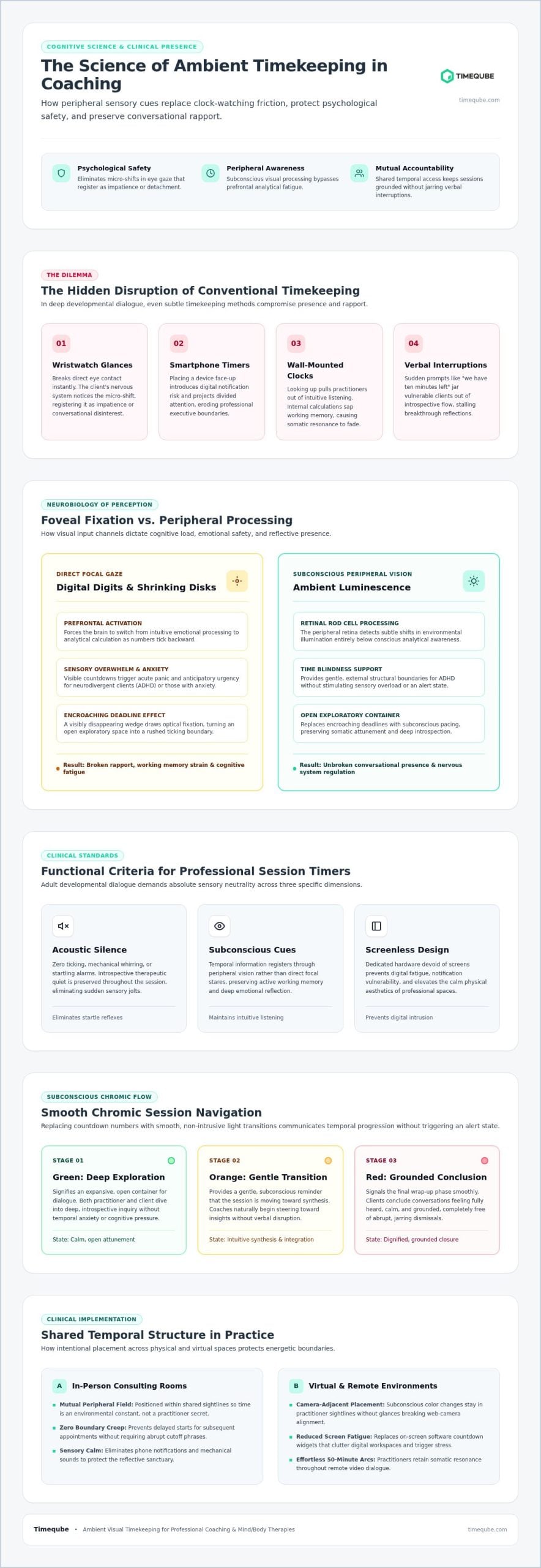
Professional coaching relies on unbroken presence. When a client explores a difficult professional impasse or emotional truth, rapport is fragile. Glancing at a wristwatch or a wall-mounted clock instantly fractures that attunement. The client’s nervous system notices the micro-shift in your eye gaze, registering it as impatience or detachment. Relying on a smartphone timer is equally disruptive. Placing a phone face-up on the table introduces digital notification risk and communicates divided attention, which undermines the executive standard you work to establish.
A dedicated visual timer for coaching sessions provides non-verbal, peripheral temporal awareness. By establishing shared visual access to time, both practitioner and client share mutual accountability without a single verbal interruption. While structured workflows like the Pomodoro Technique rely on interval tracking for task productivity, professional dialogue requires a far more subtle touch.
To better understand how visual timekeeping supports focus, watch this brief overview:
The Hidden Cost of Clock-Watching in Coaching
Subtle eye movements toward wall clocks pull practitioners out of intuitive listening. When the coach internally calculates remaining minutes, their somatic resonance fades. Sudden verbal warnings such as “we have ten minutes left” inevitably jar clients out of deep self-reflection. Without an unobtrusive cue, sessions fall victim to boundary creep, practitioner fatigue, and delayed starts for subsequent appointments.
Defining the Criteria for Professional Session Timers
Unlike elementary classroom gadgets or noisy kitchen trackers, adult developmental dialogue demands sensory neutrality. An effective visual timer for coaching sessions must satisfy precise functional criteria:
- Acoustic silence: Zero ticking, whirring, or harsh alarms to protect introspective quiet.
- Subconscious processing: Temporal cues that register through peripheral vision rather than direct focal stare.
- Screenless design: Dedicated hardware that prevents digital fatigue and elevates room aesthetics, such as Timeqube for Mind/Body Therapies.
When timekeeping operates beneath conscious scrutiny, practitioners protect their energetic boundaries while allowing clients to conclude feeling deeply respected.
The Cognitive Science of Ambient Light vs. Countdown Clocks in Coaching
Traditional timekeeping instruments rely on digits or shrinking mechanical disks. While useful for cooking or standardized exams, numerical timers trigger active prefrontal processing. The moment a client sees numbers ticking backward, their brain shifts from intuitive emotional reflection to analytical evaluation. Similarly, disappearing disks draw direct optical gaze, instilling anticipatory urgency as a red wedge visibly vanishes. Breakthrough reflections stall because the client feels an encroaching deadline rather than an open container for exploration.
Replacing active numbers with ambient luminescence fundamentally shifts session neurology. For neurodivergent individuals, especially those with ADHD who experience time blindness, a subtle visual timer for coaching sessions offers external structure without sensory overwhelm. Smooth chromic transitions (shifting quietly from green to orange, then red) communicate the passage of time without stimulating an alert state.
Focal Fixation vs. Peripheral Processing
Human vision divides into two primary systems: foveal and peripheral. Foveal vision requires direct, conscious fixation. Reading a clock face demands foveal focus, consuming precious working memory and severing conversational connection. Peripheral vision operates differently. The peripheral retina is rich in rod cells that detect environmental changes, including shifts in ambient illumination, entirely below conscious awareness. A peripheral visual timer for coaching sessions allows both minds to register session progression subconsciously, keeping executive attention fully rooted in the dialogue.
Eliminating the Startle Reflex in Deep Sessions
Auditory alerts present a severe liability in transformational work. Sudden electronic chimes stimulate the sympathetic nervous system, causing heart rates to spike and pulling clients out of somatic grounding. Silent chromatic pacing avoids this autonomic shock entirely. Pacing transitions naturally allows practitioners to guide emotional disclosures toward resolution with poise, an approach explored in depth within therapeutic frameworks like Timeqube for Mind/Body Therapies.
- Phase awareness: Green signals the expansive, open-ended exploration window.
- Subconscious pacing: Orange indicates the shift toward synthesis and action planning.
- Grounding boundaries: Red marks the closing container for reflection and departure.
If you want to protect your practice from cognitive friction and subtle boundary intrusions, consider using an ambient optical tool from timeqube.com to preserve unbroken flow across every client interaction.
Evaluating Visual Timers for Coaching Sessions: Comparison and Criteria
Selecting an effective timekeeping tool requires careful discernment. While many instruments claim to track time efficiently, few meet the delicate psychological requirements of executive or life coaching. The wrong device introduces sensory pollution, undermines aesthetic credibility, and creates cognitive task-switching. Choosing the ideal visual timer for coaching sessions means finding a solution that respects both practitioner focus and client vulnerability.
Physical, screen-free hardware eliminates practical liabilities. Dedicated devices don’t crash mid-conversation, lock their screens, or flash sudden calendar notifications. They provide reliable continuity without depending on third-party mobile applications.
Mechanical Disks vs. Digital Screens vs. Ambient Light Cubes
Understanding device taxonomy helps practitioners make intentional choices for their rooms:
- Mechanical disks: These tools rely on a disappearing colored wedge. While intuitive, their plastic designs often suit elementary classrooms better than professional offices. Many units also produce faint internal motor hums that grate on sensitive ears during contemplative pauses.
- Digital countdown screens: Numeric displays force continuous analytical math. Harsh backlit screens project cold blue light, introducing visual fatigue and making the coaching environment feel transactional.
- Ambient light cubes: High-end optical devices use gentle, non-prescriptive glow transitions. By replacing high-contrast graphics with serene chromic progressions, they blend seamlessly into modern consulting suites while keeping pacing entirely non-intrusive.
Key Selection Criteria for Coaches and Therapists
Executive settings demand minimalist elegance. When investing in an optical pacing solution, assess devices against four foundational requirements:
- Acoustic neutrality: The hardware must maintain complete silence across all phase shifts. Any sudden click, hum, or concluding chime ruins client somatic processing.
- Frictionless operation: Avoid devices requiring Bluetooth pairing, software accounts, or smartphone apps. Pacing tools should activate with a single, simple physical motion.
- Professional materiality: Choose understated physical builds that complement upscale wood, stone, or textile office textures rather than brightly colored juvenile plastic.
- Preset flexibility: Look for standard developmental intervals (such as 45, 50, and 60 minutes) to align with standard session rhythms.
Practitioners exploring somatic regulation or breathwork frameworks can adopt similar criteria; explore specialized pacing applications in Timeqube for Mind/Body Therapies to see how purposeful tactile design elevates the sensory atmosphere of modern healing spaces.
How to Integrate a Visual Timer into In-Person and Virtual Coaching Workflows
Introducing a physical pacing device into your coaching architecture requires intentional framing. When placed without explanation, any timing tool can feel evaluative, as if a clock is judging the client’s speed of discovery. Handled transparently, a visual timer for coaching sessions becomes a shared ally. It establishes an implicit boundary container that protects both parties, freeing the practitioner to hold space without glancing away and reassuring the client that their session will close with care.
Mastering this dynamic comes down to two operational dimensions: physical sightline calibration and relational onboarding.
Optimal Room Placement and Camera Framing
Ergonomics dictate how the brain registers ambient light. In physical consulting offices, place your optical device on a neutral side table positioned equidistant between your chair and your client’s seating. Keep it slightly below eye level. This positioning ensures the glow remains entirely within peripheral view, avoiding direct ocular fixation. Never place the unit directly behind a client or under concentrated task lighting that washes out the chromatic shifts.
Remote video sessions require slight adjustments. Position your visual timer for coaching sessions at the bottom outer edge of your webcam frame. Keep the device resting on your desk within your camera’s field of view. Your client sees the soft ambient glow without needing external software widgets, creating an organic, shared sense of pacing across digital screens.
Scripts for Introducing the Timer to Clients
Clear language disarms defensive reactions before the first conversation begins. Frame the tool during onboarding as a mechanism designed to protect the client’s mental decompression. Here are three adaptable scripts for your initial intake:
- The Relational Container Script: “You’ll notice this small light cube between us. It transitions silently from green to orange to red across our 50 minutes. I use this so I never have to look at a watch or glance at a phone while you are speaking. It lets me stay completely focused on you.”
- The Boundary Protection Script: “When the light shifts to orange, don’t worry about wrapping up instantly. It simply lets us both know we have fifteen minutes to begin synthesizing your takeaways and landing our conversation calmly.”
- The Virtual Clarity Script: “You’ll see a quiet glow in the lower corner of my camera frame. That is our shared session rhythm. It keeps our container tight and ensures we conclude right on time without any abrupt cutoffs.”
Ready to upgrade your executive environment with intentional, distraction-free pacing? Explore the screenless design of Timeqube for Mind/Body Therapies to transform your session flow today.
Why Timeqube Sets the Standard for Professional Coaching and Therapy
Most commercial timers treat time as a resource to count down under pressure. In contrast, Timeqube approaches pacing through human-centered sensory science. By replacing high-stress numbers and abrupt alarms with an intuitive, breathing light continuum, the device establishes a serene atmosphere that protects emotional flow. It serves as a dedicated, screenless visual timer for coaching sessions, purposefully engineered to support therapeutic presence rather than mechanical productivity.
Minimalist industrial design ensures the device integrates naturally into executive offices and wellness practices. Without glowing phone displays or clunky plastic bezels, the cube preserves client privacy and eliminates modern digital notification fatigue.
Features Tailored for Mind-Body and Executive Practices
Therapeutic conversations require complete acoustic neutrality. Timeqube operates in total silence, transitioning smoothly through a calm optical continuum of green, warm amber, and grounding red. Because the transition happens via smooth ambient luminescence, it registers through peripheral processing without interrupting sensitive personal breakthroughs.
Practitioners conducting somatic, mindfulness, or psychological work can rely on Timeqube for Mind/Body Therapies. This edition features therapy-specific presets covering 15, 30, 45, 50, 60, and 90 minutes. With an internal rechargeable battery delivering 8 to 10 hours of continuous cordless operation, the unit moves effortlessly between consulting chairs, meditation cushions, or side tables throughout a demanding day.
Versatility Across Practices and Corporate Engagements
Beyond individual client consultations, optical pacing adapts easily to broader professional scenarios:
- Interactive workshops: Facilitators can elevate team alignment and time-boxed exercises using the original Timeqube, keeping group discussions balanced and focused.
- Bespoke firm branding: Leadership consultancies can reinforce organizational elegance during board-level engagements with customized Timequbes with Your Logo.
- Frictionless session resets: Tactile physical presets allow coaches to select a new duration in seconds between back-to-back client appointments without opening an app or navigating digital menus.
Choosing an intentional visual timer for coaching sessions elevates the physical and sensory standard of your practice. It honors client vulnerability, protects your professional energetic boundaries, and turns temporal tracking into a quiet, collaborative ritual.
Transform Your Session Flow with Ambient Presence
Holding transformative space demands absolute relational attunement. Stepping away from ticking countdowns and intrusive phone screens allows both you and your client to settle into genuine emotional safety. A dedicated visual timer for coaching sessions replaces cognitive friction with calm peripheral awareness, protecting deep vulnerability while maintaining essential conversational boundaries. When timekeeping operates as an ambient current, awkward session cutoffs give way to collaborative, grounded closures.
Purpose-built for clinical, therapeutic, and executive coaching spaces, Timeqube provides completely silent and screenless hardware engineered to eliminate digital friction. It is trusted by certified coaches, therapists, and facilitators across the United States who prioritize mental well-being and professional composure. Your clients deserve your undivided attention, and your practice deserves effortless structure. You don’t have to sacrifice rapport to honor the clock. Embrace a calmer way of holding space: Discover Timeqube for Mind/Body Therapies and elevate your coaching presence.
Frequently Asked Questions
Will a visual timer distract my coaching client during deep emotional conversations?
No, ambient optical timers do not distract clients because they bypass conscious foveal gaze. Unlike digital countdowns that force analytical attention, smooth chromatic shifts register through the peripheral retina. Clients remain immersed in their reflective thoughts without tracking ticking seconds. The steady glow integrates naturally into the room’s background, maintaining emotional safety while preventing sudden, intrusive boundary interruptions.
How do I explain the purpose of a visual timer to a new coaching client?
Explain the device during onboarding as a protective container designed to prioritize their focus. Tell your client that using a visual timer for coaching sessions eliminates the need to check a watch or phone, ensuring your attention stays entirely on them. Clarify that gentle color transitions simply mark natural phases for discovery, synthesis, and grounding, so sessions conclude smoothly without cutting them off mid-thought.
Can an ambient light timer be used effectively during Zoom or remote coaching calls?
Yes, an ambient light timer works seamlessly across remote coaching sessions when placed within the camera’s perimeter. Resting the hardware on your desk at the lower corner of the video frame provides a shared visual reference point. Remote clients experience the subtle color shifts without downloading third-party software or managing on-screen popups. This hardware-first approach preserves digital privacy while keeping virtual appointments punctual and relaxed.
Why is an ambient light timer better than a silent smartphone countdown app?
Physical ambient hardware removes the pervasive cognitive baggage associated with smartphones. Even on silent mode, a phone placed face-up communicates divided attention and the threat of incoming notifications. Ticking digital digits stimulate analytical prefrontal stress. A dedicated, screenless visual timer for coaching sessions provides sensory neutrality, elevated consulting aesthetics, and complete acoustic silence, protecting the sacred boundary of the conversational container.
Does a visual timer help neurodivergent or ADHD coaching clients stay grounded?
Yes, visual light cues directly mitigate time blindness without triggering autonomic panic. Clients with ADHD or executive function challenges often lose internal track of elapsed time, yet shrinking mechanical discs or digital clocks induce acute deadline anxiety. Soft, luminescent phase shifts offer an intuitive, non-judgmental external reference point. This allows neurodivergent clients to pace their reflections naturally while staying emotionally regulated and anchored.
What should I do if a coaching client begins an emotional disclosure when the light turns red?
Acknowledge the vulnerability immediately while maintaining the safety of the temporal container. The red indicator signals the scheduled conclusion, but the coach always retains relational authority. You can validate their emotion calmly: “I hear how significant this is, and because our time has ended, I want to honor this insight by making it our primary focus next session.” This validates the client while modeling secure, respectful boundaries.