

A break is not helpful if it leaves a client feeling rushed or unsafe. When a client resists stopping, therapy session pacing tools should support choice and awareness, not impose a countdown. Respect the client’s readiness and capacity, and adjust the pace rather than insisting on a break.
It’s understandable to want structure while protecting the depth of the work. This guide explains how a visible timer can offer a gentle cue, when to keep it out of view, and how to shape breaks around what the client can manage. Flexible timing can make a pause feel manageable rather than prescribed.
You’ll also learn how preparation can make transitions less abrupt and how to preserve closing time for reflection, emotional processing, and next steps. These practices create a steadier framework without requiring every session to follow the same rhythm. The aim is not to control a client’s experience, but to make time easier to notice, discuss, and adapt as the work unfolds.
Key Takeaways
- When a client resists breaks, adapt the pace to their readiness and consider whether seeing a timer would feel supportive or pressuring.
- Use a timer or alarm as an external cue for activities without a natural stopping point, then shape pauses around the client’s needs.
- Choose a session duration that fits the work. The standard counseling preset is 50 minutes, while the short preset is 30 minutes.
- Prepare transitions so a pause feels less abrupt and clients can stay oriented to the session.
- Protect time for reflection and closing, making room to process the session and integrate skills.
Q: What if clients resist taking breaks?
Don’t turn a break into a test of cooperation. Ask what makes stopping difficult, then agree on a cue the client accepts. The aim is to respect readiness while keeping the session responsive.
Timer Visibility Choices
Decide together whether the client sees the timer, hears a cue, or has no visible signal. A screen can help one client anticipate a transition, while another may experience it as pressure. For example, ask whether a quiet visual change feels preferable to watching a countdown. A visual timer for mind-body sessions can offer a signal without requiring the client to track a screen.
Risks of Rigid Pacing
A timer can make a client feel rushed or unsafe if its signal interrupts sensitive work. Rigid pacing can also put a planned break ahead of the client’s readiness. For example, a client describing distress may need the therapist to set aside the schedule and respond. Use the timer as a flexible cue, not a command to stop or continue.
When a client resists a break, explore why before changing the plan. They may worry that stopping will disrupt their concentration or leave too little time to finish. Acknowledge the concern, then offer choices: continue briefly, pause, or return to the topic after a short reset. The client’s response can guide the next step.
Make the target behavior specific and defined by the client. Rather than asking generally for a break, agree on an observable signal, such as saying “pause,” lowering a hand, or shifting posture. Let the client choose an action that feels manageable. Clarify how you’ll respond, such as stopping the exercise and asking what would help next.
Agree on how the client can signal an urgent need during an activity. A phrase such as “I need to stop” gives them a clear way to interrupt the planned pace. Respond to that signal first, then discuss whether to pause, ground attention, or change activities. Don’t treat an urgent signal as a failure to follow the session plan.
A self-booking portal can support client choice when it allows clients to request or schedule sessions. Explain the booking steps and distinguish scheduling from urgent communication. For example, a client who needs help during a session should use the agreed in-session signal, not assume a booking request reaches the therapist immediately.
Keep the timer adjustable as the session unfolds. If a client declines a break, acknowledge their choice and revisit pacing when the activity changes. This preserves structure without making the clock more important than the client’s experience.
Using timers and alarms for breaks
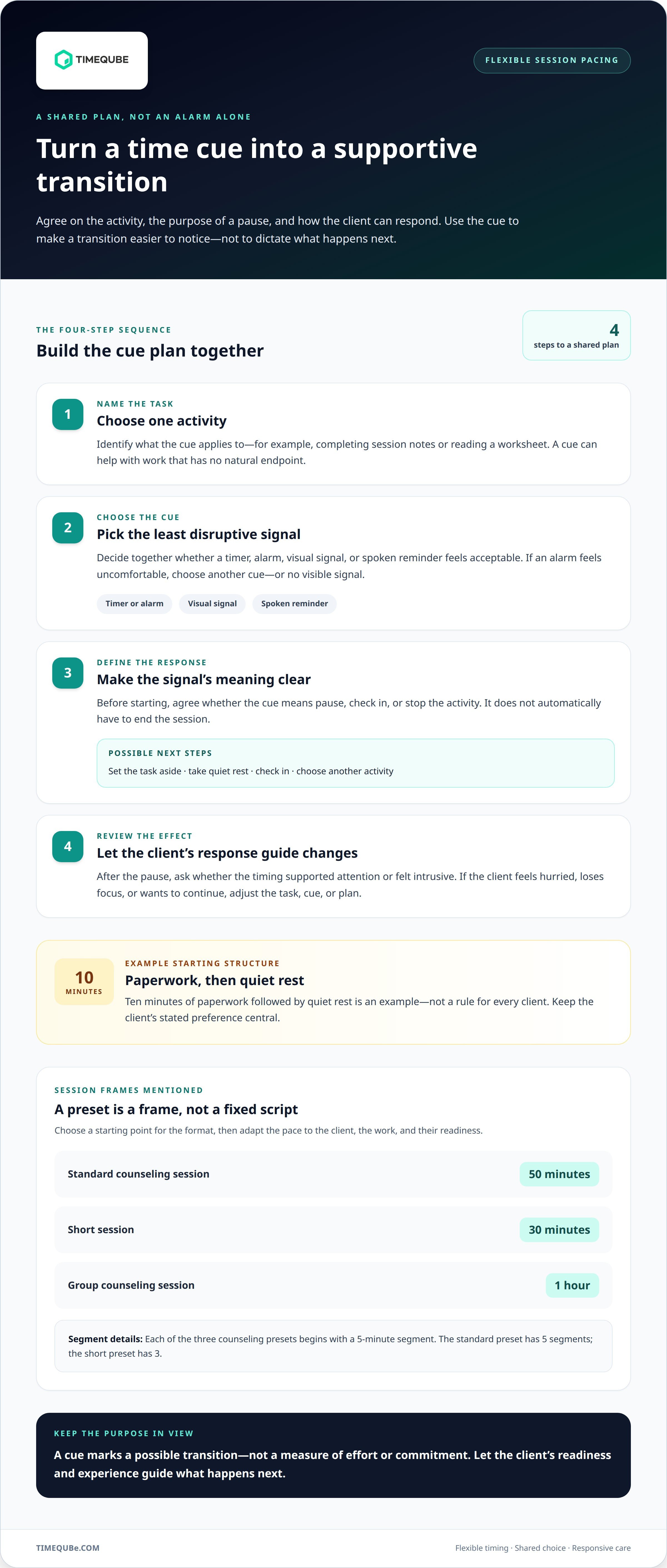
Effective time management starts with a shared plan, not an alarm alone. Agree on the activity, the purpose of a pause, and how the client can respond to the cue. For example, set a reminder during paperwork, then use it to stop and take quiet rest. Therapy session pacing tools work best when their purpose is clear.
A timer can offer an external cue to stop work that has no natural endpoint. Paperwork is one example: a client may keep revising after their attention has shifted. A planned signal makes the stopping point easier to notice. Keep the cue separate from judgment. It marks a transition, not a measure of effort or commitment.
Before starting, explain what the timer’s signal means. The client should know whether it indicates a pause, a check-in, or the end of an exercise. Agree on what happens next, such as setting the task aside or taking quiet rest. If the client prefers not to hear an alarm, choose a visual signal or verbal prompt instead. This gives the client a defined role in the plan.
Use a simple sequence to make reminders clinically useful:
- Name the task. Identify one activity, such as completing session notes or reading a worksheet.
- Choose the cue. Decide together whether a timer, alarm, or spoken reminder feels least disruptive.
- Define the response. Agree that the cue means stop, pause, or check in, rather than automatically ending the session.
- Review the effect. After the pause, ask whether the timing supported attention or felt intrusive.
Ten minutes of paperwork followed by quiet rest is a starting structure, not a rule for every client. Adjust the task or cue if the client loses focus, feels hurried, or wants to continue. A brief check-in can help distinguish a useful pause from an interruption. Keep the client’s stated preference central.
In a clinical session, plan reminders around transitions rather than scattering alarms across every activity. A cue before a demanding exercise may help prepare the client. Another can signal the agreed pause. Too many prompts can draw attention away from the work, so use only those that serve the shared plan. Therapy session pacing tools should support the interaction, not compete with it.
After the break, ask a specific question: “Would you like to return to the worksheet or choose another activity?” This gives the client a clear next step without assuming the pause had one fixed outcome. If the cue felt uncomfortable, revise its sound, visibility, or role before using it again. The timer supports the plan; the clinical relationship guides the response.
Adjusting preset durations
A preset gives the session a frame, not a fixed script. The standard counseling session preset is 50 minutes, and the short preset is 30 minutes. A group counseling preset is 1 hour. Choose a starting point based on the session format, then adapt the pace to the client’s focus, needs, and the work planned.
Each of the three counseling session presets begins with a 5-minute segment. The standard preset has 5 segments, while the short preset has 3. These divisions can help practitioners think through transitions without assuming every segment needs equal attention. For example, a client may need more time to settle before beginning focused work.
For clients who speak quickly, don’t use a preset as a reason to interrupt or compress their thoughts. Reflect what you’ve heard at the transition, then invite them to choose one thread to explore further. For a client who speaks slowly, leave more space between prompts and use the next segment as a gentle orientation point, not a demand to fill time.
Trauma-informed pacing depends on choice, predictability, and attention to the client’s responses. Explain what a timer or segment means before using it, and invite the client to pause or change direction. If a visible countdown creates pressure, keep it out of view. A preset can organize the session, but the client’s expressed readiness should guide adjustments.
On a high-symptom day, five minutes of concentrated reading may be enough for one person. Use this example to distinguish planned duration from capacity in the moment. If a worksheet feels demanding, break the task into smaller steps, offer a pause, or shift to discussion. A useful duration lets the client engage without forcing completion.
Review the preset as the session unfolds. If an opening check-in takes longer, shorten or remove a later activity rather than rushing the client through it. If the client is ready to continue, extend the conversation while protecting time for a clear ending. This flexible approach keeps the session’s purpose in view: supporting the work, not satisfying the timer.
Afterward, note which segment felt compressed or spacious. For example, if the 5-minute opening repeatedly leaves little room for the client’s main concern, adjust the next session’s plan. Keep the 50-minute, 30-minute, or 1-hour frame visible in preparation, then treat its segments as adjustable markers. Consistent review helps pacing respond to the person, not just the preset.
Reserving time for reflection and closing
Reflection and closing are part of the session’s work, not leftover minutes. Make room for clients to process emotions, notice what shifted, and connect insights with skills. Without a planned transition, the final activity can run to the session’s edge, leaving the client no time to name what matters.
Build a closing sequence into the session plan. For example, move from the main activity to reflection, then to a practical next step. Ask what stood out, what remains unresolved, and which skill the client might use outside the session. These prompts make the ending a clear moment of integration.
Use a consistent sequence, while adapting its content to the client:
- Pause the main activity. Name the transition so the client knows focused work is ending.
- Invite reflection. Ask the client to identify one feeling, observation, or question from the session.
- Connect a skill. Discuss how a practiced tool could fit a real situation after the appointment.
- Confirm the close. Summarize the next step and leave room for the client’s response.
A client who becomes quiet after discussing a difficult topic may need reflection before planning. Rather than adding another exercise, ask what they notice now. If they identify tension or uncertainty, acknowledge it and explore what would help them leave feeling oriented. Let the closing follow the client’s response instead of forcing a predetermined summary.
Protect this transition if the central discussion expands. If a client raises a new concern near the planned ending, acknowledge it and decide together whether to briefly identify it or return to it later. This avoids an abrupt cutoff while preserving the session’s purpose. A clear note of the concern can help maintain continuity at the next meeting.
Closing also supports skill integration. If a client practiced grounding, for example, ask which part felt accessible and where it might be useful. If the practice felt difficult, treat that as information, not a failure. The client can leave with a clearer sense of what to revisit, rather than a vague instruction to practice more.
Use the final transition to check understanding and emotional state. Invite the client to summarize the session in their own words, then clarify any next step they’ve chosen. A brief, client-led summary can reveal what resonated and what needs attention. Keep the ending collaborative, specific, and connected to the work completed.
Therapists can reserve time for reflection and closing when pacing a counseling session. Treat that time as part of the structure, not as something available only if every earlier topic ends quickly. If the discussion needs to continue, decide deliberately what can be held for later so the client still has a chance to reflect and prepare to leave. This connects the ending to the work without requiring every concern to be resolved before the session closes.
What tools help therapists pace a therapy session?
Therapists can combine a session plan, a timer, and client feedback. Each serves a different purpose: the plan gives direction, the timer marks transitions, and feedback helps adjust the pace. No single cue should replace clinical judgment or the client’s expressed needs.
A visual timer offers an external stopping cue for an activity without a natural endpoint, such as a worksheet, guided reflection, or skills practice. It can help both people notice a transition without repeatedly checking a phone screen. Keep it visible only when that supports the client’s orientation.
A spoken reminder or quiet alarm can work when a visual cue distracts. Agree on its meaning before the exercise begins. It might signal a check-in rather than an immediate stop. That distinction matters when a client is midway through describing an experience and needs a moment to finish the thought.
A brief written agenda can complement either cue. List the main activity, a transition point, and the closing reflection. For example, a therapist might note “check-in, body awareness practice, discussion, closing.” This sequence supports preparation while leaving room to respond when the client raises an urgent concern.
Use client feedback as another pacing tool. A simple prompt such as “continue, pause, or shift?” gives the client clear options. They might choose to continue an exercise, take quiet rest, or discuss what came up. These choices offer insight into readiness without asking the therapist to infer it from the clock alone.
For a practical toolkit, combine tools with distinct roles:
- Session outline: Holds the intended sequence and planned transitions.
- Timer or alarm: Marks an agreed cue for a task or transition.
- Client signal: Gives the client a way to request a pause or change.
- Closing prompt: Helps gather reflection and identify a next step.
Review the combination after each session. If an alarm interrupted the client, change its timing or use a spoken cue next time. If the outline felt too rigid, simplify it to the main activity and closing. A brief review helps the tools stay responsive rather than becoming another demand.
Practitioners who want a dedicated visual aid can use a visual timer for session pacing. Treat any timing tool as a cue for awareness and choice. The therapist and client still shape what happens next.
Tracking mentally demanding activities alongside symptoms before and after them can help identify personal cognitive pacing patterns. A brief record can make changes easier to notice across activities and sessions. The therapist and client can use those observations to discuss whether the current approach seems suitable, while keeping the client’s experience central.
Therapists can use reminders such as timers or alarms to help clients notice when to pause or stop an activity. A reminder works best as a cue, not a substitute for the client’s response. Discussing what happened after the signal can help the therapist and client decide whether to keep or adjust it.
Timeqube
Timeqube offers physical visual timers for mind/body therapy sessions, providing a clear time cue without digital distractions. The color-coded light signals can support transitions while leaving the therapist free to respond to the client’s pace. A timer works best as a flexible aid, not a fixed instruction.
Choose a visual timer when you want time to remain perceptible without repeatedly checking a screen or announcing each transition. Timeqube also offers branded timers and timers for business meetings, each suited to a different setting.
To explore a visual timer for therapy practice, contact Timeqube.
Shape a Pace That Can Evolve
Let each session help you learn what supports this client’s sense of choice and presence. A brief note afterward can capture which transition felt smooth, where attention shifted, and what the client preferred. Over time, those observations can help you refine how therapy session pacing tools fit your practice without making the clock the center of the work.
Choose one small adjustment for an upcoming session. You might make a transition cue less prominent, clarify what a pause means, or invite the client to shape the session plan. Then notice how that choice affects the flow. Steady, responsive adjustments can make time easier to work with while keeping the therapeutic relationship in focus.
If a physical visual timer could support your approach, contact Timeqube about session pacing. Take the next step at a pace that feels right for your practice.
Frequently Asked Questions
What is pacing?
Pacing means adjusting an activity’s rhythm and demands to match a person’s capacity. In therapy, that might mean shifting between discussion, practice, and quiet reflection instead of pushing through a planned sequence. For example, if a client becomes less engaged during a body-awareness exercise, the therapist might pause and ask what would feel manageable next. The aim is responsive participation, not simply completing every planned task.
Which therapy session timer and scheduling apps are available?
Scheduling apps organize appointments, while timer tools mark activities or transitions. They serve different purposes. A calendar can help manage bookings and reminders; a timer can make elapsed time easier to notice during a session. Timeqube offers physical visual timers for mind/body therapies, not digital timer software or appointment scheduling. Choose tools based on whether you need booking coordination, an in-session time cue, or both.
Are there evidence-based guidelines for pacing psychotherapy sessions?
Use guidance relevant to your therapeutic approach, then adapt the session structure to the client’s readiness and goals. A preset can organize time, but it cannot establish that a particular pace suits every person. For example, a therapist might review whether a planned exercise supported engagement or felt too demanding, then adjust the next session. Treat timing as a clinical aid, not proof that an intervention is effective.