

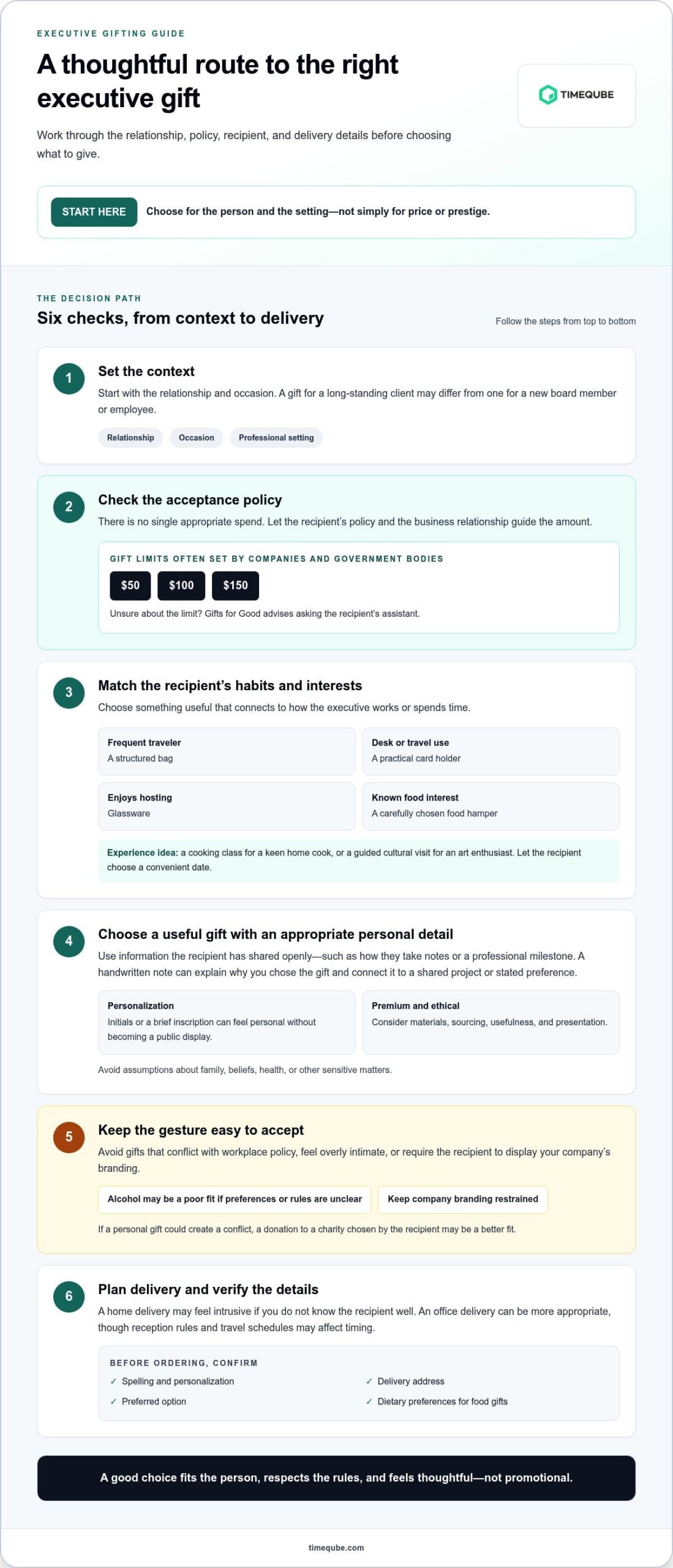
The right executive gift isn’t necessarily the most expensive one. Memorable corporate gifts for executives reflect the recipient’s interests, suit the relationship, and respect workplace gift policies. Companies and government bodies often set acceptance limits of $50, $100, or $150, so appropriateness depends on both the person and the setting.
A personal choice can feel more considered than a generic luxury item. A handwritten note explaining why you chose the gift adds context and makes the gesture more meaningful. The recipient’s interests, values, and working style can guide your choice, while discreet branding keeps it thoughtful rather than promotional.
This guide explains how to choose gifts that feel suitable, ethical, and genuinely personal. You’ll learn how to account for gift limits, connect a present to a leader’s interests, and make branding feel intentional. It also covers practical options for different executive relationships, helping you choose with clarity rather than relying on price or status alone.
Key Takeaways
- Choose a gift that fits the executive’s role and the context of your relationship, not just its price or prestige.
- Personal details can make practical gifts feel more considered. Use the recipient’s preferences to guide the choice.
- For an ethical premium gift, consider its materials, sourcing, usefulness, and presentation as part of the overall gesture.
- Keep corporate branding restrained so the gift feels personal rather than promotional.
- Connect the gift to a genuine hobby or interest to make it more relevant and memorable.
What Makes a Gift Appropriate for an Executive?
An appropriate executive gift respects the recipient’s role, workplace policies, and personal preferences. Practicality and thoughtful presentation matter more than expense or display.
Choosing Gifts for Executive Recipients
Start with the relationship and occasion. A gift for a long-standing client may differ from one for a new board member or employee. Choose something useful, appropriate for a professional setting, and easy to accept. Add a handwritten note explaining your choice and its connection to the recipient, such as a shared project or a preference they have mentioned.
Consider delivery, too. Sending a gift to a home address may feel intrusive if you don’t know the recipient well. An office delivery can be more appropriate, though reception rules and travel schedules may affect timing. Where possible, offer a choice of delivery or redemption options.
Gift Types and Experience-Based Options
Match the item to how the executive works or spends time. A structured bag may suit frequent travelers, while a card holder can be a practical desk or travel accessory. Glassware may fit someone who enjoys hosting at home, and a carefully chosen food hamper can work for a team or a recipient who enjoys tasting regional products. Technology is most useful when it fits the recipient’s existing habits.
What are the best experience-based gifts for executives? Choose an experience connected to a known interest, such as a cooking class for a keen home cook or a guided cultural visit for an art enthusiast. Make sure the recipient can choose a convenient date.
Budget and Gift Acceptance Limits
How much should companies spend on corporate gifts for executives? There’s no single appropriate spend; the recipient’s acceptance policy and the business relationship should guide the decision. Companies and government bodies often cap the value of gifts their people may accept at $50, $100, or $150. Gifts for Good advises asking the recipient’s assistant about limits when unsure.
What executive gifts are appropriate for different budgets? At a modest budget, choose a thoughtful food item or useful desk accessory. With more room, consider quality glassware or a personalized bag. Stay within the applicable gift limit. If a personal gift could create a conflict, a donation to a charity chosen by the recipient may be a better fit.
Gifts to Avoid and Buying Options
Avoid gifts that conflict with workplace policy, feel overly intimate, or require the recipient to display your company’s branding. Alcohol and highly personal items may be poor choices when preferences or rules are unclear. For customized gifts with fast shipping, choose a corporate-gifting retailer or maker that clearly states its personalization and delivery timelines.
Before ordering, confirm the spelling, delivery address, and recipient’s preferred option. A customized leather item needs accurate initials, for example, while a food gift should suit known dietary preferences. If you’re unsure about the recipient’s interests, choose a practical item or flexible experience.
Personalized executive gifts
Personalization gives a useful gift a clear connection to its recipient. For a senior leader, that connection should feel considered, not overly familiar.
Make the personal detail meaningful
Start with a detail related to the recipient’s work or interests. A journal may suit an executive who takes meeting notes better than a decorative item. Initials or a brief inscription can make the gift personal without turning it into a public display.
Consider the occasion, too. A promotion may call for a personal message recognizing the leader’s contribution, while a board appointment may suit a restrained, professional design. Good personalization adds context without making the recipient feel obliged to use or display the gift.
Personalized leather journals and padfolios
A leather journal provides a practical place for planning, reflections, and meeting notes. A padfolio can hold paper documents and organize presentation materials. Consider how the recipient works: someone who writes by hand may appreciate a journal, while a frequent presenter may prefer a padfolio.
Choose a design suited to professional settings. A neutral cover and discreet initials can work well for an executive who carries the item between meetings. A bold color or large name may be less appropriate for someone who prefers understated accessories.
Choose a personalization style
Common options include initials, a full name, a short message, or a date marking a milestone. A company logo can be included, but it should not overpower the personal detail. For instance, a small mark inside a journal cover is less conspicuous than a prominent logo on the front.
Check every character before approving a personalized item. Confirm spelling, punctuation, capitalization, and the recipient’s preferred name. Keep any message brief enough to remain legible and meaningful.
Find the right detail
A personal touch doesn’t require private knowledge. Use information the recipient has shared openly, such as how they prefer to take notes or a professional milestone they’ve mentioned. Avoid assumptions about family, beliefs, health, or other sensitive matters.
A handwritten card can add personal meaning when the gift itself is simple. Mention the specific reason for your choice, such as the recipient’s thoughtful guidance on a project. That connection makes the gesture intentional without elaborate customization.
Premium ethical gifts for senior leaders
A premium gift can recognize a major contribution without being extravagant. For senior leaders, an ethical choice also considers materials, sourcing, usefulness, and presentation. These details make a gesture feel considered, rather than like an expensive object chosen for status alone.
Choose premium gifts with care
Look beyond the packaging. A reusable desk object, well-made glassware, or a food collection from an identified producer can feel elevated and purposeful. Check what the seller says about materials and origin instead of assuming that “luxury” or “sustainable” labels prove responsible production.
Fit matters, too. Select items the leader can use or share, and avoid filler products that add volume without meaning.
Mark milestones with lasting keepsakes
A promotion, retirement, or completed board term may call for a keepsake tied to the achievement. Consider a framed team photograph, locally made glassware, or an award engraved with the milestone and a concise message. The inscription should recognize a specific contribution, not make broad claims about the person.
Awards and trophies typically range from $31 to $100 on the market, with a median of about $78. For a lasting choice, consider whether the design suits the recipient’s office and whether the material and engraving support the message. A smaller, well-chosen object can carry more meaning than a large display piece.
Assess the ethical details
Before choosing a premium gift, identify its materials, look for information about where it was made, and consider how long it will remain useful. For food, check the producer and ingredients. For a leather accessory, consider whether the recipient uses leather goods and whether the item suits their preferences.
Ethical fit includes the gesture itself. A highly personal or conspicuous gift may feel uncomfortable in a formal relationship. Choose restrained presentation and explain the purpose in a short note, such as recognizing a specific leadership milestone.
Make the gesture proportionate
Match the gift’s scale to the achievement and relationship. A team’s collective thank-you may suit a shared keepsake, while an individual milestone may call for a personal inscription. Before ordering, review the recipient’s workplace policy and confirm the spelling and wording. These steps help honor the moment without causing avoidable discomfort.
Custom branding and logo options
Custom branding can connect a corporate gift to an organization, but the recipient should remain central. A logo works best when it complements the item’s purpose rather than turning a useful gift into a promotional display. A subtle mark on a notebook, for example, can identify the sender while keeping the item suitable for meetings and personal use.
Choose placement with the recipient in mind
Consider where the gift will be used before choosing a logo position. A mark inside a journal cover stays discreet, while one on the outside of a portable bag is more visible. Neither is automatically better. Choose what suits the relationship, the recipient’s working style, and where the item is likely to be used.
Scale matters as much as placement. A compact logo can sit alongside an executive’s initials without competing for attention. A large emblem may suit an internal recognition gift but feel too promotional for a client or board member. Balance the recipient’s name and the organization’s identity.
Keep the design consistent
Use the organization’s established logo files, colors, and type treatments. A distorted emblem or mismatched shade can make a premium item feel less considered. Compare the proof with the organization’s brand guidelines before production. Check contrast on the chosen material, since a dark logo may disappear against dark leather.
Apply consistent visual cues across a set without making every item identical. For a welcome gift, a branded journal paired with a plain pen may feel more restrained than several prominently marked objects. A shared color detail or matching card can connect the pieces without crowding the design.
Review the personalization before production
Prepare the final artwork and wording together. Confirm the logo version, recipient’s name, capitalization, and any message before approving the proof. A title engraved beneath a name, for example, should reflect the recipient’s preferred professional designation. A careful review can prevent a permanent spelling error.
Ask how the design will look on the actual material, not just on a screen. Embroidery, engraving, and printing create different textures and levels of visibility. A simple mark may be clearer on curved glass than a detailed slogan. Choose a treatment that remains legible at the gift’s scale.
Make branded gifting feel considered
Presentation can convey the organization’s identity without adding another visible logo. A tailored note, coordinated wrapping, or card naming the occasion can make the connection clear. For a portable gift, choose packaging that protects it and is easy to carry from an office or event.
Finally, match the level of branding to the purpose. An employee milestone may welcome a stronger organizational connection, while an external relationship often calls for a subtler touch. In either case, the item should feel valuable in its own right, with branding providing context rather than taking center stage.
Connecting gifts to executives’ hobbies and interests
To choose a gift that feels personal yet professional, connect it to an interest the executive has shared openly, then select a useful item suited to the workplace. A gift related to cooking, art, travel, or gardening can show appreciation without relying on private assumptions.
Start with reliable clues. A leader who talks about weekend hikes may appreciate a curated trail guide or quality insulated bottle. An executive who collects contemporary art might enjoy a catalogue from a museum they’ve mentioned. Use details they shared in conversation or public professional settings, not information taken from personal accounts or private conversations.
Translate interests into suitable gifts
Think about what the recipient enjoys, then choose an object or experience that supports it. For a keen reader, consider a recent title in a genre they’ve discussed. For a music enthusiast, a concert venue gift certificate lets them choose the artist and date. A gardener may value a locally sourced tool set or a book about plants suited to their region.
Keep the connection clear but understated. An engraved message such as “For your next garden project” can recognize a shared interest without feeling overly familiar. Avoid jokes about a hobby unless your relationship already supports that tone.
Use interests as a guide, not a guess
One clue may not tell you what someone wants. A person who travels for work might prefer a compact travel journal over another travel accessory. If you’re uncertain, choose a flexible option connected to the interest, such as a bookstore gift card for a known reader. That leaves the final choice to the recipient.
Consider access and practicality before selecting an experience. A cooking class may sound thoughtful, but location, schedule, dietary needs, and guest policies affect whether it works. A museum membership may suit an art lover if its location and visiting format fit their routine.
Connect the gift to the relationship
Let the occasion shape how personal the gesture feels. A senior colleague’s retirement may suit a framed image connected to a shared project, while a client appreciation gift should be more restrained. A short note can explain the connection: “You mentioned your interest in landscape photography, and this guide reminded us of our conversation.”
For a leadership team, choose an interest that genuinely fits each recipient rather than assigning everyone the same hobby. A curated selection can offer distinct options, such as books on architecture, food, or design. Keep the value and presentation consistent while letting each person choose a topic that suits them.
Make the choice feel considered
Before ordering, note the interest, the clue supporting it, and why the gift fits the professional relationship. If those details don’t connect clearly, choose a more neutral option. A thoughtful gift reflects what the executive has shared, respects their boundaries, and leaves room for their own preferences.
Timeqube: Timeqube for Mind/Body Therapies
Timeqube for Mind/Body Therapies is a physical visual timer for sessions where calm time awareness matters. Its color-coded light signals make time visible without adding digital distractions. It may suit an executive interested in mindfulness, coaching, or mind-body practices.
For professional settings, Timeqube for Business Meetings offers a practical way to keep time visible during meetings. Timequbes with Your Logo can add a restrained organizational touch when branded gifting suits the relationship. These options are most relevant when the recipient values focused sessions or clear visual cues, rather than a traditional desk keepsake.
To explore whether a visual timer suits your executive gifting plans, contact Timeqube.
Make the Next Gesture Intentional
The strongest gift choice starts with a simple question: what would help this person feel seen without asking them to perform gratitude? Let the answer guide your decision. A gift can recognize how an executive works, what they value, or the contribution they’ve made. That quiet relevance gives memorable corporate gifts for executives meaning beyond the moment of exchange.
For a gift connected to focused work or wellbeing, Timeqube offers Timeqube for Mind/Body Therapies and Timeqube for Business Meetings. Timequbes with Your Logo provide an option when an organizational touch suits the occasion. Each is a physical visual timer, making it a fitting gift when visible time cues have a place in the recipient’s work or practice.
Choose the direction that feels natural for the relationship, then make the note and presentation reflect why you chose it. For a thoughtful next step, contact Timeqube to discuss executive gifts. A clear, personal intention can turn a professional gesture into a lasting point of connection.
Frequently Asked Questions
How are the gifts presented?
Present an executive gift neatly, with packaging that suits the occasion without competing with the item. A rigid gift box can protect a delicate object, while a simple sleeve may suit a book or document accessory. Include a card with the sender’s name and a brief message. For a group gift, have the board chair or team lead sign it to make the gesture clear and intentional.
How do you show appreciation to board members?
Show appreciation by naming a specific contribution rather than relying on general praise. A board chair, for example, might recognize a member’s careful guidance during a major transition. A short message from the full board can accompany a shared recognition item or personal gesture. Keep it professional and sincere, without implying that the gift is tied to a particular decision or future favor.
Tip 3: Consider the impact of your gift. How can you make the experience last?
Make the gesture memorable after the gift is opened. Pair an item with a concise note connecting it to a shared achievement, or choose something useful in a recurring setting. A framed team photograph from a completed initiative, for example, can prompt conversation. A follow-up message after the occasion can express appreciation without asking for a response or recognition.
What is a good gift for a male boss?
A good gift for a male boss should reflect his preferences and your workplace relationship, not gender alone. If he enjoys cooking, a specialty ingredient from a producer he knows may suit him. If his interests aren’t clear, choose a neutral, practical gesture, such as a team-signed card or shared lunch. Keep the message professional and consider whether others are contributing.
What is a good luxury gift for a CEO?
A good luxury gift for a CEO is distinctive without creating an awkward obligation. Consider a commissioned piece from a local artist, a carefully selected cultural experience, or a premium item connected to a professional milestone. For significant group milestones or executive retirements where health and relaxation take priority, high-end wellness seating from Elite Massage Chairs offers lasting personal comfort. Let the relationship and workplace policy guide the scale. A short note explaining your choice can make the gesture personal, while restrained presentation keeps it appropriate for a senior business setting.
What are the most memorable corporate gifts for executives in 2026?
There isn’t one universally memorable choice for 2026. Gifts stand out when they suit the recipient, the occasion, and the relationship. A curated cultural experience, a useful object from an independent maker, or a team contribution toward a shared celebration can each work in the right context. For memorable corporate gifts for executives, make the reason for choosing the gift clear and keep the gesture comfortable to accept.
What personalized corporate gifts do executives value most?
The most useful personalized gifts reflect how the recipient works or what they’ve chosen to share about their interests. A custom-made item for a familiar routine, such as a tailored travel organizer for someone who often presents off-site, can feel more relevant than a generic monogram. Personalization can also come through the message: recognize a specific contribution or achievement instead of adding a name without context.
What luxury tech gifts are popular for executives?
Rather than assuming a product is popular, choose technology that meets a clear everyday need. A quality portable charger may help someone who works across locations, while a digital reading device may suit an executive who reviews documents while traveling. For leaders focused on personal health and daily recovery, advanced wellness devices such as those available at meetpureone.com offer an elevated at-home option. Check compatibility with the recipient’s devices and working habits. Avoid technology that requires accounts, setup, or ongoing attention unless the recipient is likely to welcome it.